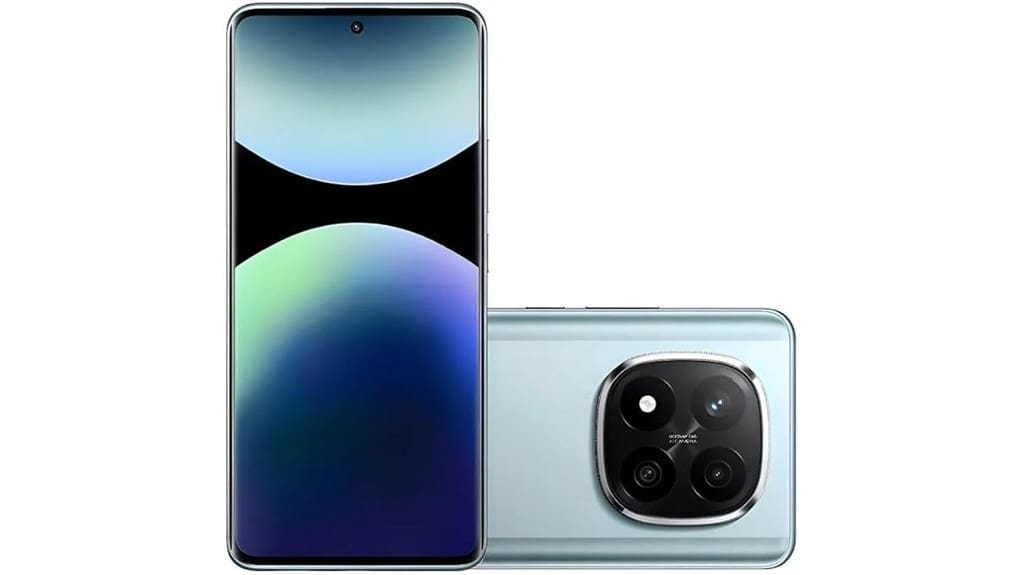
You’ll get flagship-grade display and camera hardware without flagship pricing: a 6.67″ 1.5K 120 Hz CrystalRes AMOLED with 3000‑nit peaks and a 200 MP OIS main sensor that out-resolves typical 50–108 MP midrangers. Snapdragon 7s Gen 3 delivers snappy daily use, 5110 mAh plus 120W HyperCharge refuels extremely fast, and HyperOS is lean. Watch for limited US carrier support and no official water rating; keep going to see detailed benchmarks, imaging samples, and battery tests.
Some Key Takeaways
- Outstanding 200 MP OIS main camera captures exceptional detail and dynamic range, outperforming typical 50–108 MP midrange shooters.
- 6.67″ 1.5K 120 Hz CrystalRes AMOLED with 3000‑nits peak and Gorilla Glass Victus 2 delivers vivid, highly readable HDR display.
- Snapdragon 7s Gen 3 and 12 GB RAM provide smooth daily performance, good multitasking, and solid medium‑high gaming with occasional thermal throttling.
- 5110 mAh battery plus 120W HyperCharge yields strong endurance and extremely fast recharge (majority charge in ~20–25 minutes).
- Great value for camera and display quality, though no official water resistance and limited U.S. carrier compatibility beyond T‑Mobile networks.
Quick Verdict: Is the Redmi Note 14 Pro+ 5G Worth Buying?
While the Redmi Note 14 Pro+ 5G won’t match flagship chips, it delivers a compelling midrange package: a 200 MP OIS camera, 6.67″ 1.5K 120 Hz CrystalRes AMOLED with 3,000‑nit peak brightness, 12 GB/512 GB storage, 5110 mAh battery with 120W charging, and Snapdragon 7s Gen 3 performance—so if you prioritize advanced imaging, a top-tier display, and very fast charging at a markedly lower price than flagships, this phone is worth buying; if you need peak raw CPU/GPU power, official water resistance, or carrier compatibility beyond T‑Mobile‑based networks in the U.S., look elsewhere.
You’ll get strong value via aggressive pricing strategy and solid resale value prospects thanks to flagship‑grade camera and display. Expect middling repairability and typical midrange user privacy posture—software updates matter. Overall, it’s a pragmatic choice for imaging and display priorities. A good accessory to complement your photography setup is a reliable micro HDMI cable for transferring images and video quickly.
What You Get in the Box and Key Specs at a Glance
Because Xiaomi leans into value, the Redmi Note 14 Pro+ ships with the essentials you’ll actually use: the phone, a USB‑C cable, SIM tray ejector, and a wall adapter (packaging lists a 45W adapter though full 120W HyperCharge support and a 120W charger are noted in the device details). Your unboxing experience is straightforward and efficient. Key specs at a glance: Snapdragon 7s Gen 3, 12GB RAM, 512GB storage, 5110mAh battery with 120W HyperCharge, 200MP OIS main, 6.67″ 1.5K CrystalRes AMOLED 120Hz, Wi‑Fi 6E, Bluetooth 5.4, dual SIM. For accessories comparison, bundled charger presence is notable. For mirrorless camera enthusiasts, consider adding a camera-inspired protective case or grip to improve handling when shooting with the phone alongside your gear.
How the 6.67 CrystalRes AMOLED Display Performs Day-to-Day
How bright does the 6.67″ CrystalRes AMOLED feel in everyday use? You get startling peak brightness—3000 nits—so outdoor visibility is class-leading; HDR highlights remain legible under sun. Color calibration arrives tuned to DCI‑P3 with 12‑bit processing, so whites stay neutral and saturation looks controlled versus many midrange rivals. Viewing angles are excellent: contrast and hue shift are minimal even at steep tilts. Display durability benefits from Gorilla Glass Victus 2 and robust build, reducing worry about scratches and drops. Overall, the panel is technically refined, punchy, and outperforms typical phones in clarity and resilience. For photographers who care about accurate colors, using a color calibration workflow can help ensure prints and edits match what you see on this display.
Real-World Camera Results: 200MP Main, Ultra‑Wide, Zoom and Low Light
When you switch to the Redmi Note 14 Pro+’s 200 MP main sensor, it routinely delivers more detail than typical 50–108 MP midrange shooters thanks to its 1/1.4″ sensor and 16‑in‑1 binning that yields 2.24 μm effective pixels; edges stay cleaner, noise is lower, and dynamic range benefits from Smart‑ISO Pro HDR and OIS. In daylight the main sensor yields excellent color accuracy and fine texture; ultra‑wide shows wider perspective but softer corners and reduced detail. Optical 2x/4x zoom keeps useful detail versus digital crops. Low light relies on night mode; autofocus performance remains fast and dependable across modes. For photographers aiming for consistent color across devices, using a color checker can help validate and improve color accuracy in your images.
Battery Life and 120W Charging : How Fast and How Long It Lasts
While the 5,110 mAh battery gives the Redmi Note 14 Pro+ solid endurance for a day of mixed use, its real advantage is the 120W HyperCharge that cuts recharge times dramatically compared with typical 60–80W fast charging in this class. You’ll get fast replenishment from near‑empty to majority charge in roughly 20–25 minutes (manufacturer rates), trimming top competitors’ charge windows. Daily battery longevity matches expectations for 5,100 mAh with AMOLED efficiency and adaptive refresh. Thermal management during charging stays controlled, preserving cycle health versus prolonged high‑heat sessions. Overall, you trade marginal weight for best‑in‑class refill speed. Portable SSDs can be handy for photographers who need fast, reliable storage on the go, especially when paired with high-speed phones and adapters like the portable SSDs mentioned on photography accessory sites.
Performance, Software (HyperOS) and Everyday Gaming/Cooling Behavior
Because the Redmi Note 14 Pro+ pairs a Snapdragon 7s Gen 3 with 12 GB RAM and LiquidCool tech, you get snappy day‑to‑day performance and surprisingly stable sustained loads for the class. HyperOS feels lean: app launches, multitasking, and background management are efficient, reducing jank compared with older MIUI builds. AI optimizations accelerate on‑device tasks like photo processing and voice features without heavy battery drain. In gaming you’ll see good frame stability on medium‑high settings; intensive sessions occasionally trigger mild thermal throttling but performance remains usable. Overall, the system balances thermals, power, and responsiveness effectively for its segment.
Network, Connectivity and Carrier Compatibility You Need to Know
Good sustained performance matters less if your phone can’t connect where you are, so let’s look at how the Redmi Note 14 Pro+ handles networks and radios. You get broad band support: extensive 5G (n1/2/3/5/7/8/20/28/38/40/41/48/66/77/78), full LTE FDD/TDD arrays, 3G and quad‑band 2G. Dual SIM (no microSD) and FCC ID 2AFZZRA8E confirm US/T‑Mobile compatibility; activate a SIM for service. It works on GSM global networks; carrier restrictions may apply until SIM unlocked. Wi‑Fi 6/6E, Bluetooth 5.4, GNSS and solid Roaming performance make it versatile for travel.
Some Questions Answered
Does It Support Expandable Storage via microSD?
No — it doesn’t support expandable storage via microSD capability; it’s fixed internal storage. You’ll rely on the 512 GB maximum and measure real-world performance via storage benchmarks for sustained speeds. Compared to phones with SIM hybrid trays, there’s no secondary slot for a microSD card. If you need expandable formats or removable storage, pick a device with a SIM hybrid or dedicated microSD slot instead of this model.
Is the Phone Water or Dust Resistant (Ip Rating)?
No — it’s not water resistant and has no IP rating, so you shouldn’t expect protection against water ingress or dust ingress. You’ll need to treat it less robustly than IP67/IP68‑rated phones; avoid exposure to splashes, rain, or dusty environments. For demanding or outdoor use, you should consider a device with official water resistance or add protective cases and seals, because this model lacks certified environmental sealing.
Can the SIM Tray Hold Two Active SIMS SIMultaneously?
Yes — the SIM tray supports Dual SIM with two nano cards active, so you can use two carrier lines simultaneously. You’ll get standard dual-standby behavior rather than dual-active (DSDA), so calls on one line may interrupt the other. Hotspot Sharing works when the selected data SIM is active; you’ll switch data SIM in settings to share mobile data. This setup’s comparable to most dual-SIM midrange phones, reliable and flexible.
Is Wireless Charging or Reverse Wireless Supported?
No — the phone doesn’t support wireless capabilities for charging; it only uses wired 120W HyperCharge, so you won’t get wireless charging speeds or reverse functionality. You can expect top-tier wired charging speeds and fast battery fill, but magnetic alignment accessories for wireless pads aren’t applicable. Comparatively, you’ll rely on included cable and charger; if you need wireless or reverse charging, you’ll have to choose a different model that lists those features.
What Color Options and Finish Variants Are Available?
You get two finish variants: Aurora Blue and Ceramic White. Aurora Blue offers a frosted glass-like sheen with subtle gradient shifting and a matte, anti‑fingerprint feel. Ceramic White provides a glossy, ceramic‑like surface that’s smoother and slightly more reflective, showing fewer micro‑scratches but more fingerprints. Functionally both share identical specs and button/port placement; choose Aurora Blue for grip and stealth, Ceramic White for a premium, polished look.