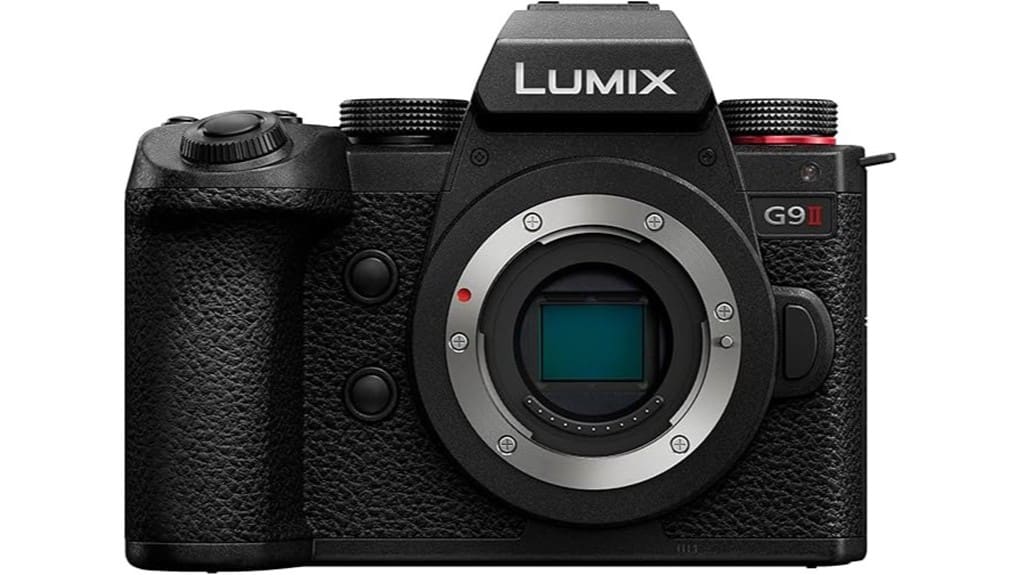
You’ll get a compact, battle-ready flagship MFT that locks focus, fires 60 fps AFC bursts with minimal blackout, and delivers 8.0-stop body stabilization (or 7.5-stop Dual I.S. 2 with compatible lenses) for handheld sports, wildlife, and run‑and‑gun work. The 25.2MP sensor balances detail and noise, while C4K/4K 10‑bit 120p gives robust slow‑motion grading headroom; expect long batteries, heavy storage needs, and streamlined workflows — keep going for full performance details and trade-offs.
Some Key Takeaways
- Fast, compact flagship MFT body offering decisive sports and wildlife shooting with 60 fps AFC and pre-burst for decisive moments.
- Excellent autofocus tracking via phase-detection AF and blackout-free bursts for roughly three seconds at 60 fps.
- Best-in-class stabilization: 8.0-stop B.I.S. for handheld low-light/astro, and 7.5-stop Dual I.S. 2 for telephoto panning.
- 25.2MP sensor plus C4K/4K 10-bit 120p enable detailed stills and high-quality slow-motion footage for grading.
- Durable, weather-sealed ergonomics, long battery life, and efficient buffer management, though heavy video demands storage and power.
Why the G9II Matters: Flagship MFT for Sports, Wildlife, and Run‑and‑Gun Shooters
Place the Panasonic LUMIX G9II in your hands and you get a compact, high-speed tool engineered for decisive shooting in sports, wildlife, and run‑and‑gun scenarios. You’ll appreciate battery life that sustains long outings and a refined ergonomics grip that locks the camera to your palm during fast pans. The menu system is logically layered for rapid adjustments on the fly, reducing menu dives between sequences. Durability weatherproofing means you’ll keep shooting in rain, dust, and cold without hesitation. This camera’s combination of mobility, control, and ruggedness makes it a practical flagship for action-focused shooters. It also pairs exceptionally well with hiking backpacks designed with camera compartments for photographers on the move.
Autofocus & Burst Performance: Real‑World Phase Detection AF and 60 Fps AFC Tests
When you push the shutter and the subject’s movement matters, the G9II’s new phase-detection AF and 60 fps AFC change the equation: they lock, track, and deliver usable frames at speeds that used to belong to much larger systems. You’ll notice crisp subject acquisition with reliable focus tracking across the frame, even on erratic subjects. AFC at 60 fps sustains tracking for roughly three seconds viewfinder-blackout-free; pre-burst helps secure the decisive instant. Buffer management is efficient — high-speed UHS-II cards keep sequences long and consistent, while slower cards truncate sooner. In short, you get pro-grade responsiveness in a compact MFT body. The camera’s performance pairs exceptionally well with sturdy support options like tripod stability for extended shooting sessions and sharper results.
Stabilization and Low‑Light Results: 8.0‑Stop B.I.S. Vs 7.5‑Stop Dual I.S. 2 in Practice
Although both systems aim to erase camera shake, the difference between the G9II’s 8.0-stop Body Image Stabilization (B.I.S.) and its 7.5-stop 5-axis Dual I.S. 2 shows up in real shooting: B.I.S. delivers the maximum shake suppression when you rely solely on the body—ideal for long handheld exposures and low-light walkabouts—whereas Dual I.S. 2 pairs body and lens correction to produce comparable results across a wider range of focal lengths and movements, especially with stabilized telephoto lenses. You’ll trust B.I.S. for handheld astrophotography and static low-light scenes; engage Dual I.S. 2 for telephoto panning, action and mixed-axis motion. For extended outdoor shooting with heavy lenses, a heavy-duty tripod can still be indispensable to avoid fatigue and ensure absolute steadiness.
Image Quality and Video Workflow: 25.2MP Sensor, C4K/4K 10‑Bit 120p, and Slow‑Motion Use Cases
Because the 25.2MP Micro Four Thirds sensor pairs with C4K/4K 10‑bit 120p capture, you’ll get both high-resolution stills and richly detailed slow‑motion footage that hold up to grading and cropping. You’ll see fine texture, tight crops and noise control thanks to sensor density and effective processing. For video, adopt a disciplined workflow integration: shoot 10‑bit where possible, log profiles for headroom, and plan proxies for editing. Account for heavy storage management—C4K 120p files eat cards and drives fast—and monitor battery life during prolonged high‑frame captures. The result: versatile, production-ready assets for demanding projects. For photographers working on location, consider rugged, high-speed portable storage like portable SSDs to keep up with large video and RAW stills.
Who Should Buy the G9II and Alternatives to Consider (Value and Lens Ecosystem)
Who should buy the G9II and why does its value hinge on lenses and workflow? You want flagship MFT speed, 60 fps AF bursts, 8.0-stop B.I.S. and C4K/4K 10‑bit 120p for slow motion; this camera rewards shooters who already invest in lenses and streamline editing. Buy it if you prioritize sports, wildlife, motorsport or stabilized handheld video and need a compact travel option without full-frame weight. If you’re cost-sensitive, consider budget alternatives—older G9, Olympus/OM System bodies, or Sony APS-C—to trade features for lens availability or lower system cost. Evaluate total system cost, not body-only specs. This site focuses on essential gear for mirrorless camera enthusiasts and how that gear affects long-term value, especially the lens ecosystem.
Some Questions Answered
How Long Does the Battery Last During Continuous 60 Fps Shooting?
You’ll get only a short run—battery endurance during continuous 60 fps shooting typically lasts for a few seconds to around 3 seconds per burst before buffer limits and heat management kick in. You’ll avoid frame skipping if you use the pre-burst and blackout-free modes, but prolonged high-rate bursts drain battery fast and may force shorter sequences. Carry spares or use AC power for extended action sessions to maintain continuous shooting capability.
Is the G9II Weather-Sealed for Professional Outdoor Use?
Yes — the G9II features robust weather sealing and professional durability, so you can trust it outdoors. You’ll get extensive dust, splash, and freeze resistance across the body and mount, letting you work in rain, dust, and chilly conditions without hesitation. Combine that with its stabilization and fast AF, and you’re set for demanding field work like sports, wildlife, and motorsports where reliability and ruggedness matter.
Does the Camera Support In-Body Raw Burst Capture With Pre-Burst?
Yes — you can capture in-body pre burst RAW sequences. You’ll trigger pre burst to record frames before and after the shutter press, and the G9II can output RAW files suitable for raw stacking or post-sequence selection. Use burst AFC settings with pre-burst engaged for continuous raw capture; plan storage and buffer accordingly because high-rate bursts and raw stacking consume card space and processing power during review.
What Compatible Lenses Offer the Best Stabilization Pairing?
Choose lenses with optical stabilization that complement the G9II’s 8.0-stop B.I.S. and 7.5-stop Dual I.S. 2: Panasonic Lumix S PRO telephotos aren’t MFT, so prefer Lumix G and Olympus M.Zuiko PRO zooms/primes with built-in stabilization. For best pairing, use stabilized 12-35mm, 35-100mm, 100-400mm equivalents, and stabilized fast primes. Your lens selection should prioritize matched IS algorithms and focal length coverage for ideal combined stabilization.
Can the G9II Tether to Smartphones or Computers for Live Shooting?
Yes — you can tether the G9II for live shooting. You’ll use wireless tethering via the camera’s Wi‑Fi for remote control, live view and image transfer to a smartphone/tablet. For computer streaming or dedicated capture, use USB streaming (UVC) to deliver clean live video over USB. Both methods work reliably; choose Wi‑Fi for mobility and quick previews, USB streaming for lower latency and stable high‑quality feeds for production workflows.