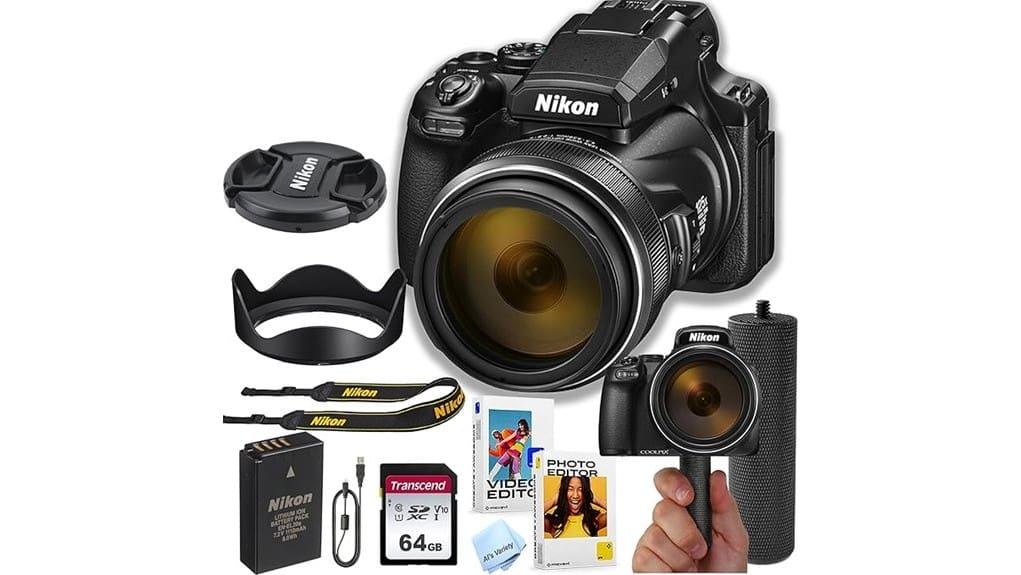
You get a 125x superzoom reaching an effective 3000mm and four-stop Dual Detect VR that yields usable handheld shots at long reach, though zoom rocker requires slow inputs to avoid overshoot. A 16MP BSI CMOS favors middetail over microtexture, holds up to ISO 800 before aggressive smoothing, and lets you extract serviceable 8MP frames from 4K with some demosaic artifacts. Moon/Bird modes and clean HDMI add utility; continue for a full evaluation of trade-offs and alternatives.
Some Key Takeaways
- 125x (3000mm equiv.) superzoom delivers exceptional long-reach framing, resolving useful detail for distant subjects.
- Dual Detect VR provides about four stops of stabilization but shows latency during pans and refocus.
- 16MP BSI CMOS yields good middetail and color accuracy, with noise control up to ISO 800.
- 4K video and extractable 8MP frames are practical, though stabilization latency and demosaic artifacts appear on moving subjects.
- Best for wildlife/travel/astronomy with tripod support; limited by autofocus speed, low‑light performance, battery life, and weather sealing.
Real-World Performance: Zoom Reach, Stabilization, and 4K Video Tests
Put the P1100’s 125x NIKKOR zoom to work and you’ll immediately see what the spec sheet promises: reach that compresses distant subjects to an almost telescope-like scale while still resolving useful detail at full 3000 mm equivalent. You’ll notice zoom ergonomics matter: the rocker’s throw is long at extreme focal lengths, so you’ll use slower inputs to avoid overshoot. Dual Detect OVR reduces motion by roughly four stops, but stabilization latency appears when you start panning or refocusing—initial frames show residual motion before correction settles. 4K video is stable for static subjects; moving targets reveal the latency trade-off. If you plan to add smooth motion to your shots, consider pairing the P1100 with a camera slider to produce professional-looking pans and timelapses.
Image Quality Deep Dive: 16MP Sensor, Sharpness, ISO Behavior, and Frame Extraction From 4K
After testing the zoom, stabilization, and 4K capture, you’ll want to examine what the P1100’s 16 MP BSI CMOS actually delivers in static image fidelity and high-ISO behavior. You’ll find the sensor render emphasizes middetail rather than microtexture; edge acuity is good at wide apertures but softens toward maximum telephoto and smaller apertures. Noise control is competent to ISO 800, with aggressive luminance smoothing beyond that reducing fine detail. Color fidelity is generally accurate straight from camera, with modest hue shifts in deep reds and saturated blues. Extracted 8 MP frames from 4K are useful for distant subjects but show additional demosaic artifacts. For optimal results when cleaning and preparing lenses before shooting, consider choosing lens cleaner designed for optical coatings.
Handling and Features: Ergonomics, Moon and Bird Modes, Menus, and Connectivity
While the P1100’s compact body packs surprising reach, its handling balances portability with controls tuned for telephoto use so you can operate comfortably for extended shoots. You get a substantial grip and logically spaced button placement: zoom toggle, record, AF-area and exposure comp are reachable without shifting your hand. Dedicated Moon and Bird modes sit on the mode dial, invoking optimized exposure, sharpening and AF parameters automatically. Menu layout is hierarchical and responsive, grouping shooting, playback and connectivity under clear tabs; USB-C and clean HDMI entries appear in the setup section. Overall tactile design and firmware organization favor efficient long-range workflow. For serious long-lens work, pairing the camera with a sturdy tripod head like a ball head designed for telephoto stability can markedly improve sharpness and tracking.
Strengths and Limitations by Use Case: Wildlife, Travel, Astronomy, and Vlogging
Because the P1100 blends an extreme 125x optical zoom, four-stop Dual Detect VR, and a compact body, it’s uniquely positioned for specific long-reach applications but also carries trade-offs you should weigh for each use case. For wildlife, you’ll get framing and subject isolation at distance, but autofocus speed and low-light ISO limits constrain fast action and dawn/dusk shooting; battery life becomes critical on long hides. For travel, the single-body versatility reduces kit but lack of robust weather sealing and sensor size limit low-light fidelity. For astronomy and vlogging, Moon/Bird modes and clean HDMI help, yet noise and ergonomics impose practical limits. Consider pairing the P1100 with a sturdy tripod to maximize sharpness at extreme focal lengths.
Should You Buy the Nikon COOLPIX P1100? Alternatives, Bundle Value, and Final Verdict
The P1100’s mix of a 125x NIKKOR superzoom, four-stop Dual Detect VR, specialized Moon and Bird modes, and 4K/clean-HDMI capability makes it a compelling one-body solution for long-reach shooting, but whether you should buy it depends on how those strengths map to your priorities and the alternatives you’re willing to weigh. If you need extreme reach, onboard stabilization, and clean HDMI, the P1100 is efficient and cost-effective; consider battery life for extended field sessions and confirm accessory compatibility (hoods, grips, cards). Compare pricing strategy versus newer compacts or mirrorless with interchangeable lenses, and check the second hand market for value. For stable long-reach shots in outdoor environments, pairing the camera with a sturdy heavy-duty tripod can significantly improve results.
Some Questions Answered
Does the P1100 Support Raw (Raw/Nef) Image Capture?
No — the P1100 doesn’t offer raw support; it saves JPEGs only, so nef compatibility? not provided. You’ll capture 16 MP BSI CMOS images processed by the EXPEED engine into compressed JPEG with in-camera noise reduction and sharpening. For highest flexibility, rely on the included 64 GB card and 4K frame extraction workflow, but if you need NEF raw files for extensive post-processing, this model won’t produce them.
How Long Does the Battery Last on a Single Charge?
You’ll get roughly 300–350 shots per charge under CIPA conditions, or about 70–90 minutes of continuous 4K recording; actual Battery lifespan varies with usage patterns and temperature. Expect degradation after hundreds of charge cycles—typically 300–500 before noticeable capacity loss—so track Charge cycles and avoid full deep discharges to extend usable life. Carry a spare battery for long sessions and optimize settings to maximize on‑camera endurance.
Is the Lens Thread Size Compatible With Common Filters?
No — the lens thread size isn’t directly compatible with common screw-on filters. You’ll need filter compatibility workarounds and adapter options because the P1100’s retracting superzoom front element and built-in hood prevent standard threads. Use custom clip-on filters, front-mounted adapter rings designed for the model, or specialty magnetic filter adapters that attach to the supplied tulip hood. These options preserve optical performance while enabling polarizers, ND, or UV filters for your shots.
Can the Camera Charge via USB-C While Shooting?
Yes — you can charge via USB-C while using Live shooting, but with caveats. USB charging supplies power during extended use and Live shooting, reducing battery drain, yet thermal and power-management limits may prevent continuous charging under heavy load (4K recording or prolonged Live shooting). Expect slower charge rates compared to dedicated chargers; battery level may still drop if consumption exceeds USB power delivery. Use a high-quality PD-capable USB-C source for best results.
Does the Camera Support External Microphones for Videos?
No, it doesn’t provide a dedicated external microphone input, so you can’t directly plug an external microphone into the camera body. You can use external audio adapters or record audio separately on a dedicated recorder and sync in post, or employ a clean HDMI output to feed video to an external recorder/mixer that accepts mic input. That workflow preserves higher-quality audio via adapters and professional monitoring during capture.