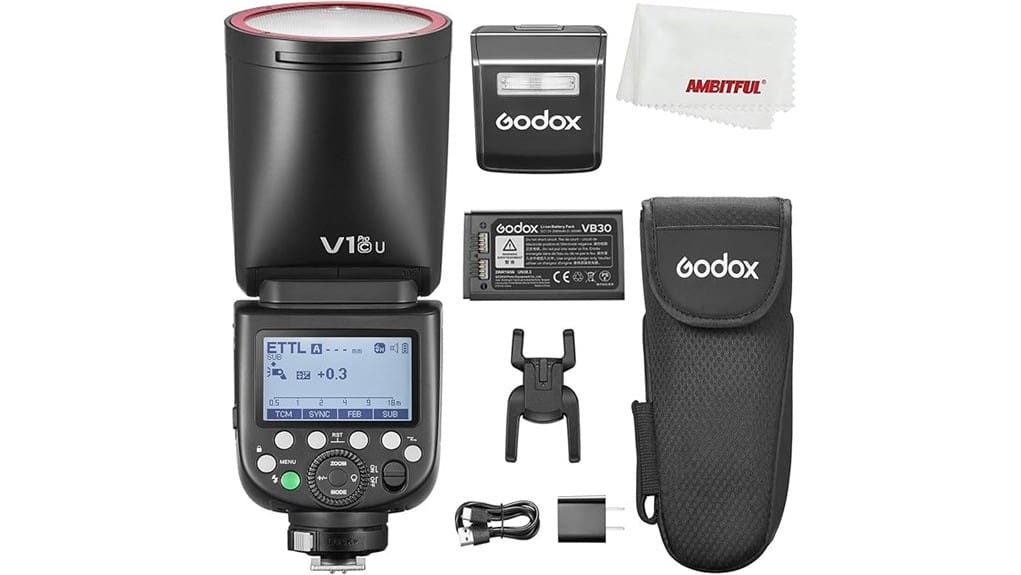
You get a Canon‑shoe native round‑head TTL flash that’s aimed at pros moving from kit strobes to reliable event and portrait work. It packs 76 Ws, a VB30 Li‑ion battery with fast ~1.3 s recycle and ~500 full‑power flashes, plus HSS to 1/8000 s. TTL is steady with minimal hunting; 2.4G RF integrates well for multi‑unit setups. Build and magnetic modifiers are practical; limitations include no weather sealing. Continue for detailed performance, handling, and use cases.
Some Key Takeaways
- Canon-compatible round-head TTL flash with 76 Ws guide number, optimized for event, wedding, and portrait photographers.
- Built-in VB30 Li-ion battery (~500 full-power flashes) enables ~1.3 s recycling and ~100 continuous full-power shots.
- Reliable TTL and HSS to 1/8000 s with minimal exposure hunting in typical event and portrait scenarios.
- Integrates with Godox 2.4G RF system for multi-unit sync; SU-1 sub-flash and magnetic modifiers expand lighting options.
- Strengths: fast recycling, consistent color, USB-C charging; limitations: no weather sealing and lower GN versus some rivals.
What the Godox V1Pro‑C Is and Who It’s For
When you need a versatile, high-performance on‑camera flash for Canon bodies, the Godox V1Pro‑C delivers a round‑head design, TTL and manual exposure control, and RF 2.4G wireless integration in a compact package. You get a TTL round-head flash optimized for Canon hot-shoe systems, offering mount compatibility across DSLR and mirrorless EOS models. It’s aimed at photographers moving from kit strobes to professional gear: wedding, portrait, and event shooters needing reliable TTL, HSS, and multi-unit synchronization. Use this as a concise beginners guide to Canon-specific flash operation and integration within Godox RF ecosystems. It also integrates well with wireless flash triggers used by photographers for multi-unit setups and remote control.
Key Specs That Matter: Power, Battery, and Connectivity
Having covered what the V1Pro‑C offers for Canon shooters, let’s focus on the specs that determine on‑set reliability: flash power, battery performance, and wireless connectivity. You get a 76 Ws guide number delivering solid output and HSS to 1/8000s for freezing motion. The built‑in VB30 Li‑ion (7.2V/2980 mAh) supports ~500 full‑power flashes, ~100 continuous full‑power shots and about 2 hours typical Battery life with 1.3s recycling—sufficient for run‑and‑gun shoots. Connectivity uses 2.4G RF transmission/reception; you’ll gain reliable multi‑unit sync and practical Wireless range for studio and field setups. Proper storage in a dry cabinet will help protect your flash and batteries from humidity damage.
Real‑World Performance: TTL, HSS, Recycling and Flash Quality
Although the V1Pro‑C is compact, its TTL and HSS systems deliver dependable exposure control in mixed lighting: TTL is responsive and accurate across common Canon bodies, compensating quickly for subject distance and ambient changes, while HSS up to 1/8000s reliably lets you freeze motion or use wide apertures in bright conditions. You’ll notice strong TTL accuracy with minimal exposure hunting in typical event and portrait scenarios. Recycling consistency from the VB30 battery keeps pace with rapid shooting; rated ~1.3s recycle and 500 full-power cycles. HSS performance is stable, and overall Flash quality is even, soft when bounced and consistent across output levels. For users wanting better results outdoors, pairing the V1Pro‑C with small modifiers and following basic outdoor flash techniques can noticeably improve lighting.
Design, Features and Accessories: Round Head, SU‑1 Fill Light, USB‑C and Build
Because Godox focused on practical ergonomics and modern connectivity, the V1Pro‑C combines a durable round head, a detachable SU‑1 sub‑flash, and USB‑C charging into a compact package that suits on‑camera and off‑camera workflows. You get a robust head with an improved head rotation mechanism for precise framing and secure locking. The SU‑1 functions as a detachable fill light or bounce modifier, expanding lighting options without extra batteries. Magnetic modifiers attach quickly and reliably to the round head, simplifying diffuser or grid swaps. Included accessories cover basic deployment: VB30 battery, USB‑C cable, charger, stand and storage bag. Many shooters will appreciate the V1Pro‑C’s suitability for on‑camera LED lighting alongside traditional flash setups.
Buy or Skip? Pros, Cons and Best Use Cases for Canon Shooters
With its reliable round head, SU‑1 fill light and USB‑C charging established, weigh whether the V1Pro‑C matches your shooting needs and workflow. You’ll buy if you need Canon‑compatible TTL, HSS to 1/8000s, fast recycling and a built‑in VB30 battery for extended runs. It’s ideal for portraits and event work where balanced catchlights and consistent color matter; pair with portrait modifiers or select aftermarket modifiers for shaping. Skip if you require weather sealing, higher GN, or native charger flexibility. Best use cases: on‑camera key/fill, small multi‑light kits, run‑and‑gun wedding coverage and location portraits. Consider also checking compatibility with your camera system and accessories for camera batteries before purchase.
Some Questions Answered
Does It Support Off-Camera TTL With Canon Radio Triggers Other Than Godox?
Yes — but with limits. You’ll get full Canon compatibility and TTL only when using Godox’s 2.4G radio system or Canon’s own wireless controllers that support Godox protocol. Third-party non‑Godox triggers often won’t pass Canon TTL or may introduce trigger latency and inconsistent TTL communication. If you need reliable off‑camera TTL and minimal trigger latency, stick to Godox X-series transmitters or verified Canon-compatible units.
Can the VB30 Battery Be Replaced With Third-Party Cells?
No — you shouldn’t replace the VB30 with third-party cells. The VB30 is a proprietary pack designed for voltage, communication and fit; using incompatible battery compatibility risks malfunction, reduced performance and safety hazards. Installing non‑approved cells can void warranty implications and may prevent official service. If you need a replacement, buy an official VB30 or an authorized Godox battery to preserve electrical compatibility, performance and warranty coverage.
Is Firmware Upgradable and How Are Updates Applied?
Yes — the flash’s firmware is upgradable. You’ll use Godox’s firmware process: download firmware files and the updater tool from Godox, connect the V1Pro‑C via USB‑C, then run the utility to flash. Update frequency varies; you’ll check Godox releases and firmware changelogs periodically for fixes or features. Follow instructions precisely, keep battery charged, and don’t disconnect during flashing to avoid bricking the unit.
Will It Fit on Older Canon Film SLR Hot Shoes Safely?
Yes — it’ll physically mount on most older Canon film SLR hot shoes, but you shouldn’t assume universal compatibility. Check shoe fit and contact voltage before use: older sockets sometimes use non‑standard contact layouts or higher sync voltages. If the camera’s sync/contact voltage exceeds modern safe levels, you risk damaging the flash. Use a multimeter or consult service docs; consider a safe hot shoe adapter or voltage protection device to prevent harm.
Can the Su‑1 Sub‑Flash Act as a Master Commander for Other Flashes?
No — the SU‑1 sub‑flash can’t act as a master commander for other flashes. You’ll use it as a detachable fill or bounce LED-assisted sub‑flash; it supports optical triggering as a slave in some setups but doesn’t provide full master RF control or advanced sync modes. For multi‑flash RF master/commander functionality and high‑speed sync coordination, you need the V1Pro‑C main unit or a separate Godox RF commander.