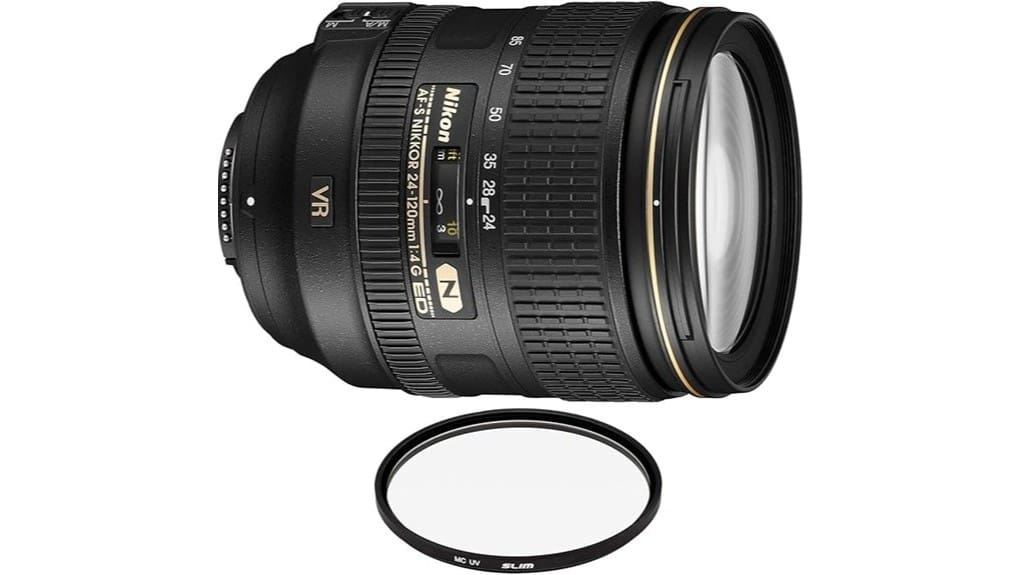
You’ll get a versatile, constant f/4 zoom that covers 24–120mm with solid center sharpness, three asphericals and two ED elements to control aberration, plus Nano Crystal and SIC coatings to reduce flare. The weather‑sealed metal barrel, internal SWM AF and VR II give reliable autofocus and several stops of stabilization for low‑light use. Distortion and corner softness increase toward 120mm, and renewed copies carry some risk—continue for specifics on performance and buying tips.
Some Key Takeaways
- Versatile 24–120mm constant f/4 zoom offers all‑around coverage for travel, events, portraits, and landscapes on FX bodies.
- Optical design with three asphericals, two ED elements, Nano Crystal and SIC coatings reduces flare, ghosting, and chromatic aberration.
- Strong center sharpness from 24–85mm; corners soften toward 120mm, especially when shot wide open.
- VR II stabilization and fast AF‑S deliver reliable low‑light performance and quiet, accurate autofocus for photo and video.
- Good build quality with weather resistance, but renewed units may show wear and potential AF calibration variance.
Optical and Build Highlights: What the 24–120mm F/4 Delivers
While the 24–120mm f/4 keeps a constant f/4 aperture, it delivers a versatile wide-to-tele zoom range with optical design choices that prioritize sharpness and control of aberrations. You get three aspherical and two ED elements, plus Nano Crystal and Super Integrated coatings to reduce flare and chromatic error. The barrel exhibits solid construction and weather resistance, suitable for demanding use. Autofocus is driven by an internal SWM for responsive framing, and Nikon VR II stabilizes handheld shooting. Zoom action is controlled and predictable—a smooth zoom with minimal play—supporting reliable operation across compatible FX and DX bodies. Perfect Tripods stocks accessories that complement the lens, including tripods and heads designed for stable support.
Real‑World Sharpness, Distortion, and Low‑Light Performance
Evaluating real‑world sharpness, distortion, and low‑light performance shows the 24–120mm f/4 delivers consistently usable results across its range. You’ll find center resolution strong from 24–85mm; corners relax toward 120mm, particularly wide open. Distortion is predictable: mild barrel at 24mm, slight pincushion by 70–120mm, easily corrected in post. Chromatic aberration is controlled by the ED elements but appears at high‑contrast edges when shooting wide open; apply profile corrections for best results. In low light you can rely on VR and solid AF to produce sharp images at lower shutter speeds. Bokeh quality is neutral, smooth for background separation. This lens is a solid choice for enthusiasts looking to master their zoom gear with practical shooting tips.
VR, Coatings, and Autofocus: Stabilization and Flare Control Tested
Because Nikon paired VR II with advanced coatings, you’ll get meaningful stabilization and improved control over flare and ghosting in challenging light. You notice steady stabilization that reliably adds several stops of usable shutter speed across the zoom range, aiding handheld sharpness at telephoto. Coating longevity appears solid in testing; Nano Crystal and Super Integrated coatings maintain performance without early degradation. Autofocus consistency is strong: the AF-S motor locks quickly and holds in varied lighting, with minimal hunting. Flare mitigation works well against off-axis light sources, reducing contrast loss and color casts while preserving microcontrast for critical detail. The lens is a popular choice among photography enthusiasts for its balance of versatility and image quality.
Who This Lens Is Best For: Use Cases and Camera Compatibility
With strong VR II stabilization, effective coatings, and fast AF-S performance established, you can confidently match this 24–120mm f/4 to specific shooting roles and camera bodies. You’ll find it ideal for travel shooters who need 24–120mm versatility, consistent f/4 exposure, and FX-format coverage on bodies like D850, D750, or D610. Portrait photographers benefit from the mid-tele range and sharpness for headshots and environmental portraits. Event videographers gain reliable stabilization and quiet AF-S for run-and-gun coverage. Landscape enthusiasts will appreciate 24mm wide edge performance and coating-reduced flare for high-contrast scenes. It suits both pro and enthusiast F-mount users. The site also highlights essential gear for mirrorless camera enthusiasts, including accessories that complement your lens choice like adapters and stabilizers for mirrorless systems.
Pros, Cons, and Buying Recommendation for a Renewed Copy
When you buy a renewed Nikon AF-S NIKKOR 24-120mm f/4G ED VR, you get the lens’s full optical and stabilization advantages—constant f/4, three asphericals, two ED elements, Nano Crystal and SIC coatings, and VR II—at a lower price point. You’ll gain versatile focal range, reliable VR, solid build and proven coatings; it’s a practical budget alternative for enthusiasts and pros needing one-lens flexibility. Cons: potential cosmetic wear, shorter usable life vs. new, and variable autofocus calibration. Check warranty considerations closely—confirm return window, refurbishment standard, and any limited warranty. Buy renewed if savings exceed perceived risk and dealer warranty is satisfactory. Many photographers buying renewed gear also consider battery and power solutions for extended shoots, so look for compatible camera batteries when evaluating your purchase.
Some Questions Answered
Does the Lens Come With a Warranty for Renewed Units?
Yes — renewed units typically include a limited warranty; check the seller for exact warranty duration and transferability terms. You’ll get a specified coverage period for defects and functionality, often shorter than new-product warranties. Warranty transferability terms vary: some warranties remain with the lens for subsequent owners, others are non-transferable. Verify the refurbished seller’s policy and get documentation at purchase to confirm coverage, exclusions, and claim procedures.
Is the Pro Filter Included After Renewal Genuine Nikon?
Yes — the listing states a Pro Filter is included, but you’ll need to confirm authenticity verification with the seller. Ask for photos of brand markings, packaging, and serial numbers, and request proof of purchase or manufacturer authentication. Check seller reputation, reviews, and return policy before buying. If the seller can’t verify genuineness, insist on a written guarantee or choose a different seller to avoid counterfeit or non-branded filters.
How Much Life Is Typically Left on Renewed Lens Mechanics?
You’ll typically get an expected lifespan of 5–10 years on renewed lens mechanics, depending on prior use and servicing. Inspect aperture blades, focus helicoid smoothness, and VR actuation; these predict remaining life. Maintenance tips: clean contacts, keep helicoid lubricated by a technician, avoid impact, and store dry. Request service records and a return warranty; they’ll materially extend usable life and clarify replacement timing.
Are There Serial Number Checks for Authenticity on Renewed Copies?
Yes — you can perform serial verification on renewed copies; manufacturers or authorized dealers can confirm authenticity via the lens serial number. You’ll also get cosmetic grading from the seller indicating external wear and included items. Check the serial against manufacturer records or service centers, confirm NFC/packaging documentation if available, and request provenance or refurbishment receipts. Keep written proof of verification and cosmetic grading for warranty or resale purposes.
Can This Lens Be Used on Mirrorless Bodies With an Adapter?
Yes — you can use this F‑mount lens on mirrorless bodies with a mount adapter. You’ll retain aperture control and VR II stabilization, but autofocus performance depends on adapter quality and camera-body AF system compatibility. Lightweight mechanical adapters pass focus slower; advanced electronic adapters preserve AF speed, communication, and EXIF. Expect potential differences in continuous AF, tracking, and startup; test your specific camera+adapter combination for reliable results.