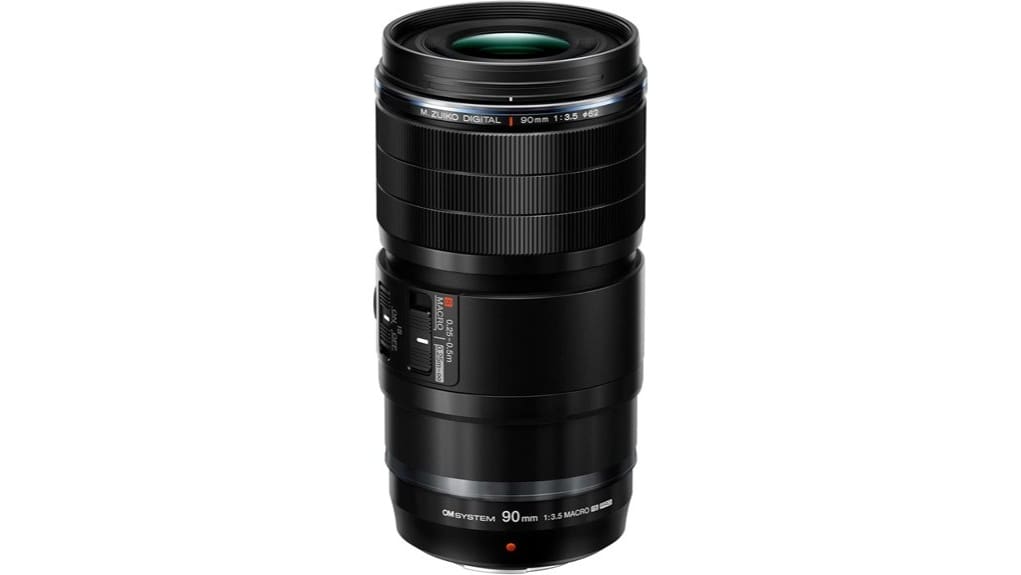

You’re getting a purpose-built Micro Four Thirds macro that gives native 1:1 (2× equivalent) magnification with a 0.224 m minimum focus distance, extendable to 4:1 equivalent with the MC-20, and up to 5-axis stabilization support on compatible bodies. It delivers exceptional central sharpness, minimal focus breathing, controlled chromatic aberration, and robust IP53 sealing with a precise AF/MF clutch for repeatable workflows—keep going and you’ll see detailed notes on handling, accessories, and alternatives.
Some Key Takeaways
- Native 1:1 magnification (0.224 m) delivers exceptional central sharpness and micro-contrast ideal for demanding macro work.
- With MC-20 teleconverter, usable reach extends to a 4:1-equivalent magnification while preserving AF on compatible bodies.
- IP53-sealed construction, fluorine front coating, and 739 g build offer rugged field durability and balanced handheld handling.
- Minimal focus breathing, smooth bokeh, and controlled chromatic aberration aid stacking, framing, and texture preservation.
- Precise AF/MF clutch, 5-axis stabilization support, and compatibility with macro rails make it ideal for scientific and product photography.
What the OM SYSTEM M.Zuiko 90mm F3.5 Macro PRO Actually Is and Who It’s For
Although it’s built on the Micro Four Thirds platform, the OM SYSTEM M.Zuiko Digital ED 90mm F3.5 Macro PRO is a specialist prime designed for high-resolution close-up work, offering native 1:1 (2x 35mm-equivalent) magnification and up to 4:1 equivalent with the MC-20 teleconverter. You’ll find it optimised for disciplined macro shooting: compact 90mm focal length, sealed construction, fluorine coating, and a precise MF clutch for repeatable focus. Image rendering emphasizes micro contrast and edge-to-edge resolution, benefiting texture-critical subjects. Its niche ergonomics suit tripod, rail, and field handheld workflows, targeting serious macro photographers and scientific applications. Proper sensor cleaning and maintenance with camera sensor care help preserve the lens’s resolving power and protect image quality.
Key Specs That Matter for Macro Work (Magnification, MFD, Stabilization, Build)
You’ve seen what the lens is and who it’s for; now focus on the specifications that directly determine macro capability. You get native 1:1 magnification (2x equivalent on MFT) and a 0.224 m minimum focus distance—extendable to 4:1 with the MC‑20—so framing and working distance are predictable. Stabilization support (5‑axis, up to 7 stops with compatible bodies) lets you handhold slower shutter speeds. Rugged IP53 build and fluorine front coating aid field durability. Optical design emphasizes minimal focus breathing for stable framing and active chromatic aberration control to reduce color fringing at high magnifications. Consider pairing these optics with extension tubes to further increase magnification and versatility.
Image Quality in Practice: Sharpness, Bokeh, Color, and Close‑Focus Performance
When you frame subjects close with the OM System M.Zuiko 90mm F3.5 Macro PRO, expect exceptionally high central sharpness at native 1:1 magnification and sustained micro-contrast across the field that keeps fine texture and edge definition readable for stacking or high-resolution crops. You’ll find edge sharpness strong even near the aperture extremes, aiding focus stacking workflows. Focus breathing is minimal, so composition stays consistent during micro-focus shifts. Bokeh gradation appears smooth with controlled background compression and pleasing out-of-focus highlights. Color rendition is neutral with accurate saturation and contrast microtexture preservation. Flare resistance is robust under angled light. This lens is highly suited for photographers who enjoy close-up work and use macro camera lenses to capture fine detail.
Handling, AF/MF Clutch, Weather Sealing, and Compatibility With MC‑20
Because the M.Zuiko 90mm F3.5 Macro PRO is built for demanding field work, handling centers on a balanced blend of tactile controls and robust construction. You’ll notice a firm handling feel: 739 g mass, well-damped focus ring, and a textured barrel that anchors the lens on a tripod collar-free body. The af/mf clutch offers positive engagement for instant manual override without menu changes. Weather resistance is rated IP53, with seals and fluorine coating for splash and dust mitigation. Teleconverter compatibility with the MC-20 preserves AF functionality and extends magnification to 4x, maintaining usable ergonomics and focus accuracy. It’s a strong choice for underwater photographers seeking durable gear and reliable performance in harsh conditions, especially when paired with underwater camera systems.
Should You Buy It? Use Cases, Alternatives, and Value for Money
Having covered handling, AF/MF clutch behavior, and weather sealing, now evaluate whether the M.Zuiko 90mm F3.5 Macro PRO fits your needs. You’ll want it if you prioritize high-resolution macro work, 2x native magnification, and robust sealing for field use. Use cases: product, entomology, and texture photography where working distance and sharpness matter. Accessory suggestions: tripod with geared head, macro rail, and MC‑20 teleconverter for extended magnification. Shooting techniques: focus stacking, controlled lighting, and small apertures to maximize depth of field. Alternatives include longer-reach macro lenses or faster primes; value depends on your emphasis on magnification and build. Consider pairing it with teleconverters to extend magnification further when needed.
Some Questions Answered
Does This Lens Have Internal Focus or Does the Front Element Rotate?
Yes — it uses internal focusing, so the front element doesn’t rotate. You’ll get a stable rotating barrel behavior: focus is handled internally, keeping the front optic stationary while the barrel extends minimally for close work. That internal focusing design preserves filter orientation and makes polarizers easier to use. Mechanically, the lens employs a precision focus group movement and MF clutch for tactile control without external element rotation, improving usability in macro situations.
Can You Use Third‑Party Extension Tubes With This Lens?
Yes — you can use third‑party extension tubes with this lens, provided they maintain electrical contacts and correct flange adaptation for Micro Four Thirds. You’ll preserve focus confirmation and aperture control if the tubes support electronic coupling; passive tubes will force manual aperture and focus. Check tube optical length to calculate working distance and magnification changes. Confirm build quality, flange distance accuracy, and extension compatibility to avoid mating stress or focus calibration issues.
Is There a Tripod Collar or Recommended Tripod Mount Point?
No, there’s no built‑in tripod collar; you’ll mount the camera body to the tripod. For tripod compatibility, use a sturdy head and quick‑release plate positioned at the camera’s tripod socket to optimize weight distribution. Consider an L‑bracket on the camera or a small Arca‑type plate placed under the body to shift balance rearward. That setup reduces stress on the lens mount and improves stability for high‑magnification macro work.
How Well Does the Lens Perform for Non‑Macro Portraits?
You’ll find it very capable for non‑macro portraits: as a short telephoto on Micro Four Thirds it delivers tight framing and subject isolation. The f/3.5 maximum gives moderate depth separation, while optical design and 7‑blade diaphragm produce creamy bokeh at close to focus distances. Resolution remains high across the field, contrast and microcontrast are strong, and AF is accurate for portrait use. Expect slight background compression versus longer primes.
Are Replacement Caps, Hoods, or Parts Readily Available?
Yes — aftermarket caps and genuine hoods/parts are generally accessible. You can source OEM replacements through authorized service centers or buy third‑party aftermarket caps and hoods from major retailers and specialist parts suppliers. Service centers can order internal components if needed, though lead times vary by region. You’ll want serial/model info when ordering; compare compatibility and material specs, and factor warranty or fit tolerances when choosing aftermarket versus OEM replacements.