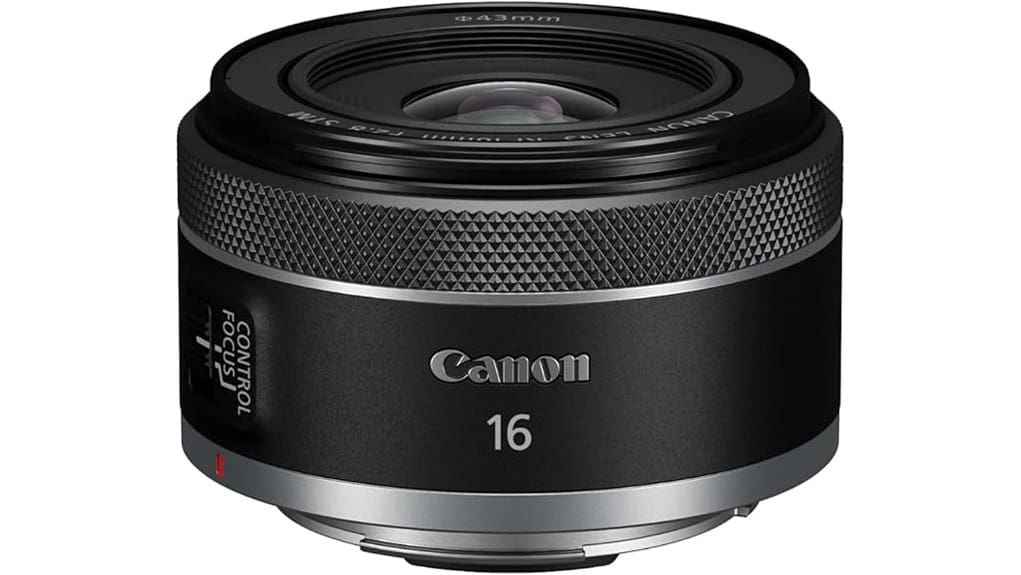
You’ll get an ultra‑wide, punchy f/2.8 optic that’s startlingly light and optimized for video, with strong center sharpness, usable edges wide open and improved microcontrast stopped down. Distortion and chromatic aberration are well controlled, and the STM motor delivers smooth, quiet AF suited to vlogging and run‑and‑gun work. It’s ideal for travel, interiors and astrophotography, though it trades some edge resolution and weather sealing for portability—keep going to see detailed comparisons and sample results.
Some Key Takeaways
- True 16mm focal length gives a 108° field of view, excellent for landscapes, interiors, and vlogging.
- f/2.8 aperture and 0.26x close-focus enable low-light shooting, astrophotography, and dramatic close-ups.
- Compact 163 g design balances well on EOS R bodies and is ideal for travel and gimbal use.
- STM motor delivers smooth, quiet autofocus suited for video with minimal hunting and predictable transitions.
- Good center sharpness and controlled distortion; edges improve stopped down but lack RF-grade edge resolution and weather sealing.
Why the Canon RF16mm F2.8 STM Is a Top Pick for Ultra‑Wide Shooters
Because it pairs a true 16 mm field of view with a compact, 163 g package, the Canon RF16mm F2.8 STM gives ultra‑wide shooters a rare blend of portability and performance. You get compact portability without sacrificing reach: fixed 16 mm covers 108° real angle, while the 43 mm filter thread and 5.11-inch close focus let you work near subjects. The f/2.8 aperture and STM deliver usable low-light and smooth, quiet AF for video. You’ll exploit creative framing with minimal bulk, rapid handling, and a 0.26x magnification that encourages bold foreground use for interiors, landscapes, and vlogging. It’s an excellent choice for photographers who value prime lens fundamentals in a lightweight, travel-ready package.
What to Expect Optically: Sharpness, Distortion, and Low‑Light Performance
When you put the RF16mm F2.8 STM on your camera you’ll notice it’s engineered for punchy center sharpness with predictable wide‑angle falloff toward the edges—stopped down to f/4–f/8 the center reaches very good to excellent resolution while corners improve noticeably but never quite match the center. In sharpness testing you’ll find usable edge detail wide open, with microcontrast improving stopped down. Chromatic aberration is well controlled in real scenes, with occasional lateral CA near high‑contrast edges. Distortion control is competent for an ultra‑wide prime, requiring minimal correction for architectural work. Low light performance is strong thanks to f/2.8 and efficient coatings. Perfect Portrait Lenses is a helpful resource for photographers researching portrait camera lenses and lens options.
Handling, Autofocus, and Video Features for Vloggers and Creators
Although small and light, the RF16mm F2.8 STM feels intentionally engineered for handheld run‑and‑gun use, offering a compact profile that keeps balance comfortable on EOS R bodies and gimbals. You get compact ergonomics that reduce fatigue and simplify rigging with cages or microphones. The gear‑type STM delivers silent focusing and smooth continuous AF suited to interview and walking shots; shifts are predictable, with minimal hunting. A tactile focus ring lets you override AF for precise framing. For vloggers and creators the lens prioritizes reliable, unobtrusive operation—fast enough for run‑and‑gun work, restrained enough for clean audio capture. It’s also well suited to adapters and third‑party accessories that expand creative options for photographers using different mounts, especially when pairing with lens mount adapters for varied systems.
Real‑World Use Cases: Landscapes, Interiors, Astrophotography, and Close‑Ups
The RF16mm F2.8 STM‘s compact handling and quiet STM focusing make it equally well-suited for static landscape framing, tight interiors, night‑sky shots, and exaggerated close‑up perspectives—each application simply asks you to exploit its 108° field, fast f/2.8 aperture, and 5.11‑inch close‑focus distance differently. You’ll use minimal distortion for expansive foreground-to-background depth, controlling apparent landscape compression by choosing foreground anchors. In interiors, you’ll rely on interior staging to maintain proportion and avoid keystoning. For astrophotography, f/2.8 and low weight favor tracked and hand‑held exposures. Close‑ups emphasize perspective exaggeration and 0.26x magnification for dramatic, wide‑angle detail. This versatility also makes it a practical choice for photographers who specialize in wildlife and sports and need a compact, reliable optic on the move.
Who Should Buy It and How It Compares to Nearby RF Alternatives
Because it balances ultra‑wide coverage, f/2.8 brightness, and featherweight portability, the RF16mm F2.8 STM suits shooters who prioritize travel, vlogging, interiors, and night‑sky work without carrying bulky glass. You’ll appreciate its 163 g weight, 108° view, and quiet STM AF if you’re a travel photographer or budget filmmakers needing a versatile, affordable ultra‑wide. Compared with nearby RF options—the faster but heavier RF15-35mm f/2.8 or the sharper RF14mm primes—you trade top-tier edge resolution and weather sealing for compactness and price. Buy it if mobility, low weight, and competent low‑light performance matter more than ultimate resolution. For lightweight, photography-focused gear and tripod-related accessories, check out Perfect Tripods for complementary products.
Some Questions Answered
Is This Lens Weather-Sealed for Outdoor Use?
No — the lens isn’t weather-sealed, so you shouldn’t rely on weather resistance for harsh conditions. You can expect minimal splash protection from incidental moisture, but it lacks formal sealing and won’t withstand heavy rain, dust storms, or prolonged exposure. If you’ll shoot outdoors in uncertain weather, you’ll want a rain cover, protective housing, or a fully sealed lens/body combination to safeguard your gear and maintain reliable performance.
Does It Accept Screw-On ND or Polarizing Filters?
No, the front element is deeply curved so it won’t accept standard screw-on ND or polarizing filters directly. You’ll need a filter adapter or specialized slim filter system to achieve filter compatibility; slim hoods may help reduce vignetting with such adapters. You’ll want to evaluate adapter fit, image circle coverage, and potential corner shading before buying. Expect some optical compromise with stacked adapters or thick filters on this ultra-wide prime.
Can I Use It on APS-C RF Bodies Without Vignetting?
Yes — you can use it on APS-C RF bodies, and you won’t get severe vignetting. The camera’s crop compatibility reduces the effective angle of view, so angle reduction turns 16mm into roughly a 25.6mm full-frame equivalent. You’ll retain sharpness and corner illumination typical for this optic, though field of view narrows. Expect slightly different framing and less pronounced ultra-wide perspective compared to full-frame use.
Is In-Lens Stabilization Included?
No — it doesn’t include in-lens optical stabilization. You’ll rely on camera-body stabilization (if available) or electronic correction for handheld shots. The STM motor supports smooth AF but provides no optical IS. For stills and video, test body IBIS plus lens electronic correction to reduce shake and vignetting on APS-C bodies. Evaluate results at slower shutter speeds and wide apertures; consider a stabilized body or tripod for critical low-light work.
Are Specialized Lens Hoods or Caps Available?
Yes — you can get specialized third party hoods and custom caps for this lens. You’ll find low-profile petal hoods and rigid screw-in models from third party vendors that reduce flare without adding bulk. Custom caps (magnetic, silicone, or engraved) are available to protect the 43 mm thread and rear mount. Evaluate build quality and exact fit before buying; poor tolerances can vignette or impair autofocus performance.