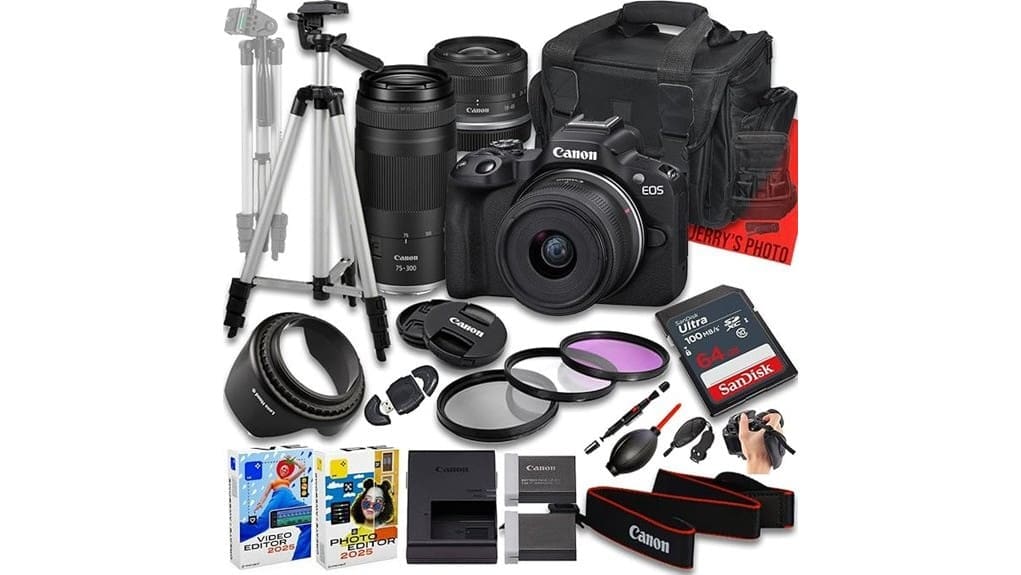
You’ll get a compact, technically capable APS‑C mirrorless body that captures detailed 24MP stills and 6K‑oversampled 4K video, driven by a DIGIC X and Dual Pixel CMOS AF II for fast, reliable subject acquisition up to 15 FPS. The articulating screen, 1080p120 slow motion, and lightweight RF‑S 18–45/75–300 kit suit vloggers and travel shooters, while LP‑E17 endurance and Wi‑Fi streamline workflows — keep going to uncover nuanced performance and practical tradeoffs.
Some Key Takeaways
- Compact, lightweight APS‑C mirrorless ideal for advanced hobbyists and vloggers seeking portability and strong autofocus performance.
- 24.2MP sensor with DIGIC X delivers detailed images, good dynamic range, and usable ISO up to 32000 with sensible noise reduction.
- Dual Pixel CMOS AF II with 651 phase-detection zones provides fast, reliable subject and eye/animal tracking and 15 FPS continuous shooting.
- 6K‑oversampled 4K video, 1080p120 slow motion, articulating LCD, and MP4/Wi‑Fi support make it vlog‑friendly and easy to deliver content.
- Kit includes stabilized 18–45mm and 75–300mm lenses, decent battery life (~300 shots), but lacks weather sealing; check warranty and bundle accessories.
Canon EOS R50 Review Summary: Who It’s Best For
If you need a compact, technically capable mirrorless body for advanced hobbyist photography and content creation, the Canon EOS R50 delivers a focused balance of speed, resolution, and video capability in a lightweight package. You’ll appreciate its 15 FPS burst and Dual Pixel CMOS AF II for quick subject acquisition, and 6K-oversampled 4K for sharp footage. It’s ideal for beginner vloggers who want studio-grade autofocus without complex setup, and travel enthusiasts seeking a small kit with stabilized 18–45mm and extended 75–300mm reach. Battery life, included accessories, and Wi‑Fi connectivity support practical, on-the-go workflows. The EOS R50 pairs well with essential mirrorless accessories like lenses and tripods to build a versatile kit.
Sensor, Processor, and ISO Performance
While the EOS R50 pairs a 24.2‑megapixel APS‑C CMOS sensor with Canon’s DIGIC X processor, you’ll mostly notice the combination in its noise control and processing speed: the sensor delivers detailed 24MP files with good dynamic range for the class, and DIGIC X enables fast Dual Pixel CMOS AF II metering, 15 FPS continuous shooting, and 6K‑oversampled 4K recording without heavy artifacting. You’ll get usable ISO 100–32000 performance; base tones stay clean to ISO 1600, with sensible noise reduction applied beyond that. Highlights retain recoverable headroom; shadows show grain earlier but respond well to targeted NR and tonal adjustments. For outdoor photographers using heavier gear, pairing the R50 with a heavy-duty tripod can help stabilize long exposures and telephoto shots.
Autofocus and Continuous Shooting in Real Use
Push the R50 into action and its Dual Pixel CMOS AF II system shows why Canon focused on responsiveness: with 651 phase-detection zones covering a large portion of the frame, subject detection and tracking for people, animals, and vehicles locks quickly and maintains stable focus through sequences. You’ll exploit up to 15 FPS continuous shooting with reliable frame-to-frame focus adjustments, minimizing hunting. Eye tracking performance is precise for stills, holding lock on faces during rapid framing changes. Low light tracking remains competent down to practical ISO limits, though lens aperture and AF assist influence consistency during extended bursts. For photographers who meter precisely, pairing the R50 with a dedicated spot light meter can help optimize exposure in challenging lighting.
Video Capabilities: 6K Oversampled 4K, 120p Slow Motion, and Vlogging Features
Having proven its AF and burst strengths in stills, the R50 brings that same tracking reliability to video, letting you exploit 6K oversampled 4K and high-frame-rate capture without losing subject lock. You’ll record 6K-to-4K oversampled detail at 30p using the full APS-C sensor, yielding cleaner fine texture and improved demosaic than native 4K. For motion, 1080p at 120p delivers usable slow motion with predictable rolling shutter and manageable bitrate. Vlog ergonomics favor the articulating 3.0-inch LCD, compact body, and lightweight kit lens for handheld framing, while MP4 workflow and Wi‑Fi simplify content delivery. Small, versatile LED panels can help you achieve consistent, flattering lighting for vlogs and handheld shoots with the R50, especially in tight or mobile setups using LED panels.
Lenses, Stabilization, and Real-World Image Quality With the Included Kit
Pairing the R50 with the supplied RF-S 18–45mm f/4.5–6.3 IS STM and RF 75–300mm f/4–5.6 gives you a compact, versatile kit that covers wide-to-tele focal lengths while keeping overall system weight low. You’ll rely on lens-based IS for steady handheld shots; the 18–45mm’s IS is effective up to several stops. Resolve fine detail with the DIGIC X sensor, watching for mild chromatic aberration at high-contrast edges on the 75–300mm. Bokeh control is limited by modest apertures but acceptable for subject separation at longer focal lengths. Note: the kit lacks formal weather sealing and can show occasional lens flare. Consider pairing these lenses with an L-bracket for improved stability and quicker transitions between portrait and landscape orientations.
Battery Life, Storage, Connectivity, and Day-to-Day Handling
While the EOS R50 keeps a compact profile, its LP-E17 battery life demands practical management—expect roughly 300–320 shots per charge under mixed use and about 90–110 minutes of continuous video recording at 4K before you need the spare. You’ll rely on the included spare LP-E17 and LC-E17 charger for extended shoots; battery longevity benefits from conservative use of electronic viewfinder and Wi‑Fi. Storage uses SDHC (included 64 GB SanDisk Ultra); swap or offload when nearing capacity. Wireless transfers to smartphones and computers are straightforward but will further tax battery, so plan charging and card rotation. For longer days on location, consider portable power options like power banks to keep both batteries and devices topped up.
Value and Warranty: Is the Renewed 22-Piece Bundle Worth It?
Managing batteries, storage, and connectivity gives you a practical sense of how the kit will perform day-to-day, and that operational picture directly informs whether the renewed 22-piece bundle represents good value. You get two LP-E17 cells, charger, and a 64 GB SanDisk card, which addresses immediate power and storage needs; included RF-S 18-45mm with IS plus 75-300mm extend shooting range. Inspect return policy and refurbished warranty specifics from the dealer: this listing cites a 1-year exclusive dealer warranty despite some fields referencing 90 days. If warranty terms and cosmetic grading meet your risk tolerance, the bundle value is strong. This kit suits photographers who need reliable power and accessories for everyday shooting, especially those focused on camera batteries and related gear.
Some Questions Answered
Does the Camera Support Tethered Shooting With Third-Party Software?
Yes — you can tether the camera to third-party software, though implementation varies by app. For reliable tethered compatibility, use Canon-supported protocols or USB streaming with apps that recognize EOS bodies; some utilities require Canon EOS Utility or paid plugins. You’ll optimize workflow by confirming USB drivers, enabling camera remote control in settings, and using high-quality cables. Expect occasional limitations with live view refresh, metadata transfer, and firmware-dependent features.
Can I Use EF Lenses With an Adapter on the R50?
Yes — you can use EF lenses on the R50 with an EF adapter. Mount compatibility is provided via Canon’s EF‑to‑RF adapter or compatible third‑party EF adapter, maintaining flange distance and electronic contacts. Aperture control is preserved electronically for most EF lenses, though some legacy glass may require manual operation. Autofocus performance generally works, but AF speed and accuracy can vary by lens and adapter quality; expect occasional slower tracking.
Is the Microphone Input Compatible With External Shotgun Mics?
Yes — you can connect an external mic via the 3.5mm jack for typical shotgun mics. You’ll get better directional audio and lower handling noise than the built‑in mic. Use proper wind protection (deadcat or foam) to reduce wind rumble; consider a shock mount for vibration isolation. Monitor levels on the camera, set manual gain to avoid clipping, and confirm polarity and plug size match standard 3.5mm TRS shotgun mics.
Does the Camera Have Bluetooth for Remote Shutter Control?
Yes — you can use Bluetooth remote functionality. You’ll pair the camera via Wireless pairing (Bluetooth Low Energy) to Canon’s Camera Connect app or compatible remotes, enabling remote shutter release, basic settings control, and image transfer. Setup requires enabling Bluetooth in the menu, initiating Wireless pairing, then confirming the device on both ends. For reliable shutter timing and full control, use Wi‑Fi pairing when available, as Bluetooth prioritizes low power and limited bandwidth.
Are There Built-In Presets for Social Media Aspect Ratios?
Yes — you’ll find built-in social presets that simplify framing for common aspect ratios (1:1, 4:5, 16:9) so you can compose for platforms quickly. The camera also offers a portrait guide overlay to help position subjects and maintain eye-line and headroom. You’ll work with technical overlays in the EVF/LCD, switch presets in the menu, and rely on precise framing assistance for consistent social-media outputs.