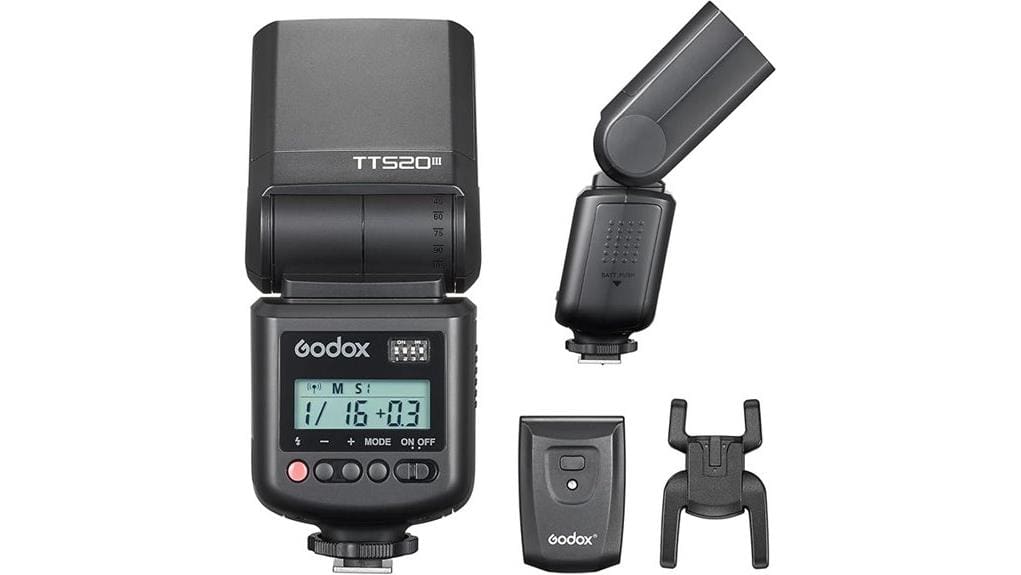
You’ll get a compact GN33 manual strobe that’s built for field use and off-camera versatility. It runs on AA/NiMH cells for about 400 full-power pops and ~1.8s recycle, with predictable voltage sag and thermal limits under rapid bursts. The head tilts 127° and rotates 330° for reliable bounce and direct work. Integrated 433 MHz receiver supports 16 channels and group control to ~15 m. Keep reading for detailed workflow, mounting, and power options.
Some Key Takeaways
- GN33 output with 8-step manual power (1/128–full) offers predictable, repeatable exposures for on-location and studio work.
- Integrated 433 MHz receiver (16 channels) enables reliable off-camera triggering up to ~15 m with group sync.
- Runs on NiMH AA batteries (~400 full-power flashes, ~1.8 s recycle); optional PB960 reduces recycle and heat.
- 330° horizontal and 127° vertical head rotation plus built-in reflector and diffuser support flexible bounce and modifier use.
- Rugged, serviceable design and single-contact hotshoe compatibility make it practical, though no TTL and limited range are trade-offs.
Godox TT520III at a Glance : Who It’s For and Core Specs
If you need a compact, versatile off-camera flash for run-and-gun and controlled lighting setups, the Godox TT520III delivers core pro features without a steep learning curve. You’ll get GN33 output (ISO100), 8-step manual power from 1/128 to full, and a 330°/127° head for bounce and direct work. Its integrated 433MHz receiver and 16-channel triggering suit multi-camera rigs; single-contact hotshoe compatibility covers major brands. You’ll appreciate rugged build quality and AA battery chemistry for field serviceability. Controls are straightforward, display-driven, and expandable with PB960 power and adapter brackets for modifiers and mounts. The site also offers a focused selection of digital camera gear geared toward enthusiasts and camera fans.
Power, Battery Life, and Recycle Performance You Can Expect
When you push the TT520III to work, expect GN33 (ISO 100) output with quick, reliable recycling thanks to NiMH AAs—around 400 full-power flashes per charge and roughly 1.8 seconds recycle time under standard conditions. You’ll control output across eight manual steps; NiMH AAs give predictable voltage sag and consistent performance. For longevity follow battery maintenance: use high-quality NiMH, charge regularly, and remove cells during storage. Heat management matters during rapid bursts—cycle shots to avoid thermal cutoff and allow passive cooling. Optional PB960 external power reduces recycle times and heat buildup for demanding sessions. Consider pairing your flash with dual battery chargers to keep multiple NiMH sets ready for extended shoots.
Wireless Triggering, Compatibility, and Mounting Options
With an integrated 433 MHz receiver and 16-channel RT wireless triggering, the TT520III gives you reliable off-camera control up to about 15 m and supports on-camera, remote, optical, and wired modes for flexible setups. You’ll find straightforward compatibility with single-contact hotshoes across major mounts; shoe adapters extend fit for legacy or specialty cameras. Group syncing is stable across channels, letting you assign and trigger multiple units. Pay attention to antenna positioning for ideal range and interference rejection. Firmware updates can refine wireless performance; check Godox releases. Mounting via standard shoe or optional brackets keeps the system modular and serviceable. For more consistent results, pair the TT520III with dedicated wireless flash triggers designed for 433 MHz systems.
Flash Head, Modifiers, and Real-World Lighting Performance
Although compact, the TT520III’s head gives you precise control over light direction and quality thanks to its 330° horizontal and 127° vertical rotation, built-in reflector, and wide-angle diffuser. You bounce reliably, shaping highlights with the reflector and achieving soft falloff when using the diffuser or small softboxes. Magnetic and optional Bowens adapters expand modifier compatibility; modifier durability depends on third-party build but adapters stay secure. Output consistency and 8-step power control let you fine-tune exposures in mixed lighting. In practice the head tracks well for repeatable angles, and flash-to-subject response supports both on-location bounce work and controlled studio setups. Many photographers pair ring lights and flashes to get flattering catchlights and even skin tones with soft, even lighting.
When to Buy the TT520III : Pros, Cons, and Recommended Alternatives
If you need a rugged, expandable TTL-less flash that balances portable battery convenience with studio-capable output, the TT520III is worth considering. You should buy it when you prioritize reliable 433MHz triggering, AA/NiMH portability, and predictable manual control for on-location or studio work. Pros: strong GN33 output, fast 1.8s recycle, multi-mode triggering, modular modifier support. Cons: no TTL, limited 15 m trigger range, fewer advanced automation features. Budget alternatives include simpler third-party strobes or older Godox TTL-lite models. Maintenance tips: use quality NiMH cells, clean contacts regularly, and update firmware where available. Also consider pairing it with continuous LED panels for mixed lighting setups to better match color temperature and achieve smoother fill light with LED lighting.
Some Questions Answered
Does It Support TTL or High-Speed Sync (HSS)?
No — it doesn’t support TTL support or High speed sync. You’ll get manual-only control with 8 power levels (1/128–full) and precise ±1/3-stop steps, plus multi-mode triggering (on-camera, remote, optical, wired) via the integrated 433MHz receiver. You can use quick-charge PB960 for more flashes and faster recycles, and accessories for modifiers, but TTL and HSS capabilities aren’t provided in this model.
Can It Act as an Optical Slave Without Radio?
Yes — you can use it as an optical slave without radio. It supports optical triggering so it can fire in response to another flash’s burst. You’ll control output manually on the unit, relying on manual power control (1/128–full in ±1/3 stops) to set exposure. This is useful for simple multi-flash setups or backup triggering when radio isn’t available, though sync options and range are more limited than radio triggering.
Is There a Firmware Update Option?
Yes — you can perform firmware upgrades, but only via an authorized service or compatible Godox updater tool; there’s no direct USB port on the unit. You’ll use menu navigation on the updater/interface, not the flash itself. Send the unit or connect it to the official updater to apply firmware files. Keep firmware current to guarantee radio stability and feature fixes; follow Godox instructions for backups and version checks before proceeding.
What Is the Flash’s Exact Weight With Batteries?
The flash’s exact weight with batteries is approximately 370 grams total mass (about 0.82 lb), which includes 4 AA NiMH cells; battery weight accounts for roughly 70–80 grams of that total. You’ll report battery weight separately when calculating gear loads. For transport planning, treat the unit as 370 g total mass; expect minor variance depending on cell chemistry and brand, which can shift battery weight and therefore the overall total mass by a few grams.
Is There a Dedicated Carry Case Included?
No — it doesn’t include a dedicated carry case. You get a simple soft pouch / protective sleeve for basic protection and transport, but it’s not a structured case. The pouch shields against scratches and light bumps, yet won’t protect from heavy impact or crush. For secure storage and travel you’ll want a padded, rigid case or organizer that accommodates the flash, batteries, and any adapters or brackets you carry.