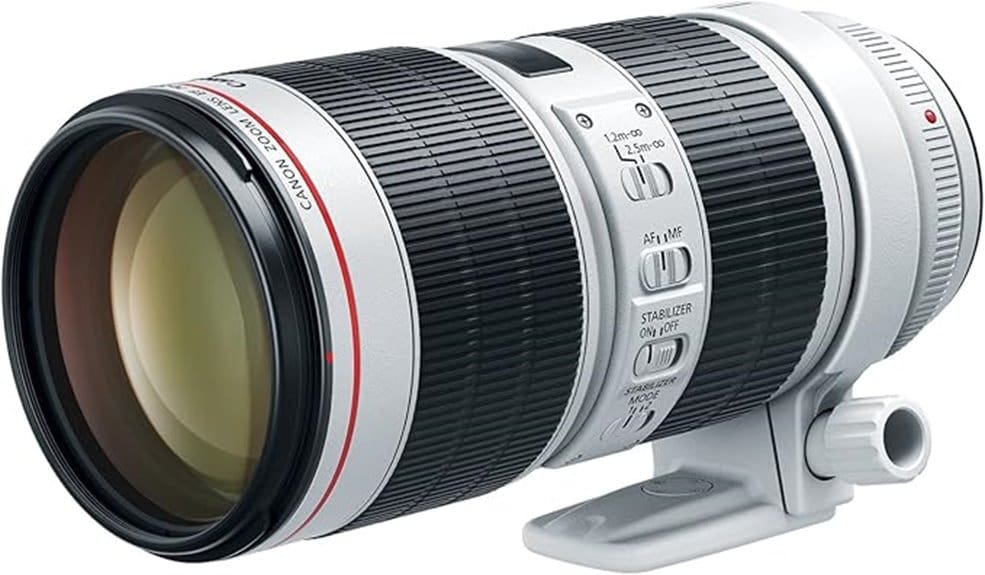

You’ll find the Canon EF 70–200mm f/2.8L IS III USM is a pro-grade, constant‑aperture telezoom that gives you fast ring‑USM autofocus, about 3.5 stops of IS, and consistently high center sharpness wide open. It handles predictably with smooth bokeh, restrained CA, and robust weather‑sealed build for long days in the field. You’ll get reliable low‑light performance and stabilization for handheld shooting, plus pro ergonomics; keep going and you’ll uncover detailed specs, handling notes, and buying advice.
Some Key Takeaways
- Pro-level constant f/2.8 telezoom delivering fast AF, predictable exposure, and excellent low-light performance.
- Strong, consistent sharpness center-to-edge with modest corner falloff corrected by f/4–f/5.6.
- Ring USM autofocus is fast, accurate, and offers full-time manual override for demanding shooting.
- IS provides about 3.5 stops of stabilization, aiding handheld use in low light and long focal lengths.
- Rugged, weather-sealed build with smooth handling, tripod collar, and high resale value for pros.
What the 70-200mm F/2.8L IS III USM Actually Is and Who It’s For
Think of the Canon EF 70-200mm f/2.8L IS III USM as a professional-grade, constant-aperture telezoom built for demanding shooters who need reach, speed, and reliability. You’ll use it for professional portraits where subject isolation and consistent exposure matter, and for wildlife sports when you need fast framing and dependable handling. It’s aimed at pros and serious enthusiasts shooting events, nature, and editorial work who prioritize robust build, weather resistance, and fast, quiet AF. You’ll appreciate predictable bokeh, close-focus utility, and smooth zoom ergonomics that keep you working efficiently across long days in challenging conditions. It’s an essential choice for mirrorless users adapting EF glass via reliable mount adapters.
Key Specs That Affect Performance (Optics, AF, Stabilization)
Having established who benefits from this lens, let’s look at the specific specs that determine how it performs in the field. You get a constant f/2.8 that offers predictable aperture behavior across the zoom range, aiding exposure and depth control. Optical coatings — Canon’s ASC plus fluorine layers — suppress flare and keep contrast reliable. The Ring USM-driven inner focus delivers fast autofocus responsiveness and smooth full-time manual override. IS offers about 3.5 stops, and build quality supports stabilization longevity under heavy use. Together, these elements give you consistent metering, repeatable focus, and steady handheld reach for demanding shoots. This lens is particularly valuable for photographers mastering zoom lenses who want reliable performance at long focal lengths and fast apertures, especially when learning about zoom lens handling.
Real-World Image Quality: Sharpness, Bokeh, Flare, and Low-Light Use
When you push this 70–200 through typical shooting scenarios it delivers exceptionally consistent sharpness across the frame, with center resolution peaking wide-open and only modest corner falloff that tightens by f/4–f/5.6; microcontrast and edge-to-edge detail remain strong thanks to the fluorite and UD elements plus ASC, so you can rely on it for critical work from portraits to sports. You’ll notice restrained chromatic aberration even at high contrast edges. Bokeh is creamy with smooth highlights and reliable subject isolation. Color rendition is natural and neutral. In low light IS and fast f/2.8 keep usable shutter speeds and clean results. It’s an excellent choice for portrait shooters looking for consistent performance and build quality, especially when paired with portrait lenses designed for flattering subject rendering.
Handling, Build, Weather Resistance, and Field Experience
Although the 70–200mm f/2.8L IS III feels substantial in your hands, its balance and ergonomics make it surprisingly manageable for long shoots: the metal and high-grade polycarbonate chassis gives a reassuringly solid, damped action on the zoom and focus rings, while the tripod collar rotates smoothly and locks positively. You’ll notice comfortable handling with predictable weight distribution on both monopod and shoulder rigs. The rugged build and weather sealed construction resist dust and moisture, keeping controls reliable in harsh conditions. IS performance and ergonomics enhance field usability, letting you concentrate on composition rather than equipment limitations. For outdoor photographers who often use heavy setups, pairing this lens with a heavy-duty tripod provides the stability needed for sharp telephoto shots.
Should You Buy It? Price, Alternatives, and Best Use Cases
If you need a rugged, fast telephoto that delivers consistent f/2.8 performance, stellar sharpness, and reliable 3.5-stop image stabilization, the Canon EF 70–200mm f/2.8L IS III USM is a strong buy—particularly for pros shooting sports, weddings, wildlife, or events where low-light reach and edge-to-edge clarity matter. Expect premium pricing; monitor pricing trends and time purchases around holiday sales or body-lens bundles for best buyer timing. Consider rental options if you need it episodically. Alternatives include the lighter f/4 version or third-party 70–200mm f/2.8s. Strong resale value makes this a sensible long-term investment. Perfect Tripods recommends matching the lens with a sturdy tripod head for optimal support and stability when shooting at long focal lengths, especially for rugged tripod setups.
Some Questions Answered
Is the Tripod Collar Removable or Rotatable?
Yes — the removable collar is removable and its rotating foot lets you smoothly switch orientation. You’ll unclip and slide the collar off for tripod-free handheld use; when attached the collar locks to the barrel while the rotating foot provides precise 90° detents for landscape/portrait framing. The foot uses a locking lever for secure mountings and tripod compatibility, and it’s robust enough for quick swaps without compromising balance or alignment.
Does It Accept Canon Teleconverters and Retain AF?
Yes — you can use Canon teleconverters with this lens, but teleconverter compatibility and autofocus performance vary: with a 1.4x TC you retain autofocus on most EOS bodies and lose one stop (effective f/4), preserving reliable AF. With a 2x TC you’ll lose two stops (effective f/5.6); AF often still works on higher-end bodies but can become sluggish or drop out on entry-level cameras. Test on your camera for best results.
What Is the Lens’ Close-Up Magnification Ratio?
The close-up magnification ratio is 1:4.4 at the minimum focusing distance. You’ll get roughly 0.23× reproduction (not 1:1.4); minimum focusing is 1.2 m (3.9 ft), so subjects aren’t true macro. Practically, you’ll frame medium-sized details but won’t achieve life-size capture. For higher magnification, use a dedicated macro lens, extension tubes, or a 1:1.4 magnification teleconverter workaround knowing AF and image quality may be affected.
How Heavy Is It for Handheld All-Day Use?
It weighs 3.2 pounds, so you’ll feel a noticeable but manageable presence for handheld all-day use. With proper fatigue management—use your camera strap, switch shoulders, and rest on your torso—you’ll mitigate strain. The lens’ weight perception increases when paired with heavier bodies, lenses, or long sessions; balance and posture adjustments plus brief breaks preserve stability and reduce muscle fatigue while maintaining sharp shooting performance.
Are Replacement Lens Caps and Hoods Included?
Yes — the package includes the original Lens Cap E-77II and Lens Dust Cap E, plus the Lens Hood ET-87 and Lens Case LZ1326. If you need replacements later, aftermarket caps and third‑party hoods will fit but may vary in finish, retention, or shade coverage. You’ll want genuine Canon parts for exact fit and coatings, or choose reputable third‑party options tested for secure mounting and proper vignetting control.