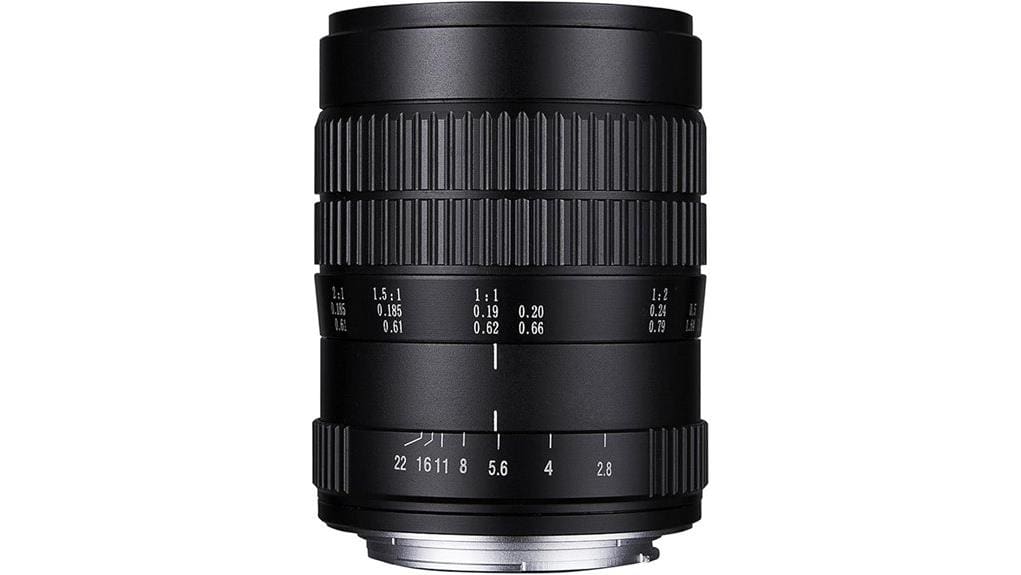

You’ll get a compact, all‑metal 60mm f/2.8 manual macro that covers 0.1×–2× continuous magnification, letting you switch from portraits to extreme close‑ups without tubes or bellows. Optics use 9 elements in 7 groups with dual moving groups to control field curvature and distortion; center sharpness is strong while edges improve stopped down. Handling is precise with a long damped ring; no IS or weather sealing. Continue for test results, comparisons, and practical tips.
Some Key Takeaways
- Manual-focus 60mm f/2.8 macro lens offering continuous 0.1×–2× magnification for versatile close-up work without accessories.
- Robust metal build, compact design, and lightweight footprint suit travel and mirrorless camera use.
- Optically sharp in the center across distances; edges soften wide-open and at extreme magnifications, improved by stopping down.
- Good control of chromatic aberration and flare thanks to coatings, with minor longitudinal fringing at very close focus.
- Best for insect, product, clinical macro, and portrait work where focus stacks, tripod or focus rail, and careful lighting are used.
Quick Verdict: Who Should Buy the LAOWA VEN6028C and Why
Although it’s a manual-focus, fixed-length optic, the LAOWA VEN6028C is a specialized tool for photographers who need extreme close-up capability without changing accessories: you get 0.1×–2× magnification in a single, mechanically robust 60 mm f/2.8 lens that also performs as a normal short-telephoto for portraits and general use. You’ll find it ideal if you require precise, repeatable macro ratios, robust metal construction, and a compact footprint that favors field portability. As an affordable alternative to modular macro rigs, it reduces gear swaps, simplifies setup, and delivers controlled working distances for insect, product, and clinical macro applications. It’s especially useful for photographers who prioritize mirrorless camera compatibility and a lightweight kit for travel and outdoor shooting.
Optical Performance: Sharpness, Bokeh, Distortion, and Coatings
When you evaluate the VEN6028C’s optics, you’ll find a lens engineered for high-resolution macro work: its 9-element/7-group construction and two moving groups keep field curvature and barrel distortion well controlled across the 0.1×–2× range, delivering crisp center resolution from close-up to normal focusing distances. Edge sharpness falls off predictably toward the frame periphery at maximum aperture and extreme magnifications; stopping down improves microcontrast and overall acutance. Chromatic aberration is well suppressed for macro standards, with minor longitudinal color fringing only at very close focus. Fluorine coating and multi-coating enhance contrast rendition and reduce flare. This makes the VEN6028C a practical choice for photographers who use lens calibration tools to achieve optimal focus and critical sharpness.
Macro Capabilities and Handling: 0.1×–2× Magnification, Focus Action, and Working Distance
Because the VEN6028C covers a continuous 0.1× to 2× magnification range on its barrel, you can shift from showpiece-scale portraits to extreme close-ups without adding tubes or bellows, and the lens’ dual moving-group design preserves framing and focus consistency throughout that span. You operate a long, well-damped focus/magnification ring that provides predictable magnification shifts; detents are absent but resistance prevents accidental slips. Working distance varies predictably with magnification, requiring careful lighting and subject placement at higher ratios. Close up ergonomics favor tripod or rail use for repeatable framing; handheld at lower ratios remains feasible with deliberate technique. For shooters using adapted lenses, mastering lens mount adapters can expand compatibility and creative possibilities.
Real-World Tests: Portraits, Insects, Studio Still-Life, and Sample Results
If you want to evaluate how the VEN6028C performs across practical scenarios, the following tests cover portraits, insect macro, and controlled studio still-life shooting with objective sample observations. You’ll assess portrait details at f/2.8 and stopped apertures, noting skin microtexture, bokeh rendition from the 14-blade diaphragm, and edge sharpness across the frame. For insect behavior studies you’ll document capture distance at 0.1×–2×, focus stacking ease, and motion freeze needs under natural light. Studio textures testing uses controlled illumination to quantify contrast, micro-contrast, and color fidelity. Sample comparisons present side-by-side crops for objective evaluation. You’ll also find actionable tips for mastering close-ups with macro lenses, including composition and lighting techniques for macro photography.
Practical Considerations: Mounts, Build, Accessories, Limitations, and Final Buying Tips
Having seen how the VEN6028C handles portraits, insects, and studio still-life, you’ll want to weigh practical factors that affect daily use: mount compatibility and mechanical build, available accessories, handling limitations, and buying trade-offs. Check that Canon EF Mount compatibility matches your body; adapters may work but can affect flange distance and focusing range. The metal construction conveys Build durability; expect solid helicoid action but no weather sealing. It ships with a pouch and filter; extension tubes aren’t required for 2× but can change ergonomics. Manual focus demands technique; no IS affects handheld macro. Buy if you prioritize optical reach and mechanical robustness. Consider also shopping trusted retailers for lens accessories to ensure proper mounts and support.
Some Questions Answered
Is This Lens Compatible With Full-Frame and APS-C Canon Bodies?
Yes — you can use this lens on both full frame and APS-C Canon bodies. For full frame compatibility, it covers the full sensor and retains 0.1×–2× magnification, though edge performance depends on framing and you’ll need manual focus. For APS-C performance, the effective field of view tightens (roughly 1.6× crop), increasing apparent magnification and working distance; resolution and depth of field behave predictably with sensor size differences.
Can I Use Autofocus Adapters or Will It Remain Manual Focus?
No — it’ll remain manual focus even with most adapters; autofocus adapters compatibility is limited and won’t add true AF functions. You can use electronic AF adapters that claim lens AF, but with this manual-design lens you’ll only get electronic communication (metadata, aperture control if supported) and occasional focus confirmation from the camera. Expect manual focusing; rely on focus confirmation, focus peaking, or magnified live view for accurate macro work.
Does the Lens Support Electronic Aperture Control or EXIF Transmission?
No — the lens doesn’t support electronic metadata or aperture signaling. You’ll operate aperture and focus mechanically; the mount is fully manual so the camera won’t receive EXIF lens data or electronic aperture commands. That means no in-camera aperture control, no recorded focal/aperture values, and no aperture signaling to the body. You’ll manage exposure and record metadata manually or via external workflow that annotates images after capture.
What Filter Thread Size Does the Lens Accept?
The lens accepts a 49mm thread for front-mounted filters. You’ll screw standard 49mm filters onto the lens and you can use a stackable extension approach to add multiple thin filters or diopters without interfering with manual focus or magnification. Because the barrel supports close focusing and high magnification up to 2×, monitor vignetting when stacking thick filters; prefer slim, high-quality glass and a stackable extension spacer to maintain optical clearance and alignment.
Is There Any Warranty Coverage From the Manufacturer?
Yes — you’ll have manufacturer warranty options, but they’re limited coverage. The vendor lists a standard manufacturer warranty; specifics (duration, defect types, and service process) aren’t fully detailed in the listing. You’ll need to register or contact Venus Optics/LAOWA to confirm terms, exclusions (wear, misuse, water damage) and claim procedures. Keep your purchase proof and serial number; that’ll speed claims and clarify whether repairs or replacements fall under the limited coverage.