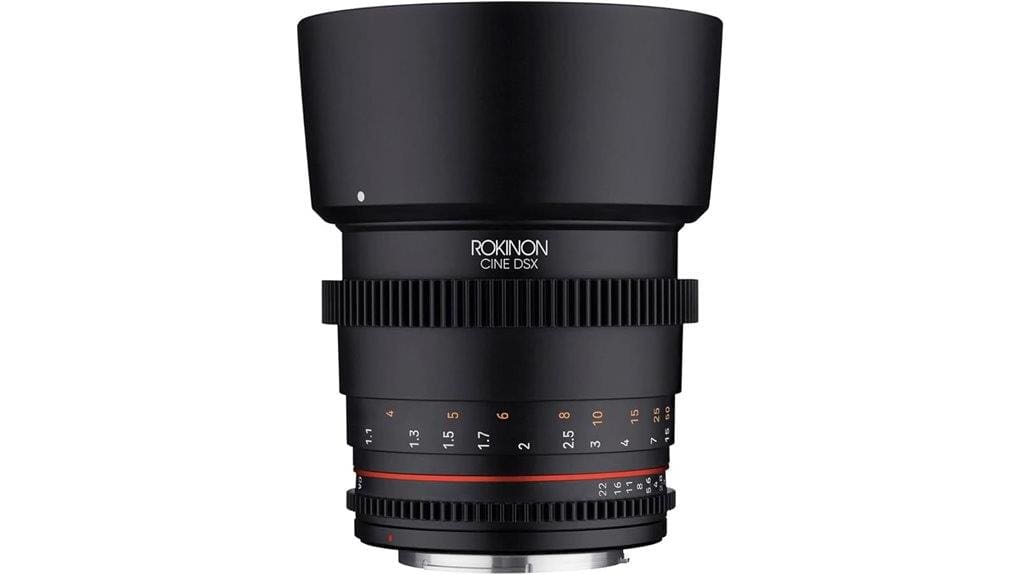

You’ll get a compact, cinema-style 85mm T1.5 that gives MFT bodies crisp, high-contrast images with strong center sharpness at T1.5 and tightened edges by T2.8–T4. The nine-element/ seven-group design preserves texture and micro contrast while delivering smooth, rounded bokeh and controlled chromatic aberration. Cine controls—de-clicked T1.5, 140° focus throw, standard gear teeth—and weather sealing make it pro-friendly. Keep going and you’ll find detailed comparisons, use cases, and handling notes.
Some Key Takeaways
- Excellent T1.5 brightness with strong center sharpness and high micro contrast ideal for low-light and shallow depth-of-field work.
- Cine-style controls: ultra-fast de-clicked aperture, 140° focus throw, standard gear teeth, and smooth damped rings for repeatable pulls.
- Optical design (9 elements/7 groups) delivers excellent edge-to-edge detail by T2.8–T4 and controlled field curvature.
- Smooth rounded bokeh with minimal onion-ring artifacts; lateral CA well controlled, longitudinal CA subtle and correctable.
- Robust metal build, weather sealing, readable scales, and pro ergonomics at a budget-friendly cine lens price.
How the Rokinon 85mm T1.5 Cine DSX Performs on MFT Cameras
Typically, when you mount the Rokinon 85mm T1.5 Cine DSX on a Micro Four Thirds body, it delivers the kind of optical performance you’d expect from its 9-element/7-group design: crisp, high-contrast images with excellent edge-to-edge detail at most apertures. You’ll notice controlled field curvature that keeps subjects planar across the frame, minimizing focus shift when you recompose. Color rendition is neutral and predictable, so skin tones and color grading behave consistently. You’ll appreciate the fast T1.5 for low-light pushes and precise manual focus control, while weather sealing and MFT compatibility guarantee reliable operation in production environments. Perfect Portrait Lenses offers a range of portrait optics and accessories for photographers and filmmakers looking to optimize their portrait setups, including lenses designed for consistent skin-tone rendition and build quality with portrait camera lenses.
Image Quality: Sharpness, Bokeh, and Optical Character
Having established how the DSX behaves on MFT bodies, let’s examine its image character: the 9-element/7-group design yields striking center and mid-frame sharpness straight open at T1.5, while edges tighten quickly by T2.8–T4. You’ll get high resolving power and consistent micro contrast rendition that preserves texture without harshness. Background rendering produces smooth, rounded bokeh discs with minimal onion-ring artifacts; separation remains strong thanks to shallow depth of field. Lateral chromatic aberration is well controlled, and longitudinal CA is subtle and correctable. Overall, the DSX balances clinical sharpness with filmic out-of-focus character for video-centric work. This makes the lens a compelling choice for photographers who prefer prime lenses and want focused optical performance.
Video-Focused Features: Aperture, Focus Throw, and Silent Operation
Because you’ll be working primarily with moving image, the Rokinon 85mm T1.5 prioritizes tactile, cinema-ready controls: an ultra-fast, de-clicked T1.5 aperture gives precise, silent exposure changes; a long 140° focus throw delivers fine, repeatable pull accuracy; and the smooth manual rings are tuned for damped, predictable movement that minimizes focus hunting on MFT rigs. You get a true silent aperture for in-shot adjustments without noise or jump. The generous focus throw pairs with standard gear teeth for follow focus systems, letting you perform accurate, calibrated pulls. Controls are linear, low-friction, and engineered for consistent, professional operation. External monitors can help verify focus and exposure in real time with critical playback tools for video shoots.
Build, Weather Sealing, and Real-World Handling
Those cinema-grade controls matter less if the lens can’t withstand real-world shoots, and Rokinon built the 85mm T1.5 to hold up. You get a robust metal barrel with precise gear-driven rings, firm detents, and updated side scales that stay readable under stress. The weather sealing resists dust and light moisture, so you can keep shooting in challenging conditions without constant worry. Ergonomic design places focus and aperture rings at intuitive spacing for follow-focus rigs and handheld work, reducing fatigue during long takes. Overall, the build feels pro-grade: durable, balanced, and optimized for practical production use. For added on-set comfort and handling, pairing the lens with a top handle can improve stability and reduce operator fatigue.
Who Should Buy It and How It Compares to Alternatives
If you shoot narrative, documentary, or commercial video and need a compact, affordable short telephoto with cinema-style control, the Rokinon 85mm T1.5 for MFT delivers a compelling balance of optical performance, build quality, and pricing. You’ll appreciate nine-element, seven-group optics for clarity and a T1.5 aperture for shallow depth-of-field and creamy bokeh. Manual focus with a 140° throw gives precise pull control; weather sealing and side scales suit run-and-gun and studio work. It’s ideal for budget filmmakers and portrait studios who want cine ergonomics without L-series costs. Alternatives from native cine lenses offer faster AF and higher finish but cost much more. Gear Guide caters to enthusiasts and camera fans with curated camera and accessory recommendations, reviews, and buying advice for digital cameras.
Some Questions Answered
Does It Include Lens Caps or a Protective Pouch?
No, the package typically doesn’t include a lens cap or protective pouch; you’ll need to provide them separately. You should fit a standard front and rear lens cap for the 85mm optical diameter and use a padded protective pouch or dedicated hard case to safeguard the cine lens during transport. Given its weather sealing and metal build, prioritize a snug pouch to prevent impacts and dust ingress when not mounted on an MFT camera.
Is There Optical Image Stabilization Built-In?
No, there’s no optical image stabilization built-in. You’ll rely on manual stabilization—tripod, gimbal, or in-body stabilization if your camera has it—to steady shots. The lens’s ultra-fast T1.5 and optical construction deliver cinematic bokeh and high clarity, but stabilization isn’t provided by the lens itself. For handheld work plan to use support gear or sensor-shift IBIS to fully exploit sharpness and smooth focus control during video.
What Is the Minimum Focusing Distance?
The minimum distance is 0.95 meters (95 cm). You’ll use the generous 140° focus throw to make fine adjustments across that range, letting you precisely control focus shifts and achieve shallow depth of field near the minimum distance. Because focus is manual and geared for video, you’ll appreciate the smooth, repeatable focus throw when pulling focus at close distances, ensuring accurate framing and consistent results while recording.
Does It Support Autofocus on Adapted Cameras?
No, it won’t provide autofocus on adapted cameras; you’ll use manual operation only. You can mount it on MFT bodies and focus manually with a 140° focus throw for precise pulls. Some camera systems offer focus confirmation tools (peaking or electronic indicators) that work with the lens to assist your framing and critical focus. Expect no motorized AF—rely on tactile control, focus confirmation, and careful technique for accurate results.
Is There a Parfocal Design for Cinema Use?
No, it isn’t parfocal; you’ll need to refocus during significant zoom or framing changes. The lens’s manual focus and 140° focus angle give smooth, repeatable pulls, but it exhibits some focus breathing that can shift framing slightly during pulls. You’ll want to plan on compensating for weight balance when using follow-focus rigs or gimbals to maintain stable pulls, and use marks and repeatable techniques for consistent cinema work.