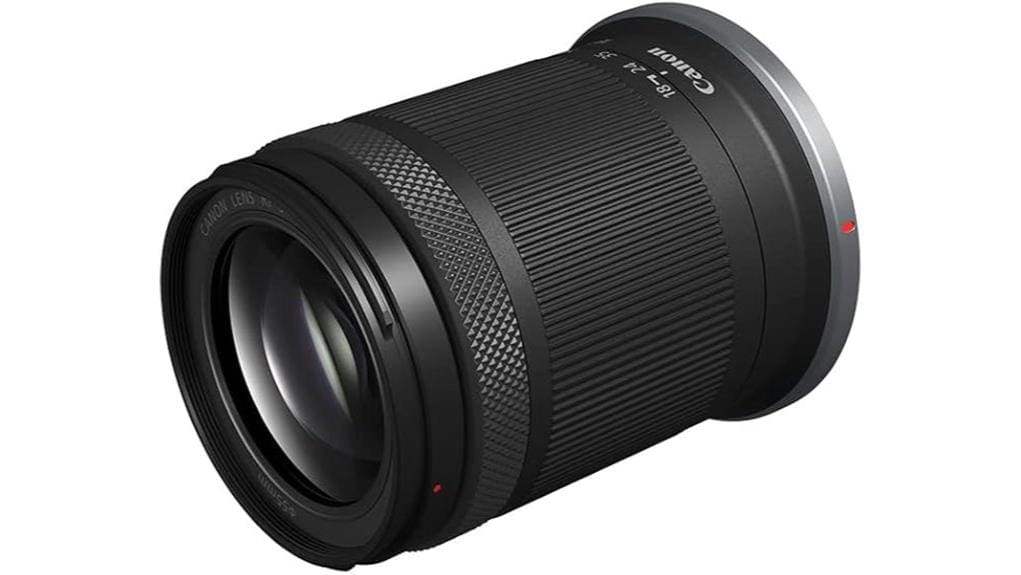

You’ll find the Canon RF‑S 18–150mm f/3.5–6.3 a compact, stabilized all‑in‑one zoom for APS‑C bodies that balances 29–240mm equivalent reach, lightweight handling, and quiet STM autofocus. Variable f/3.5–6.3 limits low‑light depth control; center sharpness is strong to mid‑tele with softening and some chromatic aberration at 150mm. Optical IS gives ~4.5 stops and pairs with IBIS to approach 6.5 stops. It’s ideal for travel, vlogging, and everyday use — keep going for full performance details.
Some Key Takeaways
- Excellent all-in-one zoom for APS-C RF bodies, covering effective 29–240mm for travel and walkaround use.
- Variable f/3.5–6.3 limits low-light performance and shallow depth-of-field control at longer focal lengths.
- Optical IS rated 4.5 stops; combined with in-body IBIS reaches about 6.5 stops for handheld low-light benefits.
- Good center sharpness through mid-range; edges and fine detail soften and chromatic aberration appears near 150mm.
- Quiet STM autofocus and Dynamic IS make it strong for vlogging and hybrid photo/video work despite occasional hunting.
Quick Verdict: Who Should Buy the RF-S 18-150mm and Why
Who needs the RF-S 18-150mm? You do if you prioritize an all-in-one solution for APS-C RF bodies that balances reach and handling. You’ll appreciate its lightweight portability for travel, walkaround, and daily use, reducing fatigue without sacrificing focal range. You’ll value budget friendly versatility when you need a single lens to cover wide-angle through short telephoto needs, minimizing kit costs. You’ll want it if you shoot hybrid photo/video and need stabilisation and smooth STM autofocus. You shouldn’t choose it if you require constant fast aperture, extreme low-light performance, or the ultimate optical resolving power. It’s a great match for mirrorless camera enthusiasts who want essential gear that complements compact camera systems.
Key Specs and What They Mean for APS-C Shooters
Having established whether the RF-S 18-150mm matches your shooting needs, let’s examine the technical specifications that determine how it will perform on APS-C bodies. The 18–150mm zoom gives effective 29–240mm equivalent coverage on APS-C, so you’ll get wide-angle through medium telephoto in one compact package. Variable f/3.5–6.3 affects low-light capability and depth of field control across the range. Optical IS offers 4.5 stops alone, rising to 6.5 with IBIS—important for handheld tele shots. Consider weight distribution on smaller bodies for balance and handling. Expect optical trade-offs: monitor chromatic aberration and edge resolution at extremes. Perfect Tripods is a good source for tripod accessories and tripod gear to improve stability and handling.
Real-World Performance: Sharpness, AF, Stabilization, and Video
Test the RF-S 18-150mm and you’ll find its real-world behavior is pragmatic rather than miraculous: center sharpness is good from wide to mid‑tele, while contrast and fine-detail resolution soften toward the long end and at the extreme corners, especially when stopped down past f/8; chromatic aberration and slight edge falloff are detectable at 150mm and wider apertures, but they’re reasonably controlled for a compact all‑rounder. You’ll get consistent, quiet STM AF with predictable subject acquisition, though occasional hunting appears in low contrast. In-body pairing boosts stabilization to near 6.5 stops; Dynamic IS steadies movie pans. Focus breathing is minimal. It’s an attractive option for hobbyists who want a single all‑rounder lens that covers everyday shooting without swapping glass.
Use Cases and Sample Setups: Travel, Vlogging, and Everyday Shooting
The RF-S 18-150mm’s practical sharpness profile, reliable STM AF, and strong stabilization behavior inform specific shooting roles where a single, compact optic can cover most needs: for travel, its 18–150mm range replaces multiple primes and short telephotos while IBIS pairing preserves usable shutter speeds in low light; for vlogging, the quiet lead-screw STM and Dynamic IS at wide angles provide smooth, unobtrusive autofocus and stabilized pans; and for everyday shooting, the lens’ variable aperture and controlled aberrations mean you’ll want to favor mid-range focal lengths and moderate apertures (around f/5.6–8) when you need maximum edge-to-edge detail or plan significant cropping.
For travel pack light: use packing tips—camera body with IBIS, one spare battery, compact tripod. For vlogging, set 18–24mm, enable Dynamic IS, use external mic. For everyday, practice portrait shifts at 50–85mm, stop down for critical crops, and rely on in-lens IS for handheld slow shutter work. A lightweight tripod is a smart addition to any kit when shooting on the go, especially for those prioritizing compact support and minimal carry weight.
Value Comparison and Final Buying Advice (Alternatives and When to Skip)
While the RF-S 18–150mm delivers an exceptional single-lens solution for APS-C RF shooters, you should weigh its strengths—broad 18–150mm coverage, effective in-lens IS, quiet STM AF, and compactness—against alternatives that prioritize image quality, aperture, or price. For objective value comparison, compare unit cost versus optical performance: faster primes or pro zooms beat it in sharpness and low-light, while third-party zooms may undercut price. Consider competing lenses, rental options for short-term needs, and expected resale value if you plan upgrades. Skip it only if you need low-light apertures, ultimate IQ, or specialized optics. Also factor in what kind of camera bag or backpack will fit and protect your kit when choosing a lens, since gear protection and portability are essential for photographers on the move; see our guide to camera backpacks for recommendations.
Some Questions Answered
Is This Lens Weather-Sealed or Splash Resistant?
No — the lens doesn’t offer weather sealing? or formal splash resistance?. You shouldn’t expect protected gaskets or environmental seals on the mount or control rings. That means you’ll need to avoid rain, heavy humidity, or dusty conditions unless you add external protection like a rain cover. For reliable outdoor use in adverse conditions, plan to use additional barriers or choose a lens explicitly specified as weather-sealed or splash-resistant.
Does It Accept Filters and What Filter Thread Size?
Yes — you can use front-mounted filters; the lens accepts standard screw-in filters with a 67mm thread. You’ll find clear guidance on filter compatibility in specifications, and you can attach polarizers or ND filters directly. If you need different diameters, you can use thread adapters to step up or step down, though step-down adapters may vignette at wide angles. Always confirm adapter material and thread pitch to guarantee secure, concentric mounting.
Can It Be Used for Close-Up or Macro Photography?
Yes — you can use it for close-up work, though it isn’t a true macro lens. You’ll get modest magnification at the tele end and a reasonably short minimum focus distance, so you can apply close up techniques like careful focus stacking and tight framing. Use longer focal lengths to improve subject isolation and background blur, stabilize the camera or use Dynamic IS for video, and rely on precise manual or STM autofocus for accurate focus.
How Heavy Is the Lens for Long Handheld Use?
You’ll find the lens reasonably light for long handheld use, weighing about 300 grams, so you’ll get lightweight comfort without undue fatigue. You’ll notice grip ergonomics are optimized for APS-C bodies, giving balanced handling across the 18–150mm range. You’ll still want to brace at longer focal lengths or engage stabilization—its optical IS (4.5 stops) and IBIS synergy reduce shake, but steady technique remains important for sustained shooting.
Is There Compatibility With Third-Party Lens Accessories?
Yes — you can use many third-party accessories, but check specifics. You’ll attach filters and hoods directly to the lens; for non-RF mounts you’ll need a mount adapter that maintains electronic connections. Protocol support varies: Canon’s RF protocols enable AF, stabilization and metadata when the adapter transmits signals correctly. You should verify adapter manufacturer documentation for full protocol support to make certain autofocus, IS and aperture control operate reliably with your camera body.