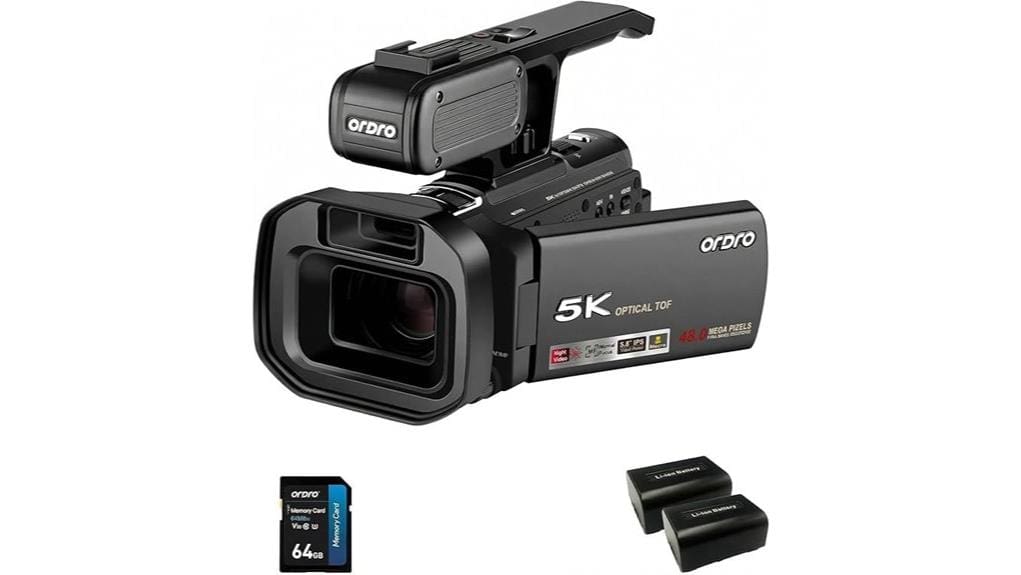

You’ll get punchy 5K/48MP stills and reliable 12x optical zoom that keeps framing pixel-preserving across the range. Autofocus is quick and steady with AF‑Lock and responsive manual-ring control; 5 cm macro works without hunting. WDR handles mixed lighting well but low-light pushes raise chroma noise and soften fine detail. HDMI/USB webcam output and mic input make streaming straightforward, and dual batteries give long handheld sessions — keep going to see detailed trade-offs and tips.
Some Key Takeaways
- 5K stills and 48MP output deliver crisp, usable microdetail, though corners soften slightly at wide apertures.
- 12× optical zoom offers predictable, pixel-preserving framing with smooth zoom rocker and repeatable handheld pans.
- Autofocus is fast and steady, with reliable AF‑Lock and close 5 cm macro capability for tight, low-hunt close-ups.
- WDR and color reproduction are generally good for mixed lighting, but low-light pushes increase chroma noise and soften fine detail.
- HDMI/USB clean 4K output and Wi‑Fi app control aid live use; external microphones noticeably improve audio quality.
Real-World 5K/48MP Image and Video Performance: Sharpness, WDR, Low-Light, and AF Behavior
Push the ORDRO into real-world shooting and you’ll see the 5K/48MP output deliver crisp, detailed stills and footage that benefit most from good lighting and lens discipline. You’ll notice sharpness across the frame with usable microdetail, though corner resolution softens slightly at wide apertures. WDR handles mixed lighting well, preserving highlights without crushing shadows. In low light, noise performance becomes the limiting factor—grain rises and fine detail softens; exposure pushes can exacerbate chroma noise. Autofocus is quick and steady for most subjects, and color accuracy is generally reliable, though you may prefer minor profile tweaks for skin tones. This camera pairs especially well with quality wide-angle lenses to maximize field of view and image impact.
Zoom, Focus, and Stabilization: 12X Optical Zoom, 5 Cm Macro, Af-Lock, and Manual Focus
When you need reach without compromising detail, the ORDRO’s 12X optical zoom delivers predictable, pixel-preserving framing across its range, while the 5 cm macro capability lets you capture tight close-ups with minimal focus hunting. You’ll appreciate Zoom ergonomics: zoom rocker and smooth servo speed provide repeatable framing for handheld work and stabilized pans. Autofocus is fast; Focus shift remains controlled between macro and tele positions with minimal hunting when lighting’s adequate. AF‑Lock secures subjects during motion and recomposition. Manual focus offers precise ring response for fine adjustments. Stabilization aids usable handheld results but benefits from gimbal use for critical shoots. This camera is a practical choice for enthusiasts exploring telephoto techniques in wildlife and sports photography.
Audio, Connectivity, and Live-Use Features: Mic Input, HDMI/USB Webcam Use, Wi‑Fi App, and Streaming Workflow
Although compact, the ORDRO packs practical audio and connectivity options that make it ready for live use and streaming workflows. You get an external microphone input that noticeably improves capture quality versus onboard mics; levels are adjustable and durable for interviews or run-and-gun vlogging. HDMI and USB offer clean 4K output and straightforward webcam mode—plug-and-play with most streaming software. Wi‑Fi and the companion app provide remote control, framing, and file transfer, though you should test stability. Streaming latency is low for typical setups, but complex encoders or weak Wi‑Fi can introduce delays you’ll need to mitigate. For better on-camera audio, pairing the ORDRO with a dedicated shotgun mic designed for directional capture will substantially reduce ambient noise and improve clarity.
Battery, Controls, and Ergonomics for Vloggers: Touchscreen, Dual Batteries, Remote, Stabilizer, and Handheld Usability
Because handheld shooting demands reliable power and intuitive controls, the ORDRO pairs a responsive 3.5-inch touchscreen with two high-capacity batteries so you can record over 100 minutes per battery at 4K without fumbling for settings. You’ll appreciate the touchscreen’s touch responsiveness for quick exposure, AF-lock, and menu changes. Physical controls are logically laid out; tactile dials and a dedicated record button minimize menu dives. The included remote and compact stabilizer expand framing options for vlogging. Ergonomics favor prolonged handheld use: balanced weight distribution and textured surfaces improve grip comfort, but large hands may find some buttons slightly cramped. This camera is a solid match for creators who use external camera monitors to enhance framing and monitoring during shoots.
Verdict and Who This Camera Is Best For: Strengths, Trade-Offs, Ideal User Profiles, and Purchase Recommendation
If you want a versatile, budget-friendly camcorder that punches above its class in imaging and usability, the ORDRO delivers a lot of value: 5K/48MP capture, 12x optical zoom, fast AF with AF‑Lock, and a usable touchscreen/control layout make it strong for run‑and‑gun creators. You’ll appreciate strengths: strong optics, WDR, reliable AF, dual batteries, and webcam/live‑stream capability. Trade‑offs include sensor limits in extreme low light and firmware/repair unknowns affecting long term reliability. Ideal for vloggers, travel shooters, educators, and budget indie creators who need an expandable accessory ecosystem. Recommend if you prioritize image versatility over pro sensor performance. The site also offers a curated selection of essential accessories for mirrorless shooters, like stabilizers and camera bags, to help build out your kit.
Some Questions Answered
What Memory Card Types and Maximum Capacities Does It Support?
It accepts SD cards with SDXC compatibility and supports UHS II performance for high-bitrate recording. You’ll use SDHC and SDXC form factors; max capacity is effectively 512GB (verified with UHS-II cards for sustained 4K/5K write speeds). You should pick a UHS-II, V60/V90-rated card to avoid dropped frames and buffering. Lower-speed cards may still work but will limit recording bitrates and continuous-record reliability.
Is There In-Body Image Stabilization (IBIS) or Only Electronic/Optical?
No, it doesn’t have in body stabilization? You’ll get electronic and optical-style stabilization instead. You should expect sensor-shift IBIS absent, so motion correction relies on electronic algorithms and lens/mechanical stabilization tied to the zoom and software. Electronic stabilization comparisons favor IBIS for multi-axis smoothness and low-frequency motion; here, electronic solutions work well for handheld vlogging but can crop the frame and struggle with aggressive stabilization needs.
Does It Record Internal Stereo Audio or Only via External Mic?
It records internal stereo audio by default, but you can use an external mic for higher-quality sound. You’ll get two-channel onboard capture adequate for casual vlogging and interviews; noise and wind handling are limited compared with pro rigs. Plugging an external mic via the mic input gives clearer, directional audio and reduces ambient pickup. Use the external mic for important shoots, and rely on internal stereo for quick, lightweight recording.
What File Formats and Codecs Are Used for 5K and 4K Recording?
For 5K and 4K recording you’ll get HEVC H.265 files (MP4/MOV container) for efficient high‑quality compression; the camcorder can also output RAW video to an external recorder over HDMI for maximum post work. You’ll record high‑bitrate H.265 internally for long clips and storage efficiency, while RAW gives uncompressed frames and latitude. Expect standard sample rates, metadata, and compatible color profiles for grading workflows.
Is There Weather-Sealing or Splash Resistance for Outdoor Use?
No, it doesn’t offer weather resistance or full splash protection. You shouldn’t rely on it in rain or dusty conditions. The housing lacks sealed rubber gaskets around controls and ports, so moisture and particulates can enter. For outdoor use, you’ll need a dedicated weatherproof case, rain cover, or protective housing to guarantee reliability. That’ll preserve electronics and lenses when shooting in adverse environments.