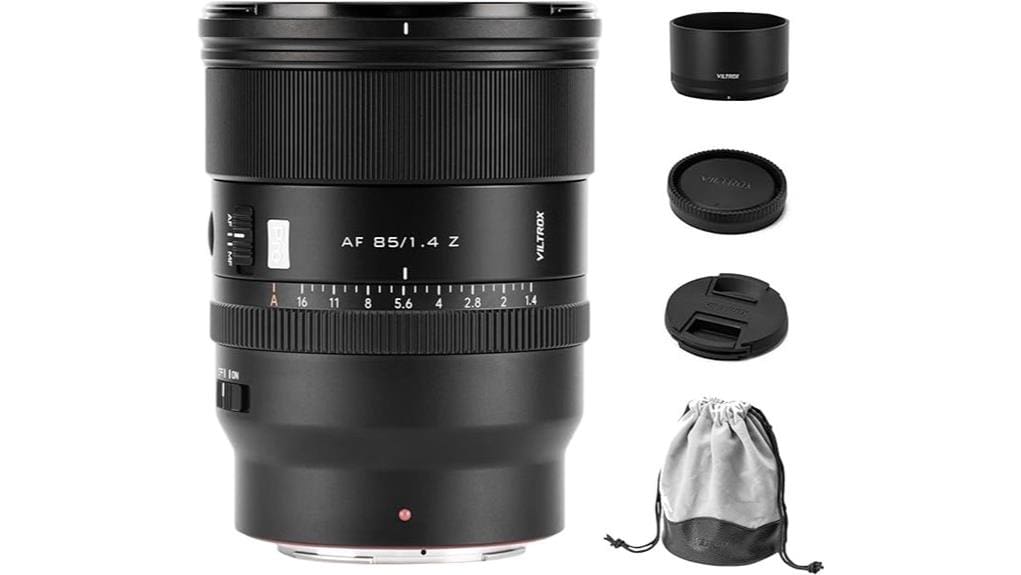

You’ll find the VILTROX AF 85mm f/1.4 is a purpose-built Nikon Z full-frame portrait lens that gives you exceptional center sharpness at f/1.4, smooth nine-blade bokeh, and strong low-light performance. Its 15-element, 11-group optical formula uses HR, ED, and aspheric elements plus coatings to control flare and CA. Dual HyperVCM delivers rapid, quiet AF, while a click-switchable aperture ring and assignable FN make hybrid photo/video work efficient — keep going to see detailed test results and handling notes.
Some Key Takeaways
- Fast f/1.4 aperture delivers strong low-light performance and creamy background separation ideal for portraits and weddings.
- Optical formula (15 elements/11 groups) with 3 ED and aspheric elements yields excellent center sharpness and minimal chromatic aberration.
- Dual HyperVCM AF provides reliable, quiet autofocus suitable for hybrid photo and video workflows.
- Nine-blade diaphragm and smooth bokeh produce pleasing out-of-focus highlights and subject isolation.
- Heavier build than some rivals, but durable controls, click-switchable aperture, and weather sealing suit professional use.
What the VILTROX AF 85MM F/1.4 Is and Who It’s for
While designed for Nikon Z full-frame bodies, the Viltrox AF 85mm f/1.4 targets photographers who need a fast, optically advanced short telephoto for portraits, low-light work, and subject isolation. You’ll appreciate its engineered optical formula—multiple specialized elements reduce chromatic aberration and distortion while delivering high center sharpness at f/1.4. The lens suits portrait photographers and studio portraits with controlled backgrounds, wedding shooters needing reliable low-light AF and creamy bokeh, and street photographers seeking subject separation without bulky gear. You’ll find robust build, tactile controls, and autofocus optimized for critical focus tasks across common Z-series camera bodies. It’s a strong choice for photographers comparing portrait camera lenses for their gear kits.
Key Specs That Matter: Optics, Aperture, AF, and Controls
Because the 85mm F1.4 combines a complex optical formula with fast aperture mechanics and a modern AF drive, understanding its core specs helps you predict real-world performance. The lens uses 15 elements in 11 groups—including 9 high-refractive elements, 3 ED elements and one ultra-precision aspheric—to minimize chromatic aberration and distortion. Optical coatings reduce flare and maintain contrast across stops. The F1.4 aperture gives maximum light and shallow depth control while a click-switchable aperture ring supports both stills and silent video. Dual HyperVCM AF delivers rapid, quiet focusing. Physical controls include an FN switch; basic weather sealing improves field reliability. This makes the lens a compelling choice for enthusiast photographers seeking specialized lens gear.
Real-World Performance: Sharpness, Bokeh, Low-Light, and Autofocus
Having covered the lens’ optical formula, aperture mechanics and controls, we can now evaluate how those elements perform in real shooting conditions. You’ll notice outstanding center sharpness wide open at f/1.4: portraits render fine detail with minimal chromatic aberration. Stopping to f/2.8–f/4 tightens microcontrast and extends usable edge resolution. Bokeh is smooth with excellent background separation thanks to the optical design and nine-blade diaphragm; highlights remain controlled. Dual HyperVCM yields reliable focus speed and consistent acquisition in typical scenarios. Low light responsiveness is excellent—large aperture plus efficient AF deliver usable exposures and fast subject locking in dim environments. This makes the lens a strong choice for enthusiast photographers seeking high-quality portrait optics.
Handling, Features, and Customization for Photo vs Video
If you shoot both stills and video, the Viltrox AF 85mm f/1.4 gives you tactile and functional controls that adapt cleanly to either workflow: an aperture ring with a click switch lets you choose precise, stepped changes for photography or silent, smooth adjustments for video, an assignable FN switch provides quick access to common functions, and the lens’ compact heft and focus ring damping balance well for handheld portrait work and gimbal use. You’ll appreciate the Ergonomics tweakability: torque on the focus ring is consistent, button placement is logical, and the build supports repeatable, quiet operation. Video friendly features include clickless aperture and low-drive AF smoothing. The lens pairs nicely with stabilizers for steady handheld and gimbal shooting, especially when used with a camera stabilizer.
Verdict and Buy Guidance: Strengths, Weaknesses, and Who Should Buy
You’ve seen how the lens’ handling and customizable controls make it adaptable for both photo and video workflows; now let’s assess whether its optical and mechanical strengths justify a purchase. You’ll get exceptional center sharpness at f/1.4, near edge-to-edge uniformity by f/8, minimal chromatic aberration, and strong bokeh from the large aperture. Dual HyperVCM AF and durable controls suit mixed shooting. Weaknesses: slightly heavier build, and some competitors offer faster AF or lighter optics. Recommendation: Portrait buyers and hybrid content creators will benefit most; if cost is critical, consider budget alternatives with trade-offs in sharpness or aperture. This lens pairs well with lens mount adapters for creatives who want to expand compatibility across camera systems.
Some Questions Answered
Does It Include Image Stabilization (Ibis or OIS)?
No, it doesn’t include optical stabilization; the lens lacks built-in OIS. You’ll rely on camera sensor compensation (IBIS) in supported Nikon Z bodies for stabilization. Technically, the lens employs precise optics and fast AF but offers no internal stabilization mechanism, so frame-to-frame motion control depends on body IBIS performance and shooting technique. For low-light handheld work, you should pair this lens with a Z camera that provides effective sensor compensation.
What Is the Lens’s Weather-Sealing Rating?
There’s no official weather-sealing rating; you won’t find an IP code for this lens. Viltrox’s materials and build suggest basic dust and moisture resistance, but they don’t publish formal weather sealing claims or environmental testing data. You should assume limited protection: avoid heavy rain, prolonged exposure, or immersion. If you need robust sealing, pair with a weather-sealed camera body or choose a lens with explicit IP/IPX certification and documented environmental testing.
How Close Is the Minimum Focusing Distance?
You can focus as close as 0.85 meters, giving practical close focus for portraits and detail work. That minimum focusing distance yields a maximum magnification ratio of about 0.12×, so subjects will appear modestly enlarged but not true macro. You’ll get strong subject separation with F1.4, while the optical design preserves contrast at close range. Use the aperture and AF system to optimize sharpness and framing at that distance.
Does It Support In-Camera Firmware Updates?
Yes — you can update the lens via in-camera firmware updates when your camera supports firmware transfer. You’ll attach the lens to a compatible Nikon Z mount body, use the camera’s firmware update utility to transfer the lens firmware, and follow on-screen prompts. Confirm mount compatibility and camera firmware version before starting, back up settings, keep battery charged, and avoid power loss during transfer to prevent bricking.
What Is the Filter Thread Diameter?
The filter diameter is 77mm. You’ll find this measurement critical for accessory compatibility, ensuring standard screw-on filters, caps, and matte boxes fit securely. Given the lens’ optical design and large F1.4 aperture, using high-quality 77mm filters preserves edge-to-edge sharpness and minimizes vignetting. When selecting accessories, confirm thread pitch and use step-up rings if needed so you don’t compromise autofocus performance or introduce additional aberrations.