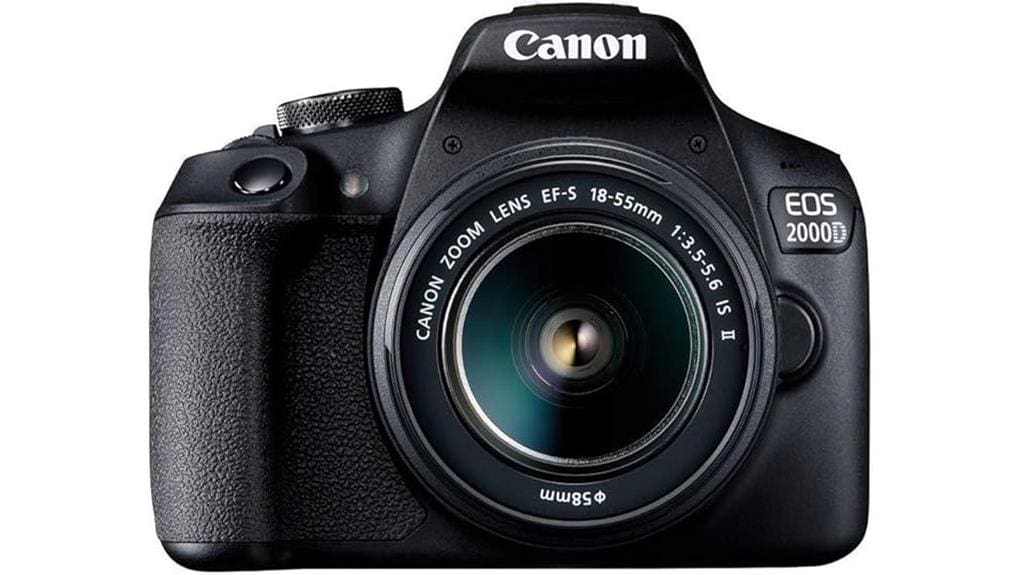

You’ll find the Canon EOS 2000D (Rebel T7) a simple, budget DSLR that’s great if you’re starting photography or need a lightweight travel camera with Wi‑Fi sharing. Its 24.1MP APS‑C sensor produces detailed stills at low ISOs, but the DIGIC 4+ processor, nine‑point AF and 3 fps burst limit speed and low‑light performance. Battery life is modest and video is 1080/30p. If cost, lens compatibility or learning are priorities, it’s sensible — more specifics follow.
Some Key Takeaways
- 24.1MP APS‑C sensor delivers good detail and RAW latitude for prints and cropping, but struggles with high ISO noise.
- DIGIC 4+ processor provides basic image processing and modest performance, without modern speed or advanced features.
- Nine‑point phase‑detect AF is reliable for static subjects but limited for tracking and action photography.
- Lightweight, compact body with Wi‑Fi/NFC suits travel and casual sharing, though battery life and single card slot are modest.
- Best value used/refurbished for beginners or backup use; lacks IBIS, 4K, and newer autofocus features found in modern alternatives.
Practical Overview: Who the Canon EOS 2000D (Rebel T7) Is Best For
While it’s not aimed at pros, the Canon EOS 2000D (Rebel T7) suits beginners and budget-conscious hobbyists who want a reliable entry into DSLR photography. You’ll find a straightforward control set, durable kit lens options, and a 24MP APS-C sensor that balances detail with manageable files. It’s ideal if you’re a beginners photographers learning composition, exposure basics, and lens handling without spending much. Budget travelers will appreciate the light weight, Wi‑Fi sharing, and refurbished availability that lowers cost. You won’t get cutting-edge speed or pro features, but you’ll get dependable image quality for learning and travel. Suitable accessories like essential gear can further improve your shooting experience.
What the 2000D’s Key Specs Mean for Everyday Shooting
Having covered who the 2000D suits, let’s look at how its headline specs actually affect shooting day to day. You’ll appreciate the 24.1MP APS-C sensor benefits: good detail for prints and cropping, plus RAW support for editing. DIGIC 4+ keeps processing simple, though autofocus is basic with nine points, so you’ll rely on composition more than tracking. 3 fps and single memory card limit action and workflow speed. The kit lens covers everyday focal lengths but has modest apertures. At 427 g the body is comfortable to carry—clear portability tradeoffs versus mirrorless: longer lens lineup but slightly bulkier system overall. For mirrorless shooters considering accessories and lenses, pairing the 2000D with essential gear like quality lenses and bags can improve the overall experience and system ergonomics essential gear.
Real-World Image, Autofocus, and Low-Light Performance
Because the 24.1MP APS-C sensor and DIGIC 4+ processor prioritize clean detail over lightning-fast performance, you’ll get well-resolved images at base ISOs with good latitude for RAW editing but noticeably more noise as you push sensitivity. In real-world sharpness tests the kit 18–55mm lens gives pleasing results center-to-edge at wider apertures, though diffraction and softer corners appear stopped down. Phase-detect AF with nine points is reliable for static subjects but conservative for action; low light autofocus can hunt and slow acquisition, especially in Live View. Overall, the 2000D rewards careful technique and stable support for best outcomes. Using high-speed memory cards can improve write times and buffer recovery for extended shooting sessions.
Handling, Battery Life, Connectivity, and Video for Vlogging and Travel
Those image-quality trade-offs also shape how you’ll use the 2000D day to day: its compact, lightweight DSLR body feels comfortable for travel but requires mindful handling for steady shots and vlogging. You get compact handling that’s ergonomic for one-handed walks, though lack of in-body stabilization means you’ll rely on lenses or a gimbal. Battery life is modest; plan for spare LP‑E10 cells on multi-day trips since batteries aren’t included. Video is limited to 1080/30p with a fixed screen angle, while basic connectivity via Wi‑Fi and NFC lets you transfer clips and control the camera remotely for simple vlogs. For longer shoots and travel, consider keeping multiple spare batteries and a portable charger to keep shooting.
Is It Worth Buying in 2026? Alternatives and Buying Advice
Even though the EOS 2000D is a capable entry-level DSLR, in 2026 you’ll only want it if you prioritize low cost and a familiar Canon DSLR workflow over newer features like in-body stabilization, higher-resolution sensors, and 4K video. If you buy refurbished or from used markets, expect basic performance: 24MP APS-C, 1080p30, 3fps. It’s fine for learning, casual stills, or as a secondary body, but don’t expect futureproofing. Consider alternatives with sensor upgrades, IBIS, or 4K—older Canon M-series, Canon EOS Kiss/M50 II, or budget Sony APS-C bodies. Buy only for price, lens compatibility, or nostalgia. Gear Guide for Enthusiast Photographers and Camera Fans is a good place to compare prices and specs for used camera gear, especially when evaluating older DSLRs and mirrorless options like the EOS 2000D for camera enthusiasts.
Some Questions Answered
Does the 2000D Support USB Charging for Batteries?
No — it doesn’t support USB battery charging. You’ll need to charge the LP‑E10 battery in an external charger rather than via a usb cable or camera port. You can power the camera with some USB power banks using a dummy battery adapter, but that’s a workaround and has charging limitations: it won’t charge the battery itself, may require specific voltage/current, and can be unreliable. Follow safety and manufacturer guidance.
Can I Use Third-Party Lenses Without Issues?
Yes — you can use third-party lenses, but check Lens compatibility and mount (EF/EF-S). You’ll get good basic exposure and metering, and most third-party lenses will work for stills. Autofocus performance can vary: inexpensive or older third-party lenses may focus slower or less accurately, especially in low light or Live View. You should test specific lens models for AF speed, firmware compatibility, and any feature limitations before heavy use.
Is There a Built-In Intervalometer for Timelapses?
No — there’s no built in intervalometer. You’ll need an external intervalometer or a tethering app to automate timelapse capture. That limitation means you’ll manually trigger many frames or rely on accessories, which can add cost and complexity. Also note timelapse limitations: movie length (1080/30p), no in-camera exposure ramping, and modest battery life. For reliable results, plan power, storage, and use a dedicated interval controller or tethered computer.
Does It Have Weather Sealing for Outdoor Shoots?
No — it doesn’t have weather sealing for outdoor shoots. You shouldn’t rely on weather protection; the refurbished body isn’t designed or seal tested for dust or moisture resistance. If you’ll shoot in rain or dusty conditions, you’ll want added protection like a rain cover, plastic bag, or weather-sealed lens and rig. Don’t assume internal seals; the camera’s entry-level construction and refurb status mean it wasn’t built or verified for harsh environments.
Can Firmware Be Updated by the User?
Yes — you can update the firmware yourself. You’ll download Canon firmware updates from the Canon support site, copy the update to an SD card, insert it into the camera, and follow on-screen prompts to install. Firmware updates improve stability and add features; user access is straightforward but you shouldn’t power off mid-update. Back up settings and battery charge fully before starting to avoid issues during the firmware updates process.