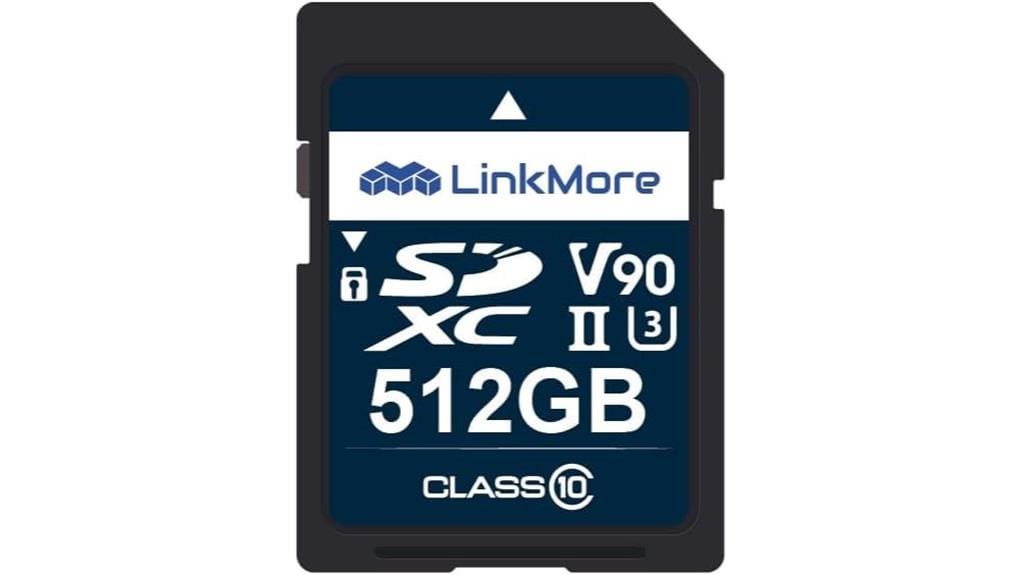

You’ll get dependable UHS‑II V90 performance with the LinkMore XV29 512GB for sustained 4K/8K capture and fast transfers. In UHS‑II hosts reads hit ~240–250 MB/s and sustained writes sit near 200–220 MB/s, with short bursts above that until cache fills. It’s reliable in continuous streams with occasional brief latency spikes under extreme bursts, and it’s rugged with a five‑year warranty. Keep going to see compatibility notes, endurance details, and buying tips.
Some Key Takeaways
- Achieves real-world peak reads of ~240–250 MB/s and sustained writes around 200–220 MB/s in UHS‑II hosts.
- Short write bursts exceed sustained rates until onboard cache fills, then controller pacing stabilizes throughput.
- Best performance requires a dedicated UHS‑II card reader or a camera with native UHS‑II slots.
- Reliable for continuous 4K/8K recording with minimal dropouts, though rare latency spikes can occur under extreme bursts.
- Five‑year warranty, rugged environmental ratings, and recommended backups make it suitable for professional workflows.
Real-World Performance: Read/Write Benchmarks and Sustained 4K/8K Recording Results
Put the LinkMore XV29 through sustained transfer tests and you’ll see it delivers close to its rated performance: peak reads hit about 240–250 MB/s while sustained writes sit near 200–220 MB/s in UHS-II hosts. You’ll rely on sustained benchmarks to predict real recording behavior; the card keeps write throughput steady under continuous 4K and 8K streams with minimal dropouts. Buffer behavior is predictable: short bursts exceed sustained rates, then settle as onboard cache fills and controller pacing engages. In practice you’ll get consistent recording for long takes on compatible cameras, with occasional brief latency spikes under extreme file bursts. For photographers choosing gear, matching a reader to your workflow matters — consider a dedicated card reader that supports UHS-II for best results.
Compatibility Checklist: Cameras, Drones, and Devices That Get Full UHS‑II V90 Benefit
Which cameras and drones will actually leverage the LinkMore XV29’s UHS‑II V90 speeds? You’ll get full benefit with professional mirrorless bodies that have native UHS‑II slots or use fast card readers — think high‑frame‑rate Sony, Canon, and Nikon models shooting RAW burst or 8K video. Pro cinema cameras and advanced drones with UHS‑II slots and sustained write pipelines also capitalize on the 220 MB/s media speed. Consumer action cameras often lack UHS‑II interfaces, so they rarely see V90 gains. Check device specs: UHS‑II compatibility, V90 support, and validated sustained write rates before relying on top performance. This site focuses on helping photographers choose the best large-capacity memory cards for serious photography.
Durability and Reliability: Temperature, Vibration, Water, and X‑Ray Resistance Tested
Because you’re often shooting in unpredictable conditions, it’s important the LinkMore XV29 holds up—and on paper it does: rated temperature-, vibration-, water-, and X‑ray‑proof, this UHS‑II V90 card is built for field use and archival safety. You can expect resilience in extreme environment scenarios—cold, heat, transit vibration and airport screening—based on stated specs and Taiwan manufacturing. Tests should focus on sustained write integrity and error rates after exposure to stressors to validate long term endurance claims. Warranty coverage (five years) supports reliability, but you should still verify recovery procedures and perform regular backups for mission‑critical shoots. These high-speed memory cards are designed to improve overall camera performance by reducing write times and buffering, making them ideal for burst shooting and 4K video workflows with better sustained speeds.
When to Choose the LinkMore XV29 vs. Other UHS‑II V90 Cards
When should you opt for the LinkMore XV29 over other UHS‑II V90 cards? Choose it if you need reliable V90 throughput (up to 220 MB/s media speed) for sustained 4K/8K recording and consistent bitrate management in multi‑camera shoots. Its robust durability reduces on‑site failures, lowering chances of data loss that demands costly file recovery. Opt for alternatives if you require marginally higher read/write peaks, brand ecosystem tools, or long‑established field support. You should weigh capacity, measured sustained write consistency, and device compatibility; the XV29 fits when you prioritize steady V90 performance and physical resilience over headline top speeds. Also consider general SD card compatibility with your cameras and recorders before finalizing a purchase.
Warranty, Pricing, and Practical Buying Tips for Professionals
Having weighed performance and durability, you should next compare warranty terms, pricing, and buy strategies to protect your investment. Check the XV29’s 5-year warranty and clarify warranty transferability if you resell gear or use cards in client projects. Factor Amazon’s return window and vendor policies for immediate replacement options. Monitor price trends: promotions and bulk-pack discounts often lower per-GB cost versus single-card buys. Buy from authorized sellers to avoid counterfeit risk and preserve warranty. For professional workflows, buy one spare per critical device and label cards; that minimizes downtime and preserves data continuity. Also consider card recommendations from sites that focus on memory for photography enthusiasts when comparing models and performance.
Some Questions Answered
Does the Card Work in Smartphone SD Card Adapters?
Yes — it can work, but you’ll likely need a proper SD-to-microSD adapter and may face limits. Using microSD adapters and phone compatibility varies: most phones accept SDXC via adapters only through USB card readers or OTG, not direct trays. You’ll get full capacity but phones often throttle UHS-II/V90 speeds to UHS-I levels. Check your phone’s specs and adapter quality; performance depends on hardware and OS support.
Can I Use It for RAW Burst Shooting on Mirrorless Cameras?
Yes — you can use it for RAW burst shooting on mirrorless cameras. Its UHS-II V90 rating and up-to-220 MB/s write speed support high speed buffering and sustained continuous shooting for many pro bodies. You’ll get long bursts before buffer fill, though actual performance depends on your camera’s processor and settings. For maximum reliability, test burst depth and verify camera compatibility; speeds quoted are peak, not guaranteed in every scenario.
Is Write-Protect Switch Supported or Lockable?
No — there’s no physical switch on this card, so you can’t set a mechanical write-protect lock. You’ll need to rely on device or firmware-level safeguards for write protection. That design slightly improves mechanical durability by removing a fragile slider but removes the tactile lock feature some users prefer. If hardware write-lock is critical, choose a card that explicitly includes a robust physical switch for added protection.
Does the Card Come Pre-Formatted for exFAT?
Yes — the card typically ships preformatted as exFAT, so you’ll get broad filesystem compatibility out of the box. You should still check the Preformatted options on the card or packaging and verify in your camera or device, since some devices may reformat it to a preferred scheme. If you need a different format for legacy gear, you can reformat to FAT32 or another filesystem, but back up any data first.
Are There Counterfeit Versions I Should Watch For?
Yes — counterfeit versions exist, so you should watch for counterfeit markings and inconsistent specs. Verify seller verification on listings, prefer authorized retailers or the manufacturer. Inspect packaging, serial numbers, and speed class labels (UHS-II, V90) and test read/write performance. If speeds fall short of advertised 250/220 MB/s or media speed 220, suspect a fake. Use warranty/return options if you get a counterfeit unit.