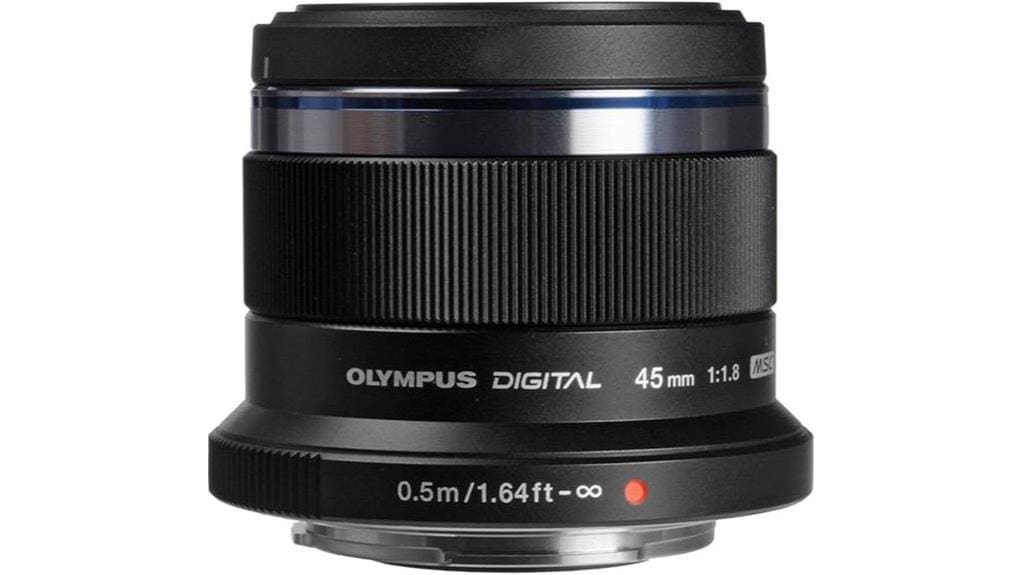
You’ll find the OM System M.Zuiko 45mm f/1.8 is a compact, 90mm-equivalent portrait prime that gives you excellent center sharpness wide open, improved microcontrast by f/2.8–f/4, and smooth seven-blade bokeh for pleasing subject separation. It’s light and fast with a quiet MSC autofocus motor, close-focus at 0.20 m, and NanoAR coatings that limit flare though lateral CA can appear on high-contrast edges. If you want tighter portrait compression with minimal bulk, keep going to see specifics.
Some Key Takeaways
- Compact, lightweight 45mm f/1.8 prime (116 g) ideal for Micro Four Thirds portrait and travel use.
- Excellent center sharpness at f/1.8, with microcontrast and edge uniformity improving by f/2.8–f/4.
- Smooth bokeh from seven rounded blades and close 0.20 m focus for strong subject separation.
- Fast, quiet MSC micromotor autofocus suits hybrid stills/video with minimal hunting and low audio noise.
- Lacks weather sealing and telephoto reach; use 37mm filters and LH-40B hood for best outdoor results.
Overview and Quick Verdict: Who the OM SYSTEM M.Zuiko 45mm F1.8 Is For
Who benefits most from the OM SYSTEM M.Zuiko 45mm F1.8? You will, if you need a compact, fast prime for Micro Four Thirds that balances portrait lighting control with portable, compact handling. Compared with heavier 85mm-equivalents, this 45mm (90mm eq.) gives tighter framing without bulk, aiding subject isolation and off-camera flash routines. You’ll appreciate the silent MSC autofocus for hybrid stills/video workflows and the NanoAR coating for contrast in mixed lighting. It’s aimed at portraitists, street shooters, and travel photographers who prioritize low weight, quick handling, and reliable subject separation over ultra-telephoto reach or macro capability. This lens is a natural fit for users of Micro Four Thirds systems who value compact, lens-centric setups.
Optical Performance: Sharpness, Bokeh, Low-Light and Close-Focus Behavior
Having established its intended users and handling strengths, let’s examine how the M.Zuiko 45mm F1.8 performs optically in real shooting scenarios. You’ll find center sharpness excellent wide open at f/1.8, with microcontrast improving noticeably by f/2.8–f/4; edges lag slightly on Micro Four Thirds sensors, so stop down for uniformity. Bokeh is smooth thanks to seven rounded blades, producing pleasant subject isolation and gradual focus falloff. Chromatic aberration is well controlled by NanoAR coating, with only minor lateral fringing in high-contrast edges. Close-focus at 0.20 m yields strong background separation, useful for portraits and detail work. For photographers who also use tripods, choosing the right tripod head can further enhance compositional precision and stability, especially when working at wider apertures or close focus distances with precision tripod heads.
Autofocus, Handling, and Video Use: MSC Motor, Weight, and Real-World Operation
Because Olympus equipped the 45mm f/1.8 with an MSC micromotor, autofocus is both fast and quiet, making it well-suited to hybrid shooters who switch between stills and video. You’ll notice MSC motor performance delivers predictable acquisition and minimal hunting compared with older micromotors; Silent focusing reduces audio contamination during recording. At 116 grams the lens enables lightweight handling and steadier handheld framing, improving gimbal balance and run-and-gun workflows. For video you get responsive focus shifts and reduced focus noise, though you’ll still rely on camera body stabilization and manual control for complex pulls. Overall: compact, Video ready, and operationally efficient. This makes it a great option for mirrorless photographers who prioritize portability and system-specific accessories like lenses and adapters mirrorless camera gear.
How It Compares to Similar Micro Four Thirds Primes (45mm Vs 42.5mm, 50MM Equivalents)
While focal lengths cluster around the classic 50mm field of view on full-frame, the OM SYSTEM 45mm f/1.8 maps to a 90mm equivalent on Micro Four Thirds and sits between the common 42.5mm (85mm equiv.) and 50mm (100mm equiv.) options, so you’ll notice subtle but practical differences in framing, compression, and working distance. You’ll find the 45mm offers slightly tighter framing and more subject isolation than 42.5mm, improving portrait compression without drastic reach. Compared objectively, sharpness and bokeh quality are comparable; focal length nuances affect composition and perspective more than optical resolution. Expect minor color rendering differences across manufacturers and coatings. The site specializes in helping photographers choose the best portrait optics with reviews and comparisons for different Micro Four Thirds primes, including focal length and use-case guidance for portrait lenses.
Buying Guide: Accessories, Compatibility, Pros/Cons, and Final Recommendation
After comparing the 45mm’s framing and rendering to nearby primes, you should match accessories and use-cases to that slightly longer portrait reach. Check mount compatibility with Micro Four Thirds bodies and pack lens caps; in-box front and rear caps cover basic protection. Consider 37mm filter options for ND or polarizer use and the LH-40B hood for flare control. Pros: compact 116 g build, f/1.8 low-light, pleasing bokeh, fast MSC AF. Cons: not weather-sealed, modest focal length flexibility. Recommendation: buy if you want a lightweight, sharp portrait prime for Olympus/Panasonic systems; add filters and a hood. For outdoor shoots, pair the lens with a sturdy heavy-duty tripod to stabilize longer exposures and compositional framing.
Some Questions Answered
Does This Lens Have Weather Sealing for Outdoor Use?
No — it isn’t fully weather sealed. You’ll find the lens lacks a weather resistant design and doesn’t include a sealed mount gasket, so it’s more vulnerable than Olympus pro-grade lenses. Technically, its build is light and compact for controlled conditions; comparatively, it offers no official dust/moisture protection. You should avoid heavy rain or dusty environments unless you use extra protection like a weather cover, rain sleeve, or sealed camera body.
Can the Lens Be Adapted to Non-Mft Mounts?
Yes — you can adapt it to non-MFT mounts using appropriate adapter options, but mount compatibility varies. You’ll need a passive adapter that maintains register distance for MFT to larger mounts (e.g., Sony E, Fuji X via glassless adapters) or a focal-length-altering adapter for DSLR mounts. Expect manual aperture control or loss of autofocus depending on camera electronics. Comparatively, native MFT use preserves full AF and metadata; adapters trade convenience for versatility.
Is There a Focus Limiter or Manual Focus Clutch?
No, it doesn’t have a focus limiter or manual focus clutch. You get a smooth focus ring feel with micromotor-driven MSC autofocus that’s quiet and fast, but no mechanical clutch to switch to manual instantly. Compared to lenses with dedicated limiters or clutch, you’ll rely on camera-assist features (focus peaking, magnification) and the aperture ring absence means manual control focuses via focus ring only; tactile resistance is light and precision-focused.
How Compatible Is the Lens With Third-Party Lens Hoods/Filters?
You’ll find strong third party compatibility: the lens uses a common 37 mm thread, so third party filters and slim hoods fit reliably. Filter sizing is standard 37 mm, making adapters, polarizers and ND filters widely available. Compared to proprietary bayonet hoods, screw-on third party hoods may sit slightly less flush but remain functional. Optically, reputable third party filters match OEM results; cheaper options can introduce vignetting or color cast.
Are Firmware Updates Available for Lens Performance Improvements?
Yes — firmware updates can be available for lens performance tuning, though availability varies by model and release cycle. You’ll check OM SYSTEM/Olympus support pages for lens firmware or for camera body updates that improve lens behavior. Comparatively, body firmware often yields larger autofocus and stabilization gains than lens-only updates. You should apply updates per manufacturer instructions and compare changelogs to confirm whether a specific firmware version addresses your desired performance tuning.