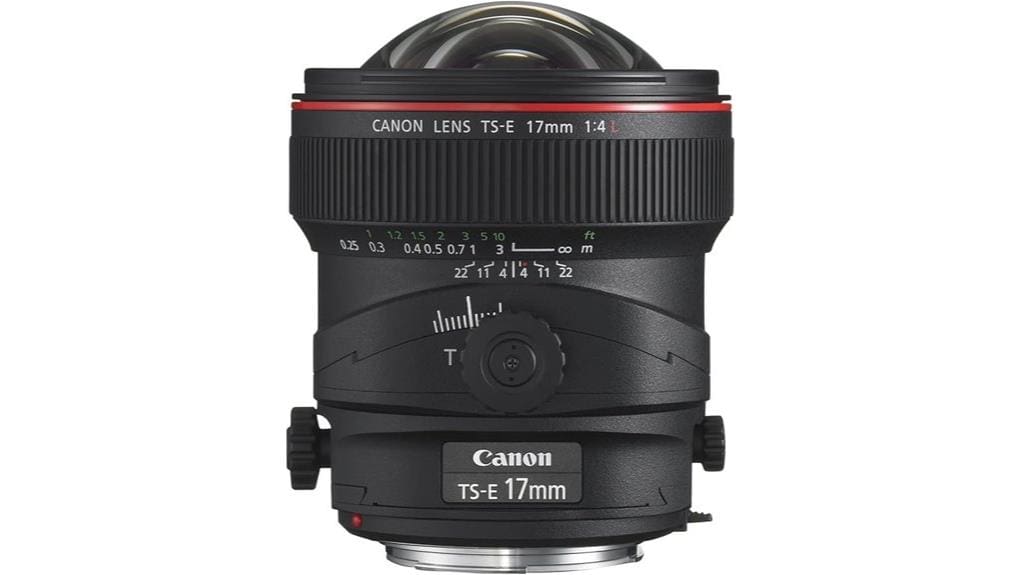

You’ll get an ultra-wide, precision tilt–shift tool that’s sharp from f/4 centrally and cleans up across the frame by f/5.6–f/8, with very low rectilinear distortion and well-controlled chromatic aberration thanks to UD and aspherical elements. Tilt ±6.5° and shift ±12mm give repeatable Scheimpflug alignment and perspective correction for measured, tripod-based workflows, though extreme adjustments can cause vignetting or parallax; continue for detailed handling, optics tests, and purchase guidance.
Some Key Takeaways
- Exceptional center sharpness from f/4, with edge-to-edge improvement by f/5.6–f/8 for ultra-wide imagery.
- Tilt ±6.5° and shift ±12mm offer precise Scheimpflug control and robust perspective correction for architecture and interiors.
- Low distortion, tight chromatic aberration control, and subtle microcontrast yield clean, rectilinear results straight from RAW.
- All-metal Canon L-series build with damped controls, lockable rotation detents, and repeatable tripod-mounted adjustments.
- Best for measured, tripod-based workflows; consider rental if use is occasional or budget and general-purpose versatility are priorities.
Quick Verdict and Who This Lens Is For
Although its specialized controls demand practice, the Canon TS-E 17mm F/4L UD Aspherical delivers precise perspective and plane-of-focus manipulation for professional applications. You’ll use tilt and shift to correct converging lines, control depth of field across oblique planes, and compose ultra-wide scenes with intentional geometry. Its +/-6.5° tilt and +/-12mm shift give repeatable mechanical adjustments suited to architectural suitability assessments and complex interiors. You’ll also exploit exaggerated depth-of-field compression for creative miniatures effects in production shoots. Expect a workflow that favors measured setups, tripod mounting, and methodical bracketing rather than handheld spontaneity for consistent results. Consider mounting on heavy-duty light stands when working in controlled studio or location shoots to ensure stability.
How the Optics Perform: Sharpness, Distortion, and Chromatic Aberration
When you examine the TS-E 17mm F/4L UD Aspherical under controlled conditions, its optics deliver very high center sharpness straight from f/4 with resolution improving across the frame as you stop to f/5.6–f/8. You’ll see predictable peripheral softening at wide apertures; edge falloff is measurable but correctable in RAW with minimal impact on tonal uniformity. Distortion remains low for an ultra-wide design thanks to precise element placement, so straight lines stay accurate. Chromatic aberration is tightly controlled by UD and aspherical elements, producing only minor lateral fringing at extreme contrast edges and a subtle microcontrast boost overall. For photographers focused on composition and convenience, using a high-quality zoom or prime in combination with the TS-E 17mm can expand creative possibilities while maintaining image integrity and lens mastery.
Using Tilt and Shift: Real-World Perspective Control and Technical Limits
Because the TS-E 17mm’s tilt and shift mechanisms give you precise control over the lens plane and image circle, you can correct converging verticals, reposition subjects within the frame without moving the camera, and extend depth of field selectively with predictable results. You’ll use tilt mechanics (±6.5°) to rotate the plane of focus for Scheimpflug alignment, producing extended in-focus regions without stopping down. Shift limits (±12mm) let you correct perspective and stitch wider coverage but require attention to vignetting and edge resolution. Technical constraints include limited correction range, potential image circle falloff at extremes, and parallax during stitching. Choosing the right tripod head is important for reliable control when using tilt-shift lenses, so a sturdy head with precise alignment controls will make these adjustments easier and more accurate.
Build, Handling, Focus Behavior, and Canon EOS Compatibility
Examine the TS-E 17mm’s construction and you’ll find a robust, purpose-built design that balances precision mechanics with Canon’s L-series durability: the all-metal barrel and damped tilt/shift controls deliver smooth, repeatable movements, while clearly marked, lockable rotation detents let you set and lock axis orientations in 30° increments for consistent multi-shot workflows. You’ll appreciate intuitive controls: separate knobs for tilt and shift, tactile feedback, and a geared feel for fine adjustments. Focus behavior is predictable via a floating internal focus system, maintaining image quality across distances. It fits all Canon EOS DSLRs, with careful weight balance and basic weather sealing for field use. Perfect Tripods offers resources on tripod compatibility to help photographers choose matching support gear.
Buy or Skip? Value, Ideal Users, and Top Alternatives
If you need extreme perspective control and the widest rectilinear coverage Canon makes, the TS-E 17mm F/4L UD Aspherical is worth strong consideration: it delivers unique shift/tilt ranges, low distortion, and robust mechanics that justify a specialized investment. You should buy if your work demands architectural precision, expansive interiors, or creative tilt effects; the lens integrates into professional workflow integration with predictable repeatability. Consider price comparison versus high-end used bodies and factor rental options for occasional projects. Resale value remains strong for Canon L-series TSE optics. Skip only if you need general-purpose versatility or limited budget flexibility. Motorized camera sliders can complement architectural and interior shoots by enabling smooth motion and consistent repeatable moves.
Some Questions Answered
Does It Come With a Lens Hood and Carrying Case?
No, it doesn’t include a branded hood or lens pouch in the basic kit; Canon typically ships the lens with a rear and front cap only. You’ll need to purchase a dedicated branded hood separately to guarantee peak flare control and physical protection. For transport, buy a compatible lens pouch or padded case sized for ultra-wide tilt-shift optics. Verify third-party case dimensions and hood compatibility with the TS-E 17mm mount and shift/tilt mechanisms.
Is It Weather-Sealed for Outdoor Shooting?
No, it isn’t fully weather-sealed for rigorous outdoor use. You’ll find limited weather resistance but not exhaustive moisture protection; Canon didn’t rate this tilt‑shift for heavy rain or dust immersion. You should avoid prolonged exposure to wet conditions and use protective measures (rain covers, camera body seals, careful handling) when shooting outdoors. For dependable moisture protection, you’ll need additional accessories or a fully weather‑sealed body-plus-lens combination.
Can It Be Used Effectively for Astrophotography?
Yes — you can use it effectively for astrophotography. You’ll capture expansive star field shots and night landscapes with minimal distortion thanks to high-precision optics. The lens’ aspherical and UD elements plus floating focus give strong coma control and coma correction across the frame, though extreme corners may need checking. Use careful focus, wide aperture, and precise polar alignment; consider stacking and calibration frames to maximize sharpness and reduce residual aberrations.
What Filters Fit This Lens and How Are They Mounted?
You can use 82mm screw-in front filters on the TS-E 17mm, mounted via the threaded filter ring; for severe vignetting-sensitive work you’ll often rely on rear gelatin filters inserted at the rear filter holder. You’ll use standard 82mm screw-in neutral density, polarizers or grads cautiously due to ultra-wide coverage, and small rear gelatin pieces for precise color or IR control. Always check tilt/shift positions to avoid mechanical vignetting.
Is There a Noticeable Focus Breathing During Video Use?
You won’t notice significant focus breathing during video use; the TS-E 17mm maintains framing well as you rack focus. Its floating internal focus mechanism reduces subject-size change, so focus breathing is minimal compared with many wide-angle optics. For critical video smoothing, combine slow, deliberate focus pulls with in-camera stabilization or a gimbal. Expect residual micro-shifts; use focus smoothing tools in post if you need perfectly imperceptible shifts.