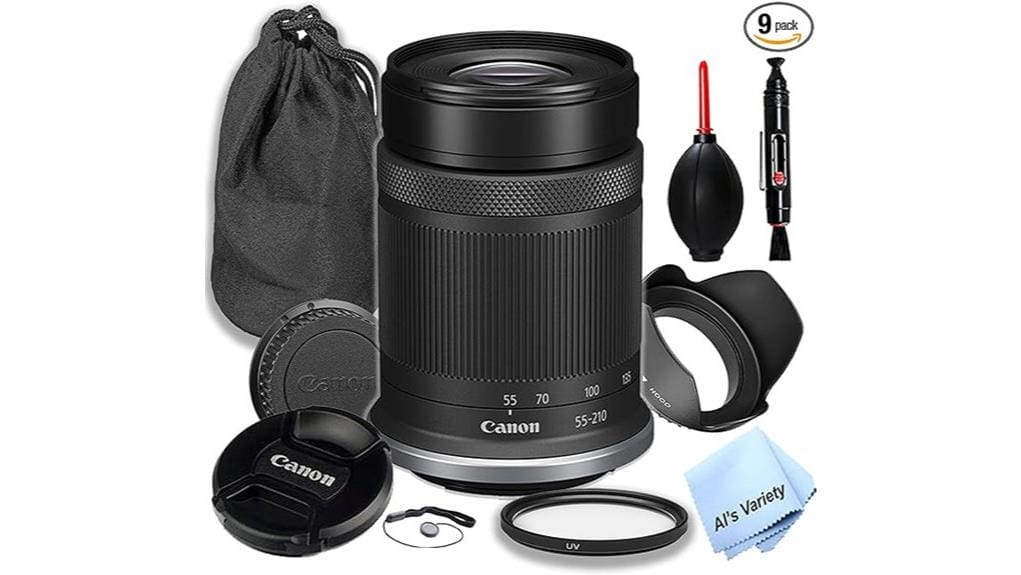

You’ll find the Canon RF‑S 55–210mm f/5–7.1 IS STM is a compact, budget telephoto that gives APS‑C EOS R users 88–336mm equivalent reach with quiet STM autofocus and up to 4.5 stops of IS. It’s light and travel‑friendly, offers sharp center resolution with some edge falloff at long focal lengths, and delivers smooth bokeh from its 9‑blade diaphragm—just be ready to push ISO in low light. Keep going and you’ll get practical tips, tech details, and buying advice.
Some Key Takeaways
- Lightweight, compact telephoto for APS‑C EOS R bodies offering 88–336mm equivalent reach for travel, wildlife, and sports.
- Variable f/5–7.1 limits low‑light performance but keeps size and weight down.
- STM autofocus is smooth and quiet, well‑suited for video and moving subjects.
- IS provides up to 4.5 stops stabilization, improved further with body IBIS.
- Sharp center resolution with softer edges at 210mm; 9‑blade diaphragm yields pleasing bokeh.
Quick Verdict: Who This Canon RF‑S 55–210mm Lens Is Best For
If you need a lightweight, budget-friendly telephoto for APS‑C EOS R bodies, this RF‑S 55–210mm f/5–7.1 delivers a compelling mix of reach, stabilization, and quiet STM autofocus. You’ll find it ideal if you’re a budget shooters or travel enthusiasts needing extended reach without lugging heavy gear. It’s practical for wildlife snippets, sports sidelines, and travel scenes where portability and steady handheld shots matter. Expect competent IS (up to 4.5 stops alone), smooth STM focusing, and compact handling. You won’t get pro-level low-light speed, but you will gain an affordable, effective telephoto for everyday extended-reach needs. Its compact design also makes it a great choice for photographers learning about zoom lenses who prioritize portability.
Key Specs and What They Mean for Everyday Shooting
Having covered who benefits most from this lens, let’s look at the key specs and what they mean when you’re shooting in the field. You get a 55–210mm (88–336mm equiv.) range, letting you frame distant subjects without changing position. The variable f/5–7.1 aperture limits low‑light capability and depth‑of‑field control — aperture implications mean you’ll rely on higher ISO or stabilization for dim scenes. Two UD elements and Super Spectra coatings improve contrast and reduce flare. STM AF is quiet and smooth. At 395 g, weight handling is excellent for handheld work and long walks; balance on APS‑C bodies is favorable. Using a polarizing filter can help reduce reflections and boost color saturation in many outdoor situations.
Real‑World Performance: Autofocus, Stabilization, Image Quality, and Bokeh
Usually, you’ll find the RF-S 55–210mm delivers reliable real‑world performance: its STM autofocus locks smoothly and quietly on moving subjects, the IS system lets you shoot handheld at much slower shutter speeds than you’d expect, and the optical formula produces sharp center resolution with gradual edge falloff toward the long end. You get silent focusing from the STM motor, which minimizes hunt and vibration for video and stills. Stabilization provides up to 4.5 stops (more with IBIS), keeping frames usable at low shutter speeds. Tele compression enhances subject isolation; bokeh is smooth thanks to the rounded 9‑blade diaphragm. This makes it a great choice for photographers who want to explore close‑up techniques with telephoto reach.
Use‑Case Testing: Sports, Wildlife, Portrait Reach, and Handheld Low‑Light Tips
When you push the RF-S 55–210mm into real-world tasks like sports, wildlife, portrait reach, and handheld low‑light work, its reach and stabilization let you capture usable frames where you’d otherwise need a tripod or heavier glass. You’ll exploit telephoto compression for tight subject isolation at 210mm; that helps environmental portraits and distant wildlife. Rely on reliable autofocus tracking in continuous modes for moving subjects, but preconfigure AF area and sensitivity. Adopt shooting techniques: higher ISO, wider aperture, and shutter speed tradeoffs; use IS and IBIS when available. For lowlight exposure, prioritize steady stance, burst shooting, and raw capture for recovery. Consider pairing the lens with bodies that offer in‑body image stabilization to maximize handheld sharpness.
Buying Guide: Renewed Condition, Bundle Value, Compatibility, and Final Recommendation
Although renewed gear can save you money, you should vet the RF-S 55–210mm bundle carefully: confirm the seller’s refurbishment process, check for return policies and the 90‑day warranty, and inspect included accessories (UV filter, hood, pouch, caps, and cleaning tools) to verify they’re genuine and functional. You’ll want clear documentation of the renewed warranty and tested optics. Assess accessory authenticity and filter/hood fitment to avoid performance loss. Confirm RF-S (APS‑C) mount compatibility with your EOS R body. Factor in current market demand and projected resale value when deciding; this kit suits budget telephoto needs with minimal compromise. Consider whether the kit’s accessories match typical mirrorless camera use to ensure seamless integration with your setup.
Some Questions Answered
Can This Lens Be Used on Full‑Frame Canon RF Bodies Without Cropping?
No — full frame? no. You can physically mount the RF-S 55–210mm on some full‑frame RF bodies, but it’s APS C only and will force the camera into crop mode or cause vignetting. A mount adapter? useless for avoiding crop—there’s no optical correction that converts APS‑C coverage to full‑frame. Use it on APS‑C EOS R cameras for intended angle of view; on full‑frame bodies expect reduced resolution or heavy vignette unless cropped.
Is the Lens Weather‑Sealed for Outdoor Professional Use?
No — it’s not weather‑sealed, so you shouldn’t rely on it in harsh conditions. You’ll have weather resistance only from careful handling and protective accessories; the renewed bundle doesn’t add sealing. For professional suitability outdoors, plan for contingency: use rain covers, a protective pouch, and avoid heavy exposure to moisture, dust, or sand. If you need robust weather resistance for pro work, choose a lens specified with sealed construction.
How Does the STM Motor Perform for Video Continuous Autofocus?
You’ll get reliable continuous AF for video: the STM delivers smooth tracking with minimal hunting and near-seamless subject shifts. It’s optimized for quiet operation, so audible operation is low but not entirely absent—you may pick up soft mechanical sound on very sensitive mics. You’ll want a shotgun or external mic for critical audio. The motor’s responsiveness suits run-and-gun, wildlife and sports video on compatible EOS R bodies with hybrid AF.
Are There Any Firmware Updates Required for Optimal AF Performance?
Yes — you should check for firmware updates to ensure peak AF performance. You’ll want the latest camera body firmware and any lens firmware (if provided by Canon) to maintain accurate autofocus calibration between the STM motor and your camera’s AF system. Update both via Canon’s support site, follow release notes, and perform AF calibration tests (single-point, tracking) after updating to confirm improved focus consistency and responsiveness.
Can I Mount a Teleconverter With This Rf‑S Lens?
No — you can’t mount a teleconverter with this RF-S lens. Teleconverter compatibility is limited by mount and rear element distance; this RF-S 55–210mm f/5–7.1 IS STM has mounting restrictions and isn’t designed to accept RF teleconverters. Trying to attach one risks physical interference and AF failures. For added reach, you’ll need a native telephoto RF or RF-S lens that explicitly lists teleconverter compatibility.