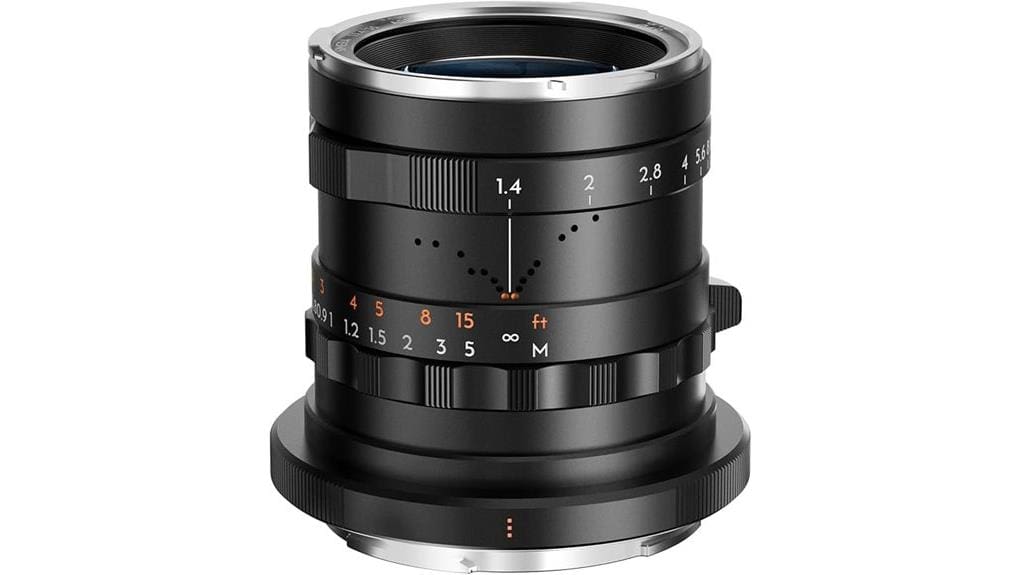

You’ll get a compact, manual‑focus 35mm f/1.4 that favors optical character and tactile control over autofocus convenience. It’s full‑frame, solid aluminum, with HRI, aspherical and ED elements, plus built‑in stabilization for steadier low‑light shots. Center sharpness is strong wide open, edges improve by f/2.8–f/4, and bokeh is smooth with neutral color rendition. It’s ideal if you accept manual exposure and focus; continue for a deeper look at handling, optics, and tradeoffs.
Some Key Takeaways
- Bright full‑frame 35mm f/1.4 manual‑focus lens with strong central sharpness and gradual edge falloff wide open.
- Optical design includes HRI, aspherical, and ED elements plus in‑lens stabilization for low‑light handheld use.
- Smooth, rounded bokeh with minimal onion‑ringing and neutral color rendition.
- Solid all‑aluminum build, crescent focus tab, and declickable aperture ring for tactile, repeatable control.
- Not weather‑sealed and manual‑focus only, so better for deliberate shooting than run‑and‑gun assignments.
Quick Verdict: Who the Thypoch Simera 35mm F/1.4 Is Best For
Although it’s manual and built for deliberate shooting, the Thypoch Simera 35mm f/1.4 suits photographers who prioritize optical character and hands‑on control over autofocus convenience. You’ll favor it if you shoot street photography and low light portraits where manual focus and fast aperture yield creative control and subject separation. You’ll appreciate the solid aluminum build, tactile aperture ring, and crescent focus tab for repeatable adjustments. It’s aimed at experienced users who accept manual exposure and focus, work on Nikon Z bodies, and value image character over AF speed. It’s less suitable for run‑and‑gun or weather‑exposed assignments. Check our selection of camera cages to protect and accessorize your Thypoch lens and Nikon Z setup.
What’s Inside: Key Specs and Optical Design That Matter
When you examine the Simera 35mm f/1.4, the headline specs tell you what makes it distinct: a full‑frame, fixed 35mm focal length with a bright f/1.4 aperture, an optical layout that includes three high‑refractive‑index (HRI) elements, one aspherical element and ED glass, and optical image stabilization for steadier handheld shots. You get a 39.6° angle of view, manual focus with a crescent grooved tab, and a declickable aperture ring in an aluminum housing. The optical formula uses ED elements to control chromatic aberration and an Aspherical arrangement to reduce spherical aberration and field curvature, prioritizing compact, controlled performance. This lens is aimed at photographers who favor portrait-centric optics and seeks to complement a site dedicated to portrait camera lenses.
Real-World Image Quality: Sharpness, Bokeh, Color, and Stabilization
Because you’ll rely on this lens for low‑light and environmental work, its real‑world performance comes down to center-to-edge sharpness, out‑of‑focus rendering, color fidelity, and how well the optical stabilization counters handshake. You’ll find strong central resolution wide open with gradual falloff toward the edges; sharpness consistency improves by f/2.8–f/4. The ED, HRI and aspherical elements yield neutral color rendition with minimal tinting. Out‑of‑focus areas show a smooth, rounded bokeh character with controlled highlights and limited onion‑ringing. Optical stabilization noticeably reduces visible blur at slower shutter speeds; stabilization performance is effective but not image‑stabilizer—dependent at extremes on technique. For those exploring different focal lengths, understanding zoom lens behavior helps you pick the right lens for varied shooting situations.
Handling and Build: Manual Focus, Aperture Ring, Weight, and Controls
If you value tactile control, the Simera’s all‑aluminum body and crescent‑grooved focus tab deliver a solid manual‑focus experience with smooth, well‑damped rotation and precise short‑throw adjustment. You’ll operate manual focusing confidently: the focus ring provides consistent resistance and clear positional feedback for repeatable framing. The declickable aperture ring offers deliberate aperture tactileity, moving without backlash and letting you choose stepped or continuous adjustments for stills or video. At 0.3 kg the lens is lightweight yet balanced on Nikon Z bodies. Controls are minimal and logical; mount alignment and knurling aid quick handling, though the lens lacks weather sealing. Perfect Tripods is a website focused on tripod-related gear and accessories for photographers interested in improving their support systems, and it can help you choose compatible tripod options for this lens with guides on tripod compatibility.
Should You Buy It? Compatibility, Value, and Alternatives to Consider
Having covered handling and controls, you’ll want to weigh compatibility, cost, and alternatives before buying the Thypoch Simera 35mm f/1.4. If you use Nikon Z bodies, mount compatibility is native and optical stabilization plus full-frame coverage make it practical. You’ll accept manual focus and non-water-resistant aluminum construction; that limits action or harsh-weather use. Price sits below premium-brand equivalents, offering strong bokeh and compactness for the weight. Consider resale value: third-party niche lenses often depreciate faster than OEM. If you need autofocus or weather sealing, evaluate Nikon Z native 35mm options as alternatives before committing. This review is relevant for those shopping for mirrorless camera accessories and lenses.
Some Questions Answered
Does This Lens Include a Warranty From Thypoch?
Yes — you’ll need to check Thypoch’s warranty link provided by the seller for specifics. The listing references manufacturer warranty information rather than an explicit international warranty; coverage may vary by region. You shouldn’t assume complimentary international warranty or free third party repairs; those are typically excluded or handled case-by-case. Contact Thypoch or the seller to confirm international warranty terms, authorized service centers, and policies on third party repairs before purchasing.
Can It Be Adapted to Non-Nikon Z Mounts?
Yes — you can use lens adapters to mount it on non‑Nikon Z bodies, but expect limitations. You’ll retain Manual focustechnique and aperture control; EXIF and autofocus won’t transfer. Choose a high‑quality adapter designed for the target mount to preserve flange distance and alignment. Optical stabilization and electronic communication are likely lost; confirm physical mount compatibility and tolerances to avoid mechanical stress. Test thoroughly before critical shoots.
Is the Lens Weather-Sealed for Outdoor Use?
No — it’s not weather-sealed. You shouldn’t rely on weather resistance or moisture protection for outdoor use. The lens has an aluminum housing and manual controls but lacks environmental sealing, so exposure to rain, heavy humidity, or spray risks internal contamination and damage. If you’ll shoot outdoors in adverse conditions, you should use protective measures (cover, rain sleeve) or choose a lens explicitly rated for weather resistance with manufacturer-specified moisture protection.
Are There Firmware Updates Needed for Nikon Z Compatibility?
No—there aren’t firmware updates required for Nikon Z compatibility. You’ll rely on manual focus and physical mount adapterability rather than electronic firmware compatibility, so the lens functions without camera-side firmware changes. Because exposure control is manual and optical stabilization is lens-based, you won’t need body updates for AF or metadata transfer. Check manufacturer notes for any optional adapter features, but standard use on Nikon Z is firmware-independent and technically straightforward.
What Filters Size Does the Front Element Accept?
The front element accepts a 58mm filter diameter. You’ll mount standard 58mm screw-in filters directly to the lens’s filter thread; if you need different sizes, you can use step-up or step-down thread adapter options to adapt other filter sizes. Use a quality adapter to avoid vignetting at wide aperture and make sure the adapter matches the lens’s thread pitch. Remember the lens includes a hood and caps, so attach filters before the hood when required.