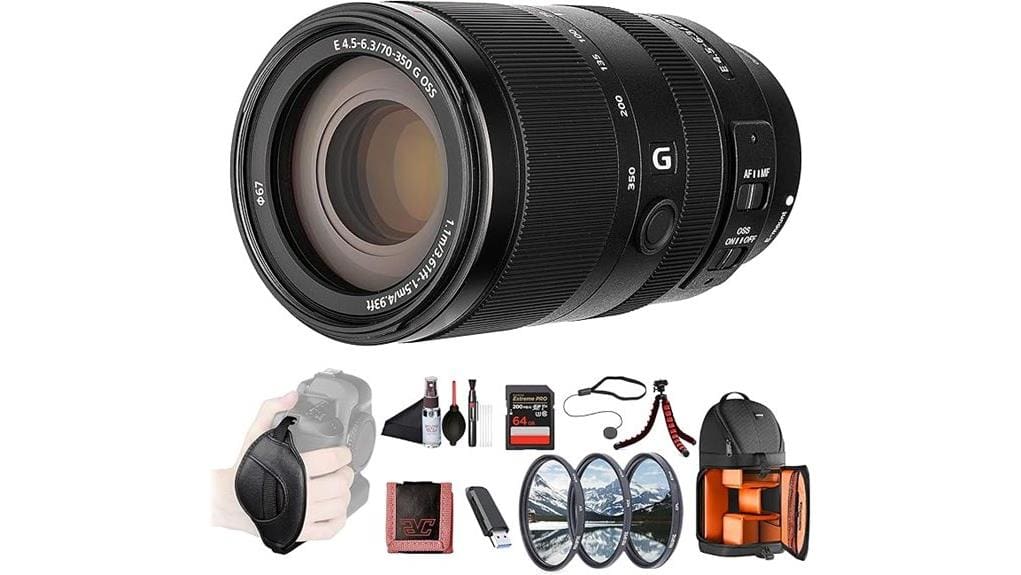

You’ll find the Sony E 70–350mm F4.5–6.3 G OSS a lightweight, long‑reach telezoom that’s ideal if you value reach, portability and price over the fastest aperture or pro‑grade sealing. Centre sharpness is strong around f/5.6–f/11, AF is reliable on modern E bodies, and OSS gives about 3–4 stops of handheld help. It’s great for wildlife and sports handheld or on a monopod, but don’t buy it if you need top‑tier speed or optics — more details follow.
Some Key Takeaways
- Lightweight 70–350mm telezoom offering excellent reach for travel, wildlife, and sports at a budget-friendly price.
- Strong center sharpness from about f/5.6–f/11, with some corner softness wide open at longest focal lengths.
- Fast, quiet, and reliable autofocus on modern Sony E bodies, though it may hunt in low-contrast or dim light.
- OSS yields roughly 3–4 stops of handheld stabilization, but tripods improve critical sharpness at long focal lengths.
- Well-built and weather-resistant for field use, but not pro-level sealing or fastest apertures for low-light demand.
Quick Verdict : Who Should Buy the Sony 70–350mm G
If you need a lightweight, long-reach telezoom that won’t break the bank or your shoulder, the Sony E 70–350mm G is a smart choice. You’ll appreciate its compact build and practical controls if you’re an enthusiast photographer chasing wildlife or sports without hauling pro glass. It’s aimed at budget conscious travelers who need reach and reliability more than fastest aperture or pro-grade weather sealing. You’ll trade ultimate low-light performance for portability and value, but gain versatile focal range and OSS. Choose it if you prioritize weight, price, and reach; skip it if you demand top-tier optics or speed. Its focal range and stabilization make it especially useful for wildlife and sports photography.
What the Lens Delivers Optically (Sharpness, AF, Stabilization)
Having established why the 70–350mm G is appealing to travelers and enthusiasts, let’s look at what it delivers optically. You’ll find centre sharpness strong from about f/5.6 to f/11 across most focal lengths; sharpness evaluation shows slight edge falloff at 350mm and softer corners wide open. Autofocus reliability is excellent on modern E bodies — fast, quiet, and consistent for still subjects, though hunting can appear in low contrast or dim light. OSS stabilization gives you 3–4 stops of usable advantage handheld, letting you push shutter speeds at long reach, but tripods still help for critical detail. For extended handheld sessions, pairing the lens with a compatible top handle can improve comfort and handling camera grip.
Handling, Build and Weather Resistance for Travel and Field Use
A solid-feeling zoom like the 70–350mm balances portability with purpose: you’ll notice its compact, 625 g body stays comfortable on long shoots and tucks easily into travel bags, yet the metal-reinforced mount, textured zoom and focus rings, and thoughtfully placed focus-hold button give a reassuring, professional grip. You’ll appreciate the lightweight portability without feeling toy-like; grip ergonomics are well judged for handheld stalking. Controls feel robust and the lens offers dust- and moisture-resistant construction, though Sony notes it’s not fully water resistant—treat it cautiously in heavy weather. A removable tripod collar would improve stability on long reaches. For photographers focused on precise results, pairing this lens with lens calibration tools can help ensure sharp, consistent autofocus across focal lengths.
Real-World Use Cases With Sample Settings (Wildlife, Sports, Aviation)
When you need reach without hauling a pro rig, the 70–350mm delivers usable images across wildlife, sports, and aviation by balancing focal length, stabilization, and exposure controls; you’ll rely on its OSS and fast, silent AF to keep distant subjects sharp while you fine-tune shutter speed and ISO for the action. For wildlife: 350mm, 1/1000–1/2000s for birds, ISO 400–1600; low light wildlife needs tripod or higher ISO plus OSS, aim for 1/500s. For sports: 200–350mm, 1/500–1/1000s, continuous AF, high burst. For aviation: 350mm, 1/800s–1/1600s, panning. Also good for telephoto portraits at mid-tele. The lens fits well within a lineup for portrait enthusiasts, pairing naturally with Perfect Portrait Lenses guidance on choosing the right optics for you.
Alternatives, Accessories and Final Buying Recommendation
Because you’ll want to compare options before committing, here’s how the 70–350mm stacks up: it’s a lightweight, affordable long-reach solution with reliable OSS and fast AF, but if you need faster apertures, shorter minimum focus, or pro-level build you should consider alternatives or add specific accessories to fill its gaps. For alternatives look at Sony’s FE 70–200mm f/2.8 (with a teleconverter), pro-level 100–400mm options, and third party rivals from Sigma or Tamron. Complement with a sturdy monopod or gimbal head, extra batteries, teleconverters, and consider budget primes for low-light work. Buy if weight and reach matter. If you plan to use this lens for stabilized motion shots, pairing it with a quality gimbal stabilizer will make handheld long-reach shooting much smoother.
Some Questions Answered
Does This Lens Work With Full-Frame Sony E Cameras?
No, it’s designed for APS-C bodies so it won’t cover full-frame fully; you’ll get heavy vignetting or cropped modes on full-frame cameras. You can use it on full-frame Sony E bodies with Mount adapters or by switching the camera to APS-C/Super 35mm crop mode, but you’ll lose resolution and field of view. If you need true Full frame compatibility, consider a native full-frame telephoto instead.
Can You Use Teleconverters With This Lens?
Yes — you can use teleconverters, but teleconverter compatibility is limited and not officially supported for peak AF performance. You’ll lose aperture (and consequently autofocus reliability) with 1.4x or 2x converters, and some camera bodies may not AF at all. Image stabilization impact is mixed: OSS still helps, but reduced light and altered AF can negate benefits, so expect slower focus, more noise, and diminished reach practicality. Test before critical shoots.
How Long Is the Warranty and Is It Transferable?
The warranty duration is one year, and it typically covers manufacturing defects. You should check transferability terms with the seller and Sony USA Authorized—warranties like this often aren’t transferable to subsequent owners or may require registration/receipt to validate transfer. Don’t assume coverage if you buy used; insist on original paperwork. If transferability matters, get confirmation in writing before purchase and clarify any service limitations or fees that could apply.
Is the Lens Compatible With In-Camera Lens Corrections?
Yes — you’ll get in camera corrections and lens profiles support for this lens on most Sony E bodies. Your camera will apply distortion, vignetting and chromatic aberration corrections automatically when lens data is recognized. Don’t assume every model handles every correction identically; older bodies might offer reduced profile detail. If you need maximum correction control, shoot RAW and apply updated lens profiles in post for critical work.
What Is the Minimum Focus Distance and Magnification Ratio?
Minimum focus distance is 1.2 m (3.9 ft) at the wide end and 1.5 m (4.9 ft) at 350 mm, giving a maximum magnification of 0.23×. You’ll get decent close up capabilities for subjects like birds or small wildlife, though it’s not a true macro. At long focal lengths you’ll enjoy strong background compression, which helps isolate subjects, but expect limited working distance and moderate magnification compared with dedicated macro optics.