
You’ll find the D‑Lux 8 is a pocketable, image‑first travel camera that prioritizes bright 24–75mm‑equivalent optics, Leica color, and tactile controls over interchangeable lenses or pro video tools. Its 17MP Four Thirds sensor and DNG support give flexible, low‑ISO detail, with usable stabilization and decent AF for stills but limits in fast action or high‑ISO work. Video is straightforward 4K with modest bitrates. Scroll on and you’ll get a deeper comparison and handling notes.
Some Key Takeaways
- Bright 24–75mm (full‑frame equiv.) zoom with f/1.7–2.8 offers versatile travel framing and strong low‑light performance.
- 17MP Four Thirds sensor delivers clean JPEGs and flexible DNGs, usable up to about ISO 1600 for modest crops.
- Compact, well‑built magnesium alloy body is pocketable and tactile, trading some control size for portability.
- 79‑point contrast‑detect AF and optical stabilization handle everyday stills well but lag hybrid systems for fast action.
- 4K video is serviceable for travel clips, but limited bitrate and no log profile restrict pro grading flexibility.
What to Expect From the Leica D‑Lux 8 as a Travel Camera
When you’re choosing a travel camera, the Leica D‑Lux 8 delivers a concise, high‑quality toolset that balances portability with serious image control: its 24–75mm full‑frame equivalent zoom and bright f/1.7–2.8 aperture cover most travel scenarios from landscapes to low‑light interiors. You’ll appreciate its compact footprint and lightweight portability compared with mirrorless kits, though the listed weight (2.9 pounds) suggests careful packing—body materials are magnesium alloy and plastic. Expect reliable connectivity and DNG support for workflow. Note battery lifespan is modest; you’ll want spare batteries or USB‑C power options for extended trips to avoid interruptions. This camera pairs well with essential accessories for mirrorless camera enthusiasts like protective cases and extra batteries for travel photographers essential gear.
How the D‑Lux 8 Performs: Image Quality, Autofocus, and Stabilization
Although compact, the D‑Lux 8 punches above its class: its 17 MP Four Thirds sensor and Leica 10.9–34mm f/1.7–2.8 lens deliver clean, detailed JPEGs and flexible DNGs that hold well for modest crops and post‑processing. You’ll notice low‑ISO clarity and balanced color; noise performance degrades predictably past ISO 1600 but remains usable with careful NR. AF speed is competent for stills—contrast‑detect, 79 points—though it trails hybrid systems in fast action. Optical stabilization steadies handheld shots across the zoom range, letting you drop shutter speeds by a stop or two compared with unstabilized compacts. For consistent results in varied shooting environments, pairing the camera with continuous LED photo lighting can make a noticeable difference.
Lens, Handling, and Ergonomics for Street and Travel Shoots
Pulling the D‑Lux 8 out on the street, you immediately notice how the 24–75mm (35mm‑equiv.) reach and bright f/1.7–2.8 aperture balance versatility with discretion: the wide end is great for environmental shots while the 75mm equivalent tightens framing for candid portraits without switching lenses. You’ll find the lens sharp center-to-edge at mid apertures, with usable background separation at long end. Controls are compact and logical, letting you shift aperture and exposure quickly, though Compact controls create small tactile tradeoffs. Pocketability tradeoffs are clear: usable in a jacket pocket, but magnesium alloy build adds reassuring heft for handheld stability. Perfect Tripods carries a range of compact supports and accessories that pair well with travel cameras like the D‑Lux 8 for improved stability and shooting flexibility, including compact tripods for on-the-go setups.
Video, Connectivity, and Workflow: Shooting, Transfer, and Editing
Plunge into the D‑Lux 8’s video and connectivity stack and you’ll find a compact system that favors straightforward capture and fast handoffs over pro‑level codecs or long record times. You’ll shoot 4K/2160p MP4 or MOV with usable detail but limited bitrate and no log profile; record lengths suit travel clips rather than extended interviews. Wi‑Fi, Bluetooth LE and USB‑C enable reliable wireless transfer and tethered offload to computers or phones. Leica FOTOS integrates remote control and quick previews, streamlining mobile editing workflows. DNG stills give you editing latitude; video needs simpler color grading and quicker turnaround. Consider pairing the D‑Lux 8 with studio lighting to improve image consistency and take full advantage of its compact travel-oriented strengths.
Who Should Buy the D‑Lux 8 and How It Compares to Rivals
If you want a pocketable, image‑focused camera that prioritizes fast, high‑quality stills and straightforward 4K video over pro video features, the D‑Lux 8 deserves serious consideration. You’ll appreciate its bright 24–75mm-equivalent lens, Four Thirds 17MP sensor with DNG support, and optical stabilization for travel and street work. Enthusiast buyers who value build quality, Leica color, and tactile controls will find it compelling versus similarly sized rivals. In competitor comparison, it trades off pro video tools, extreme low‑light resolution, and interchangeable-lens flexibility for compactness and image fidelity. Choose it if control and pocketability beat absolute versatility. Many DSLR and mirrorless photographers also keep essential accessories on hand to get the most from compact cameras.
Some Questions Answered
Does the D‑Lux 8 Support In‑Camera RAW Editing?
Yes — you can do in camera editing of RAW files on the D‑Lux 8. You’ll perform basic raw conversion and adjustments (exposure, white balance, cropping) directly on the camera, which is handy compared with systems that require tethered software. It’s not as flexible as desktop raw converters, but it’s detailed enough for on‑the‑go edits and quick delivery. For deep edits you’ll still prefer DNG processing on your computer.
Can I Charge the Battery via Usb‑C Power Bank?
Yes — you can charge the battery via USB‑C power bank. USB charging with Power Delivery will work for the Leica D‑Lux 8, letting you top up or run the camera when mains aren’t available. Compare power banks: choose one supporting PD output matching the camera’s input voltage/current for fastest, reliable charging. Note battery isn’t included in some bundles, so confirm internal charging behavior and carry a spare battery for extended shoots.
Is There Built‑In GPS or Geotagging Support?
No — it doesn’t have internal GPS, so the camera won’t geotag images on its own. You’ll rely on smartphone geotagging via the Leica FOTOS app and Bluetooth/Wi‑Fi to sync location data or transfer GPS-tagged files. Compared to cameras with built-in GPS, this workflow is lighter but requires your phone and pairing; it’s flexible for travel but adds steps and potential connectivity delays versus internal GPS convenience.
Does the Camera Accept Third‑Party Lenses or Adapters?
Yes — you can use adapters and accessories, but with limits. The D‑Lux 8 has fixed Leica zoom and uses Leica L/M compatibility for some accessories; you’ll need a mount adapter to fit other optics and third‑party adapters won’t change the built‑in lens swap limitation. You can attach screw‑on filters via filter threads (if adapter includes them) for creative control. Comparatively, you’ll get more flexibility with mirrorless bodies that accept native interchangeable lenses.
What Accessories Are Included Beyond the Listed Bundle Items?
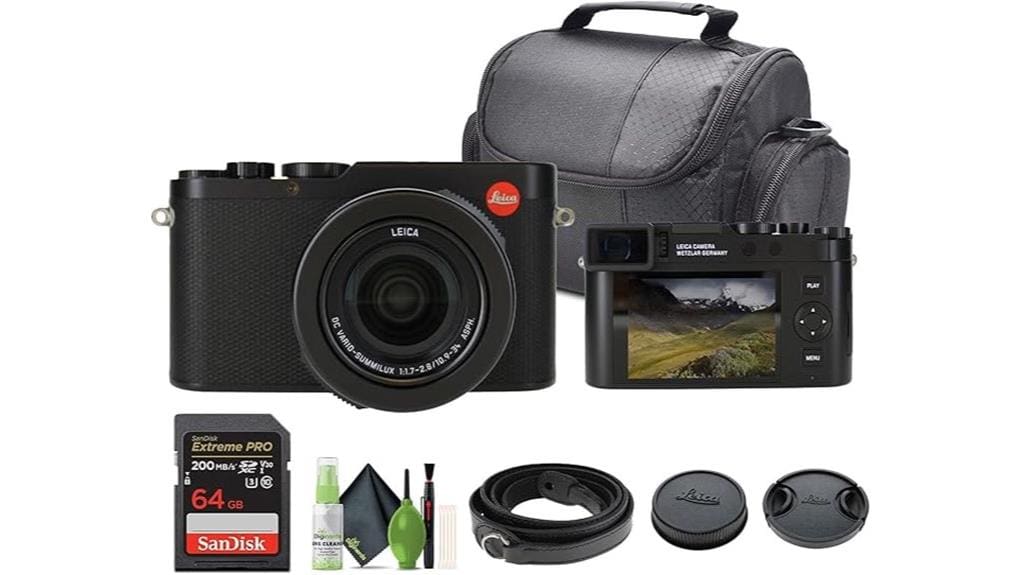
Beyond the listed bundle items, you won’t find many extra accessories or unlisted items — Leica sticks to the camera, 64 GB card, bag, cleaning kit and card wallet. Compared to competitor bundles, there’s no spare battery, extra strap, or protective case included. You’ll need to buy third‑party batteries, filters, or adapters separately. This keeps the package lean but means you should budget for essential add‑ons.