
You’ll get a compact, pocketable APS‑C camera built for decisive street work, pairing a 24.2MP sensor with a sharp fixed 28mm f/2.8 and GR Engine 6 processing for clean RAW files and strong micro‑contrast. Controls are tactile and fast, AF is quick for static subjects, and 3‑axis stabilization helps handheld low‑light shots though high ISO needs restraint. Video is basic; battery and buffer limit long sessions. Keep going and you’ll find detailed notes on quirks, performance, and tradeoffs.
Some Key Takeaways
- Pocketable APS-C camera with a sharp 28mm f/2.8 fixed lens optimized for discreet street shooting.
- 24.2MP sensor delivers high-detail RAW files with excellent micro-contrast at base ISO; RAW recommended.
- Fast hybrid AF and usable eye-detection, though continuous AF struggles with erratic subject movement.
- In-body 3-axis stabilization and clean low-light JPEGs, but noise rises noticeably past ISO 800 in RAW.
- Strong value for decisive street shooters; consider alternatives for weather sealing, longer battery life, or higher burst performance.
Ricoh GR III Street Edition at a Glance: Who It’s For and What It Promises
Though it’s compact enough to forget in your jacket pocket, the Ricoh GR III Street Edition promises serious image quality for street and travel shooters: a 24.2MP APS-C sensor, GR Engine 6 processing, and in-body 3-axis stabilization combine with a sharp 28mm f/2.8 fixed lens to deliver detailed, low-noise files and steady handheld performance. You’ll appreciate its deliberate feature set: fast hybrid AF, true pocketable ergonomics, and practical accessories in the kit. The target audience is decisive shooters who prioritize discretion and speed over zoom flexibility. Promised benefits are reliable walkaround handling, responsive controls, and pro-level RAW capture readiness. The kit is especially appealing to enthusiasts shopping for mirrorless camera gear who want compact, high-quality walkaround solutions.
Image Quality and Lens Performance: Sensor, RAW, and Crop-Mode Results
Judge the GR III Street Edition by its sensor and lens: the 24.2MP APS-C CMOS paired with the GR Engine 6 yields clean, high-detail RAW files with excellent micro-contrast at base ISO, while the fixed 28mm f/2.8 optic delivers sharp center resolution and well-controlled longitudinal aberrations but shows mild corner softness and light vignetting that are correctable in RAW—crop modes (40mm/50mm/71mm equivalents) retain good detail but expose the lens’s falloff and resolution limits sooner, so you’ll want to favor the full-frame-equivalent 28mm for maximum fidelity and use crops for composition rather than to recover lost sharpness.
You’ll see noise rise predictably past ISO 800; highlight recovery is forgiving, shadow noise manageable. Inspect sensor heatmap reads for uniformity—hot pixels are rare. RAW gives peak micro-detail and latitude; apply conservative JPEG sharpening only when delivering straight-from-camera JPEGs, since aggressive in-body JPEG sharpening can mask fine texture and amplify noise in crops. Overall: an APS-C sensor that punches above its weight, with a lens best used wide and crops treated as framing tools, not resolution saviors. For routine maintenance and to preserve that RAW performance, use proper sensor-care techniques such as sensor cleaning to avoid dust and blemishes.
Handling, Controls, and Real-World Street-Shooting Ergonomics
Those RAW files and the lens’ behavior matter only if you can point the camera where it needs to go quickly; the GR III Street Edition‘s compact body and control layout prioritize speed and minimal fuss for street shooting. You get tactile dials and a programmable front dial that put exposure tweaks under your thumb; button placement favors right-hand access, reducing menu dives. The textured grip and slim profile make pocket carry realistic without snagging. Shot-to-shot ergonomics are purposeful: you compose fast, change settings fast, and keep a low profile. It’s built for decisive moments, not lab comfort. The site also offers a range of camera leveling accessories that help maintain composition when shooting on uneven surfaces.
Autofocus, Stabilization, and Low‑Light Performance Tested
When you need reliable focusing and steadiness in dim, chaotic streets, the GR III Street Edition delivers a compact, technically capable package. You’ll find the hybrid AF fast and accurate for static subjects; continuous AF holds pace in slow pursuits but struggles with erratic movement. Eye detection is usable for candid portraits but isn’t as consistent as larger mirrorless systems. The 3-axis sensor-shift stabilization meaningfully reduces handshake at shutter speeds you’d normally avoid, letting you shoot slower without blur. Manual focus aided by focus peaking is precise and practical for quick zone control. Low‑light JPEGs are clean; RAW needs careful noise management. Gear Guide for Enthusiast Photographers and Camera Fans offers further resources on digital cameras for interested buyers.
Still and Video Capabilities: Frame Rates, Formats, and Practical Limits
Although the GR III Street Edition’s stills and video specs look modest on paper, they deliver practical performance for street shooters: you’ll get 24 MP RAW/JPEG stills at up to 10 fps in burst modes (real-world sustained rates depend on write speed and buffer), and Full HD 1080p video up to 60 fps in MP4. You’ll appreciate precise 12-bit RAW, quick JPEG write options, and reliable AF during bursts, though buffer depth limits continuous sequences. Video is clean but constrained by bitrate limits and rolling shutter on fast pans. For street use, it’s competent, compact, and predictably bounded. This makes it a great choice for photographers shopping for essential gear focused on DSLR-style handling and portability.
Battery Life, Storage, and the Bundled Accessories That Matter
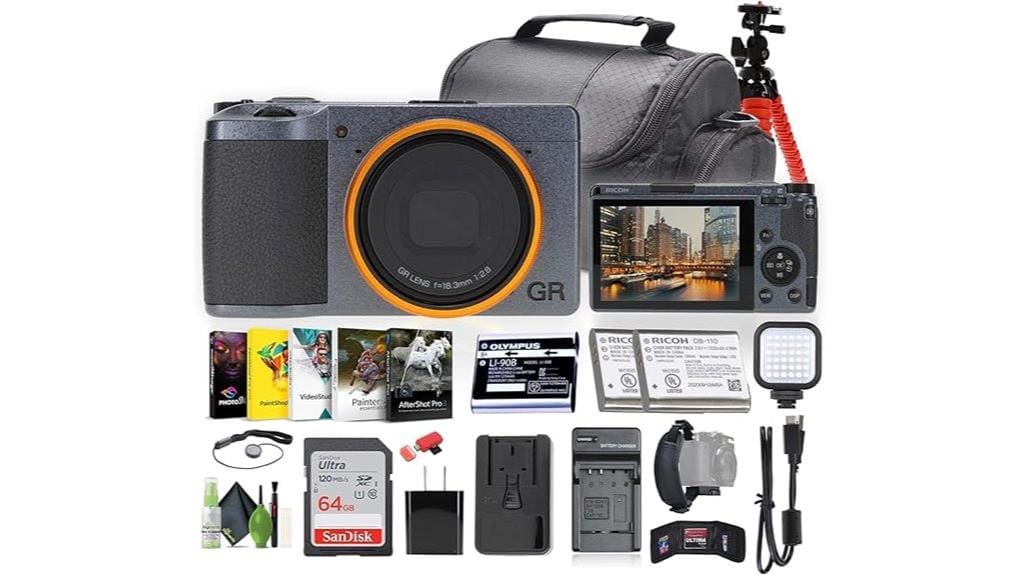
Frequently, power and storage are the practical limits you’ll hit shooting all day with the GR III Street Edition, and Ricoh’s bundle helps but doesn’t fully eliminate those constraints. You get two DB-110/LI-90B batteries and a USB‑C fast-charge option, which improves charging options and keeps battery lifespan manageable if you rotate cells. The included 64GB UHS‑I card and card reader simplify your storage workflow, though heavy RAW bursts will fill space fast. Accessories — tripod, LED light, bag — boost usability, but expect accessory longevity to vary; plastics and hinges feel serviceable, not indestructible. For photographers hunting extra runtime, a dedicated spare camera battery is often the simplest solution.
Should You Buy It? Value, Alternatives, and Final Recommendation
Battery and storage realities shape whether the GR III Street Edition is the right tool for you: the bundled extras—spare batteries, fast USB‑C charging, and a 64GB UHS‑I card—mitigate runtime and workflow limits, but they don’t transform the camera into a full-day RAW workhorse. If you prioritize pocketable APS‑C image quality, tactile controls, and low-profile street use, buy it. If you need extended battery life, high‑rate burst RAW, or weather sealing, consider alternatives like the Fujifilm X100 series or a compact mirrorless with larger battery and lens options. Strong resale value and a modest accessory ecosystem soften buyer risk. Consider pairing the camera with dual battery chargers to ease on-location power management.
Some Questions Answered
Does the Camera Support External Microphones for Better Audio Recording?
No — you can’t plug in an external microphone directly. The camera lacks a mic input, so you’ll need external microphone solutions and audio adapters to capture better sound. You’ll want a separate recorder or a wireless mic with its own storage, then sync audio in post. Opinion: that’s a frustrating omission for video-focused users; relying on adapters and separate recorders adds bulk and workflow complexity but yields superior audio.
Can the Lens Be Replaced or Upgraded With Third-Party Optics?
No — you can’t replace the GR III Street Edition’s fixed 28mm lens; it’s integrated and not designed for third-party conversion or interchangeable lenses. You might attempt mount adapters or third party conversion services, but they’re impractical, risk optical/AF/stabilization issues and void warranty. If you need different optics, you’re better off using crop modes, digital post-crop or switching to a true interchangeable-lens camera for reliable results.
Is There Any Built-In GPS or Geotagging Functionality?
No GPS is built in, so you won’t get onboard geotagging. You can geotag images using external app tagging via your phone and Wi‑Fi sync or by recording GPS tracks with a separate device and applying coordinates later in software. That’s clunky compared with integrated GPS, but it preserves battery and keeps the camera compact. If you need in-camera location stamps, this model won’t satisfy that requirement.
How Weatherproof Is the Street Edition Finish Over Time?
It’s not weatherproof long-term; the Street Edition finish durability is moderate and won’t survive heavy exposure. You’ll want to avoid rain, salt air, and sustained humidity because surface corrosion can appear on metal parts and finish wear will show in high-contact areas. With careful care and drying after light moisture you’ll prolong life, but don’t rely on the coating as protection—treat it as cosmetically vulnerable, not sealed.
Are There Firmware Updates Improving Autofocus or Stabilization?
Yes — Ricoh issued firmware tweaks that improve autofocus and stabilization performance. You’ll notice autofocus tweaks refine AF-C tracking and focus acquisition speed, while stabilization firmware improves sensor-shift responsiveness and micro-correction smoothing. In practice you’ll get fewer focus hunts and steadier handheld results, especially in low light or crop modes. It’s a worthwhile update; install via USB/SD following Ricoh’s release notes and backup your settings first.