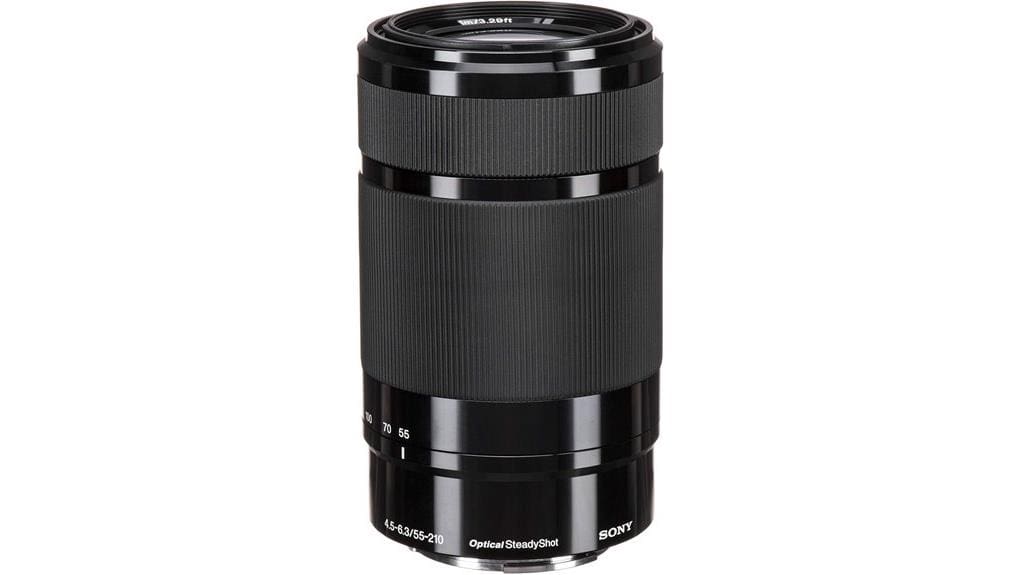

You’ll find the Sony E 55–210mm f/4.5–6.3 (SEL55210/B) gives you affordable APS‑C tele reach with light weight and effective OSS, making handheld shooting practical. Optically it’s competent: good center sharpness at mid apertures, tame chromatic aberration for the price, but corners and bokeh at 210mm show limitations. Autofocus is quiet and generally reliable for stills and casual video. If you want budget reach with sensible compromises, keep going for full performance and buying tips.
Some Key Takeaways
- Affordable lightweight telephoto for Sony E APS-C bodies, offering 82–315mm equivalent reach.
- Variable f/4.5–6.3 aperture limits low-light performance and shallow depth-of-field control.
- Good center sharpness at mid apertures; corners soften noticeably near 210mm.
- OSS provides roughly four stops of stabilization, aiding handheld photos and video.
- Quiet reliable AF for stills, with occasional hunting in low light and non-weather-sealed build.
Quick Verdict: Is the Sony E 55-210mm Worth Buying for APS-C Users?
While it’s not a pro-grade telephoto, the Sony E 55-210mm is a strong value for APS-C users who need reach without breaking the bank. You’ll find its optical design delivers competent sharpness across the range, with moderate chromatic aberration control. Compared to pricier alternatives, its bokeh performance is serviceable but shows busy edges at long focal lengths; expect smooth backgrounds only when you’re near the subject. Color rendition is neutral and consistent, requiring minimal correction in post. If you prioritize affordability and usable reach over ultimate edge-to-edge resolution or creamy bokeh, this lens is a sensible buy. It’s well suited for photographers who favor mirrorless camera systems and want an affordable telephoto option.
Key Specs That Matter: Focal Length, Aperture, Stabilization, and Build
Because the 55–210mm range gives you an effective 82–315mm reach on APS-C bodies, this lens lets you frame distant subjects that short telephotos can’t, but you’ll trade maximum aperture for affordability—the variable f/4.5–6.3 limits low-light performance and depth-of-field control compared with constant-aperture pro zooms. You get a useful telephoto reach for sports and wildlife at a compact, lightweight package. OSS provides roughly four stops of stabilization, helping handholdability and slower shutter use. Build quality is modest: aluminum-alloy exterior and plastic internals keep weight and cost down, but it’s not weather-sealed or pro-grade. This lens is well suited for enthusiasts seeking affordable telephoto reach without the bulk of pro glass.
Real-World Performance: Sharpness, Autofocus, and OSS in Photos and Video
Although it’s an entry-level telephoto, the 55–210mm delivers predictable, usable results: center sharpness is good across the range at mid apertures, corners soften noticeably toward 210mm and at the widest apertures, and chromatic aberration and contrast are controlled well for the price. You’ll see in sharpness tests that peak results sit around f/8–f/11 at 55–135mm; diffraction and edge falloff matter more near 210mm. Autofocus behavior is quiet and reliable on stills, with occasional hunting in low light. OSS performance and video stabilization are effective, yielding steady handheld clips when panning or shooting at longer focal lengths. This makes the lens a practical choice for wildlife and sports photography enthusiasts.
Who Should Buy It: Best Use Cases and Camera Compatibility
If you need an affordable, lightweight telephoto that extends your APS-C kit for sports, wildlife, or distant travel shots, the Sony E 55–210mm is a pragmatic choice. You’ll find it a solid budget telephoto that trades top-tier optics for portability and OSS-stabilized reach. For a wildlife beginner it delivers useful reach and quiet AF, letting you capture distant subjects without a hulking lens. As a travel companion it balances weight and focal length (82–315mm equivalent). Its portrait reach at longer focal lengths creates pleasing compression, though sharpness and bokeh lag premium alternatives. Compatible with all Sony E APS-C bodies. The site also offers related gear like tripod heads to help stabilize telephoto setups for better results.
Buying Advice: Price, Alternatives, and Recommended Accessories
Having outlined who benefits most from the Sony E 55–210mm, let’s assess whether it makes sense for your budget and setup. You’ll find the lens offers solid optical reach and OSS at a low price; compare street prices to refurbished units for value. For tighter budgets, consider budget alternatives like third‑party 55–210mm equivalents or a used Sony 70–300mm, weighing AF speed and build. Essential accessories: a 49 mm UV/protect filter, compact travel tripod, and a padded zoom case; add a cleaning kit and extra warranty if you shoot professionally. Prioritize focal range and stabilization over premium optics. Also consider pairing the lens with a dedicated lens pouch to protect it during travel and lens changes.
Some Questions Answered
Does This Lens Support Full-Frame Sony Cameras Without Vignetting?
No — it’s APS C only, so you’ll get heavy vignetting on full-frame bodies unless you use a Full frame adapter that crops or reduces the image circle. With native Mount compatibility to Sony E, the lens projects a smaller image circle sized for APS-C sensors. Comparatively, full-frame lenses avoid this issue by design. If you need full-frame coverage, choose a lens designed for full-frame or accept crop-mode limitations.
Can I Use Teleconverters With the Sel55210/B?
You can physically mount some third-party teleconverters, but teleconverter compatibility is limited and not recommended. You’ll lose autofocus reliability and risk significant image degradation—reduced sharpness, contrast, and effective aperture into slow, dim ranges. Compared to using a native longer lens, performance drops significantly; stabilization and focus speed suffer. If you need extra reach, you’re better off choosing a higher-quality telephoto designed for teleconverter use.
Is the Lens Weather-Sealed for Outdoor Shooting?
No — it has no weather sealing. You’ll find the build isn’t rated for heavy moisture, though it’s splash resistant in light conditions compared with fully sealed pro lenses. Technically, the alloy finish and seals offer limited protection, but the lens lacks thorough gaskets and desiccant design. Comparatively, expect more vulnerability to sustained rain, dust ingress, and humid environments than weather-sealed telephotos used for serious outdoor work.
How Loud Is the Autofocus During Continuous Video Recording?
You’ll find the autofocus noise during continuous focusing is low and unobtrusive; the stepper motor runs quietly compared with older screw-drive designs. In technical terms, it emits a faint mechanical whirr detectable on sensitive mics but rarely distracts in-camera. Evaluatively, it’s well-suited for run-and-gun video work. Comparatively, it’s quieter than consumer telephotos lacking internal focusing, though pro-grade silent AF systems remain slightly superior.
Are There Firmware Updates Required for Compatibility?
No, you typically won’t need firmware updates for firmware compatibility with native E-mount bodies; the lens works plug-and-play. If you use mount adapters, you might need adapter or camera firmware to guarantee AF, OSS and exposure communication behave correctly. Compare adapter types: electronic adapters preserve features better than passive ones. Check camera and adapter maker sites for updates before shooting, especially for continuous AF and video stabilization performance.