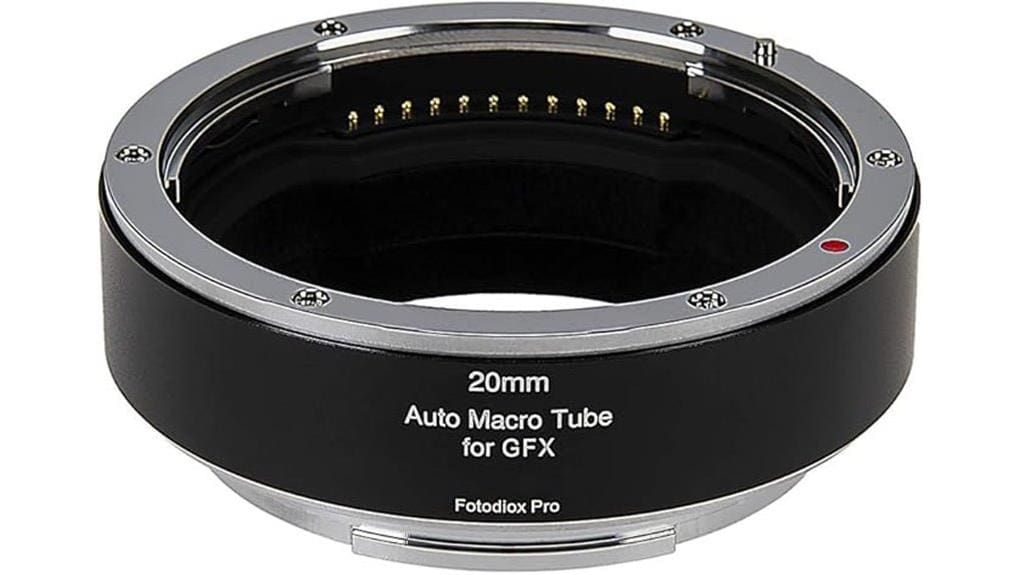

You’ll get a rugged, all‑metal 20mm extension tube that preserves autofocus and auto‑exposure on Fujifilm GFX bodies while turning your existing lenses into higher‑magnification macro tools. It keeps electronic communication reliable, mounts with tight tolerances, and won’t degrade optics—though focus hunting and depth‑of‑field limits mean you’ll often switch to manual focus and tripod work. Light loss and reduced working distance are expected trade‑offs. Keep going and you’ll find practical tips, performance notes, and buy/avoid guidance.
Some Key Takeaways
- All‑metal Fotodiox Pro tube preserves electronic contacts for autofocus and auto‑exposure on Fujifilm GFX bodies.
- Machined mounts and tight tolerances minimize wobble, providing repeatable alignment when stacked.
- Maintains optical quality (no glass), so sharpness and color follow the attached lens characteristics.
- Reduces working distance and light, requiring slower shutter speeds, higher ISO, or wider apertures.
- Best for studio/product macro: manual focus, tripod, and focus stacking recommended for critical detail.
Real-World Overview: What the Fotodiox Pro 20mm GFX Tube Is and Who It’s For
While the Fotodiox Pro 20mm GFX extension tube fits between your Fujifilm GFX camera and lens, it’s fundamentally a metal spacer that turns your existing glass into a higher-magnification macro tool. You’ll gain closer working distance and greater subject detail without changing optics, maintaining autofocus and exposure communication. It’s aimed at photographers who want flexible macro ratios from gear they already own — studio shooters, product photographers, and field-focused enthusiasts. Expect improved creative composition through tighter framing and selective depth. Its simple, compact design supports field portability, letting you add macro capability without bulk or optical compromise. This makes it a practical choice for photographers familiar with lens mount adapters who want to extend their system’s versatility.
Key Specs and Build: All-Metal Construction, Electronic Contacts, and Mechanical Fit
Featuring a solid all-metal build, the Fotodiox Pro 20mm GFX tube feels robust and precise when you mount it, with machined mating surfaces that promote repeatable alignment and a smooth twist-lock action. You’ll notice a clean build finish that resists wear and matches camera aesthetics. Internal electronic contacts maintain autofocus and auto-exposure communication reliably; contact springs seat firmly without play. Mount tolerance is tight, minimizing wobble and ensuring consistent flange distance for repeatable focus shift and magnification. You can combine sections without losing mechanical integrity. Overall, the tube prioritizes durable materials and precise fit for dependable macro workflows. This makes it a practical accessory for photographers who also rely on camera body caps to protect mounts and maintain cleanliness.
How It Performs on a Fujifilm GFX Camera: Focus, Exposure, and Image Quality Tests
Because the 20mm Fotodiox Pro extension tube preserves electronic communication, you’ll see predictable autofocus behavior and consistent auto-exposure on a Fujifilm GFX body, though with the usual macro caveats. You’ll notice focus accuracy remains acceptable for larger subjects but degrades near minimum focus distances; contrast-detect and phase-assist systems hunt more and you’ll often switch to manual for critical frames. Exposure consistency is reliable across frames, with metering compensating predictably for reduced light, though slower shutter speeds or higher ISO become necessary. Image quality shows no optical degradation from the tube itself; sharpness and color fidelity track with the attached lens. This makes it a practical option for photographers looking to expand close-focusing capabilities without losing electronic communication.
Practical Usage Tips: Lens Pairings, Stacking Tubes, Working Distance, and Focusing Techniques
When you pair the 20mm Fotodiox Pro tube with different lenses you’ll see predictable changes in magnification and working distance, so choose combinations that match your subject and shooting style. Use short focal-length lenses for wider field and longer working distance; long focal lengths yield higher magnification but shorter reach. Stack tubes sparingly: two tubes multiply extension and magnification but cut light and depth of field. Rely on the camera’s electronic coupling for aperture control and autofocus where usable, then switch to manual for precision. For critical sharpness, use tripod, small aperture, and focus stacking to extend usable depth in macro shots. Also, keep your camera sensor pristine by using proper cleaning tools and techniques to avoid spots appearing in your macro images, such as a sensor swab and gentle cleaning procedure.
Buying Decision: Advantages, Limitations, Warranty, and When to Choose This Tube
If you need a simple, reliable way to turn your GFX lenses into true macro tools, the Fotodiox Pro 20mm G-Mount tube delivers: its all‑metal build preserves lens handling and optics while maintaining electronic communication for aperture control and AF where applicable. You’ll gain affordable magnification, preserved autofocus/AE functionality, and rugged mounting — useful if you already own compatible Fujifilm GFX lenses. Consider macro limitations: reduced working distance, light loss, and potential depth‑of‑field constraints. Warranty implications are minor; a limited 2‑year manufacturer warranty covers defects but not misuse. Choose this tube when you want cost‑effective, non‑optical magnification without buying dedicated macro glass. Our selection of essential L-brackets shows ergonomic mounting options for passionate photographers L-bracket picks.
Some Questions Answered
Does the Tube Affect Weather Sealing of My Camera+Lens?
Yes — adding the tube can reduce seal integrity. You’ll lose the continuous mounting gasket contact between camera and lens when you insert the 20mm tube, so the original weather sealing is interrupted. While the all-metal construction and smooth surface mount well and electronics keep working, you shouldn’t rely on the assembly for heavy moisture or dust exposure. Use additional protection or avoid adverse conditions to preserve equipment.
Can I Use the Tube With Third-Party Lens Adapters?
Yes — you can use the tube with third-party lens adapters, but check adapter compatibility and electrical contacts. You’ll maintain autofocus and auto-exposure only if the adapter passes through reliable electrical contacts and supports G-Mount signaling. Adapters that lack proper pins or introduce signal conversion may break communication or reduce functionality. Test your specific adapter+tube+lens combo before critical shoots, and prefer well-reviewed adapters that preserve electronic contact integrity.
Is There Any Play or Wobble After Long-Term Use?
You shouldn’t notice play or wobble after long-term use if you handle it properly. The all-metal construction minimizes mount tolerance issues and resists hinge wear, so electrical contacts and mating surfaces remain stable. If you frequently swap heavy lenses or expose the tube to impacts, inspect for loosened tolerances and hinge wear; servicing or replacement under the 2-year warranty will address defects. Regular care preserves fit and function.
Does It Support In-Camera Lens Correction Profiles?
Yes — it preserves electronic communication, so in-camera corrections and lens profiles still work. You’ll retain autofocus and auto-exposure signals, letting the camera apply its lens profiles for distortion, vignetting, and chromatic aberration. Expect consistent metadata passthrough so corrections occur automatically. However, because the tube adds extension, extreme macro framing may exceed typical profile assumptions, so verify results and apply manual adjustments if you notice residual artifacts.
Are There Any Compatibility Issues With Future Firmware Updates?
You shouldn’t expect widespread firmware compatibility problems, but update risks exist. Because the tube preserves electronic connections and relies on camera–lens communication, future camera firmware changes could alter behavior. You can minimize issues by keeping lens and camera firmware current and checking Fotodiox firmware/support notes. If incompatibilities appear, Fotodiox may release updates or guidance under its limited 2-year warranty, but you’ll need to verify before major firmware upgrades.