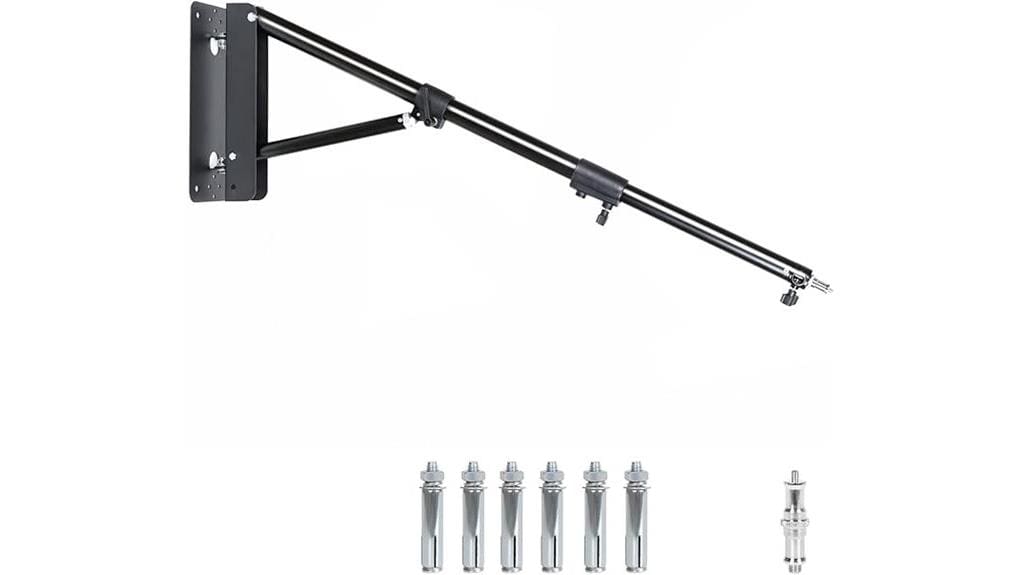

You’ll like this 68″ triangle boom arm if you need a sturdy, space-saving wall or ceiling mount that holds ring lights, strobes, or softboxes with repeatable positioning. It extends to 68″ and folds flat, uses a 1/4″ and 3/8″ spigot, and favors stud or heavy-duty anchor installation. Aluminum construction gives solid stability and quick damping of small knocks; plan cable routing along the arm. Keep going to uncover installation tips, load limits, and real-world performance notes.
Some Key Takeaways
- Extends to 68″ (173 cm) and folds flat against the wall for space-saving studio setups.
- Triangle aluminum arm offers strong stability with minimal sag for heavy strobes and ring lights.
- Spigot head has 1/4″ on one end and 3/8″ on the other—confirm fixture compatibility.
- Swing covers ~0°–180° for precise repeatable positioning; folding preserves alignment.
- Best for permanent studio/salon installs; skip if you need frequent portability or temporary rigs.
Quick Verdict: Who This 68 Triangle Boom Arm Is Best For
Quick verdict: this 68″ triangle boom arm suits professionals and serious hobbyists who need a sturdy, space-saving mount for lights and audio gear. You’ll appreciate its space saving aesthetics if you work in compact studios, salons, or workshop corners where tidy sightlines matter. You’re the kind of user who prioritizes reliability and straight-forward installation over novelty—photographers, content creators, and pro stylists who need fixed, repeatable positioning. User demographics skew toward experienced operators and small studios that mount strobes, ring lights, softboxes, or mics. If you value durability, clean visual presentation, and efficient floor space use, this arm fits your needs. Consider pairing it with heavy-duty light stands for maximum stability and compatibility in professional setups.
Key Specs and Compatibility Checklist (Dimensions, Mounts, Supported Gear)
Now that you know who benefits most from the 68″ triangle boom arm, let’s look at the specs you’ll need to confirm fit and compatibility. Check that the arm extends to 68″ (173 cm) for your planned reach and folds flat against the wall when idle. Verify mounting to a solid wall or ceiling and match the spigot head—1/4″ screw on one end, 3/8″ on the other—to your light or adapter. Confirm weight capacity for your ring light, strobe, or softbox and plan cable management along the aluminum arm. Supported gear includes ring lights, strobes, softboxes, reflectors, and mics. These compact setups are ideal for photographers who need portable light stands and minimal storage impact.
Real-World Performance: Reach, Stability, Swing Range, and Fold-Away Use
Because the 68″ triangle boom arm extends to 173 cm and folds flat, you’ll get a full, studio-grade reach without losing floor space when it’s idle. In reach test scenarios you can position lights and mics precisely across a 0°–180° arc; side-to-side swing gives predictable coverage. Stability is solid thanks to the aluminum arm and triangle base—heavy strobes hold steady with minimal sag. Vibration damping performs well: small knocks damp within a second, though extreme taps transmit. Folding it flush is quick and repeatable, keeping gear out of the way while preserving alignment for next use. This makes it a smart choice for photographers who need reliable, space-saving light stand solutions in their workflow.
Installation and Setup: Mounting Options, Tools, and Step-by-Step Tips
Having confirmed reach, stability, and fold-flat repeatability, you’ll want to secure the boom exactly right to keep those benefits—installation choices and proper setup determine long-term performance. Choose a solid wall or ceiling mount; verify the bolt pattern against studs or use heavy-duty drywall anchors only when stud mounting isn’t possible. Gather wrench, drill, level, and torque specs. Consider electrical considerations early: route power safely, avoid load on the mount, and plan outlet placement. Feed cables along the arm and base, fastening with clips for neat cable management. Tighten fasteners to spec, test swing and lock positions, then recheck. For photographers using this setup, consider storing the boom in a padded tripod bag to protect it during transport and when not in use, as recommended for many dedicated tripod bags.
Buy or Skip? Pros, Cons, and Cost-to-Value Considerations
If you need a durable, space-saving mount that handles heavy lighting and accessories, this boom arm is worth serious consideration: it delivers solid aluminum construction, a 68″ reach, and a versatile 1/4″–3/8″ spigot for most strobes, ring lights, and mics. You’ll buy if you value high weight capacity, repeatable positioning, and clean aesthetic appeal—ideal for studios or salons where floor stands are impractical. Skip it if you need portability, temporary setups, or ceiling-only mounting. Cost-to-value leans positive for dedicated spaces: modest price for robust materials and long reach, but evaluate compatibility with your gear before buying. LED panel users will appreciate how the mount supports larger fixtures and enables precise, consistent positioning for studio lighting.
Some Questions Answered
Does It Include Any Warranty or Manufacturer Support?
Yes — it typically comes with a limited warranty and customer support. You’ll get coverage for manufacturing defects for a specified period, though terms vary by seller. Check the warranty duration, what’s excluded (wear, improper mounting), and whether returns require proof of purchase. Contact customer support for claims, installation questions, or spare parts; keep receipts and photos handy. If buying used, warranty might not transfer.
Can It Be Painted or Powder-Coated to Match Decor?
Yes — you can paint or powder-coat it for color customization, but you’ll want to prepare properly. Strip grease, sand lightly, and use a primer suited to aluminum. Powder-coating gives a tougher, more uniform finish option and resists chips better than spray paint. Confirm any warranty or mounting hardware tolerances before coating, and avoid blocking moving joints or spigots. Choose professional coating for best durability and appearance.
Is There Any Corrosion Resistance for Humid Environments?
Yes—you’ll get basic protection but not full marine-grade resistance. The aluminum arm resists rust inherently, and parts that could corrode often use stainless plating and a protective coating for humid environments. That reduces oxidation and surface pitting, but you’ll still want periodic checks, avoid salt exposure, and consider additional powder-coating or sealants for coastal or very damp settings to guarantee long-term durability.
Can It Support Continuous Outdoor Exposure or Only Indoor Use?
Only indoor use is recommended; it doesn’t have a specified weatherproof rating for continuous outdoor exposure. You shouldn’t expect UV resistance or sealed corrosion protection from the aluminum arm and black triangle base as described. If you want outdoor mounting, you’ll need a unit rated for weatherproof conditions or add protective coatings, UV-stable paint, and corrosion-resistant fasteners. Otherwise moisture, sun and salt will degrade finish, hardware and moving joints over time.
Are Spare Spigot Adapters or Replacement Parts Available?
Yes — you can get spigot adapters and replacement parts. Check the manufacturer or reseller for 1/4″ and 3/8″ spigot adapters, mounts, and screws; they often sell individual pieces or kits. If originals aren’t available, compatible third-party adapters match standard spigot sizes. Verify thread type and material (metal preferred) before buying. Keep receipts and part numbers so you can replace components quickly and maintain safe, reliable mounting.