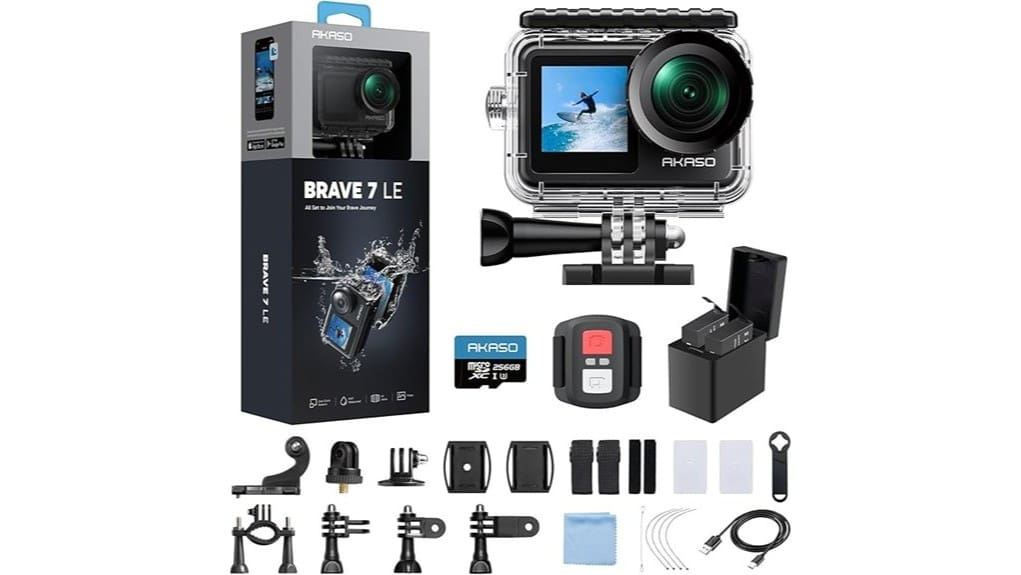
You’ll get a budget-friendly, selfie-ready action cam that shoots 4K30 video and 20MP stills with dual displays for easy framing. Colors are pleasing in daylight and EIS 2.0 steadies walking or biking clips, though detail and low-light noise lag behind pro gear. It’s durable for rain and snorkeling with the included housing, and ships with two batteries and mounts for extra value. Keep going to see performance, battery life, and underwater tips.
Some Key Takeaways
- Shoots 4K30 video and 20MP stills with good color in daylight but limited low-light detail and increased noise.
- EIS 2.0 6-axis stabilization noticeably smooths walking and biking footage but can’t replace a gimbal for high-impact action.
- Dual displays and a front selfie screen improve framing and vlogging convenience for casual users.
- Includes two batteries, 256 GB U3 microSD, waterproof housing to 40 m, and mounts for strong out-of-box value.
- IPX7 body protects against splashes; use the included housing for full snorkeling/diving and follow regular O-ring maintenance.
Quick Verdict : Is the AKASO Brave 7 LE Worth It?
Wondering if the AKASO Brave 7 LE is worth your money? You get a strong value proposition: dual displays, solid weatherproofing, two batteries, and bundled accessories that let you shoot right away. The user experience is straightforward—easy menus, a front selfie screen, and a touchscreen you’ll switch between quickly. Image and video specs aren’t the focal gripe here; stabilization, battery life, and included mounts deliver practical benefits for casual shooters and adventure users. If you want pro-grade image fidelity, look elsewhere. For reliable features at a budget price, this camera’s a sensible, user-friendly pick. Many photographers also value fast, portable storage options like portable SSDs to quickly offload and back up footage in the field.
Image and Video Performance: 4K30, 20MP Photos, and Digital Zoom
While the Brave 7 LE doesn’t match flagship sensors, its 4K30 video and 20MP stills deliver solid results for casual shooters and action clips—you’ll get crisp day footage and usable photos for social sharing, but fine detail and low-light performance fall short of pro cameras. You’ll appreciate accurate color reproduction accuracy in bright conditions; skin tones and landscapes look pleasing straight out of camera. Digital zoom is handy but degrades detail quickly—stay wide when you can. In mixed light you’ll notice noise and softer edges, so plan shots in good daylight or use post-processing to rescue contrast and sharpness. The Brave 7 LE pairs well with essential drone camera gear for capturing aerial shots.
Stabilization, Shooting Modes, and Real-World Footage Quality
Because AKASO’s EIS 2.0 leans on improved 6-axis correction, you’ll get noticeably smoother handheld and action clips—especially at walking or biking speeds—though it’s not a substitute for a gimbal during high-impact movement. You can switch between time-lapse, burst, and fast-motion modes quickly; each is intuitive and useful for travel or sports shots. Real-world footage holds good detail at 4K30, but you’ll see occasional motion blur during rapid pans. Low light performance is modest: noise rises and detail softens after sunset. Overall, stabilization and modes serve casual users well but won’t match pro gear. This makes the Brave 7 LE a solid pick for enthusiasts seeking handheld gimbal alternatives for smoother everyday footage.
Durability and Underwater Use : IPX7 Body vs Waterproof Housing
Stabilization and shooting modes help you capture better footage, but you also need to know how the AKASO Brave 7 LE will hold up in rough conditions. You get IPX7 water-resistant protection for rain, snow, and splashes—fine for hikes and storms but not full submersion. For snorkeling or diving, use the included waterproof housing; it extends depth to 40 m and improves impact resistance. Check housing compatibility with accessories and perform regular waterproof maintenance—clean seals, dry the camera, and inspect O-rings. Overall, the body suits everyday adventures; the housing makes underwater exploration reliable and safe. For added protection and to find the right fit, consult our guide to waterproof camera housings.
Batteries, Accessories, and Who Should (or Shouldn’t) Buy It
If you plan to shoot all day, you’ll appreciate that the Brave 7 LE ships with two rechargeable batteries and a 256 GB U3 microSD card, but expect to swap batteries for long sessions since 4K30 and EIS drain power quickly. You’ll like the included waterproof housing and multifunctional mounting options for action setups, plus a WiFi remote for hands-free control. Buy it if you want an affordable, versatile action cam with solid stabilization and selfie-friendly dual screens. Don’t buy it if you need all-day battery life or pro low-light performance—consider cameras with longer runtimes or interchangeable batteries. Instant camera enthusiasts may still find the Brave 7 LE useful as a complement to analog photography for capturing dynamic action and behind-the-scenes moments.
Some Questions Answered
Does It Record External Audio via an External Microphone?
No, it won’t record external mic audio directly. You can use an external mic only via specific Adapter types (USB-C or proprietary) with compatible housings or third-party adapters, but AKASO doesn’t include native mic input. If you want better audio, you’ll need an external recorder or verify an adapter that supports External mic input and sync audio in post. That setup’s more cumbersome but gives clearly improved sound quality.
Can You Livestream Directly From the Camera?
Yes — you can livestream directly using the camera’s Wi‑Fi streaming feature. You’ll pair it with the app, choose your service, and start broadcast; however, live bitrate is limited compared with dedicated streamers, so expect modest resolution and stability. For casual social streams it’s fine, but you shouldn’t rely on it for professional, high-bitrate livestreams. Use steady connection and backup power for best results.
Is There GPS or Location-Tagging Support?
No — GPS absent on this model, so it won’t embed location data directly. You can use Geotagging workarounds: record with your phone’s GPS-enabled app or a GPS logger, then sync timestamps in post to apply coordinates to photos/videos. That’s a practical but extra step; you’ll need to keep device clocks matched and use software that supports external GPX files for geotagging. It’s workable but less seamless than built-in GPS.
What Video File Formats and Codecs Does It Use?
It records video using H.264 Encoding and saves files in MP4 Containers. You’ll get 4K30 and lower-resolution clips compressed with H.264 for broad device compatibility and efficient file sizes. That’s good for quick editing on most platforms, but you won’t get newer codecs like H.265 for smaller files or better compression. Overall, it’s a practical, consumer-friendly choice balancing quality, compatibility, and ease of use.
Does It Support Charging While Recording (Pass-Through Power)?
No — it doesn’t reliably support battery passthrough for continuous recording. You can charge the Brave 7 LE while on, but the camera may not accept power through the USB reliably during active recording or inside the waterproof housing. For uninterrupted long shoots you’ll want to use the included dual batteries and swap them, or record with an external power solution outside the case. Expect potential cutouts if you rely on passthrough.