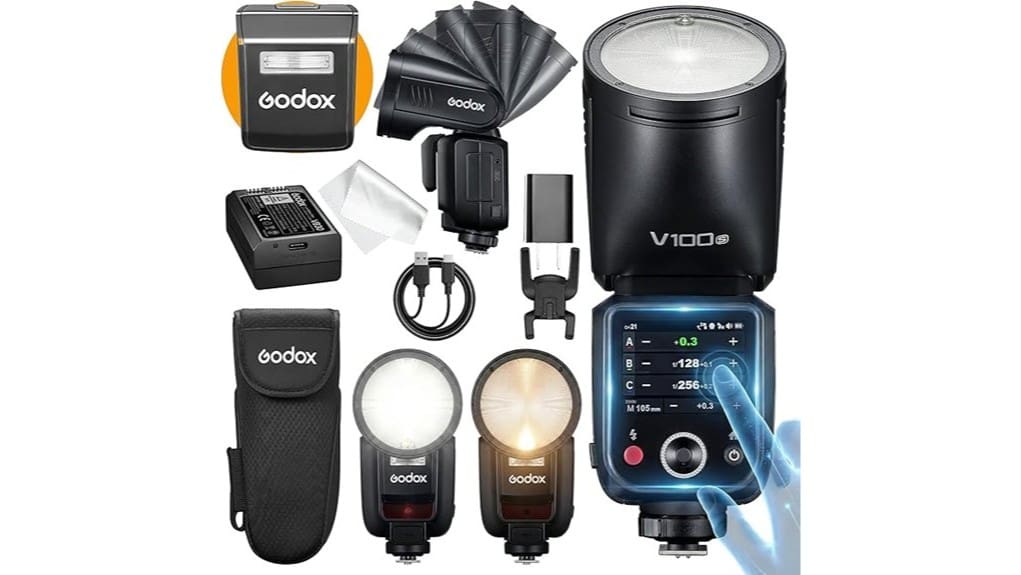
The GODOX V100 S gives you surprisingly studio-grade output in a compact, Sony-friendly package: 100 Ws with 1/1–1/256 fine steps, reliable TTL and HSS to camera limits, and fast recycle on VB30 cells for long event runs. The touchscreen and SU‑1 sub‑flash make tricky angles and quick adjustments easy, though the plasticky build lacks weather sealing and advanced color control. It’s a strong portable choice for mirrorless shooters—keep going to see detailed tests and workflow tips.
Some Key Takeaways
- Compact, well-balanced flash with Sony hot shoe and responsive 2.3″ touchscreen for quick adjustments.
- 100 Ws max with 1/1–1/256 steps, consistent output, low latency, and reliable sync across power range.
- TTL and HSS perform reliably on Sony bodies, enabling shallow depth with retained catchlights in HSS.
- VB30 battery offers fast recycle, sustained high-power endurance, and solid ergonomics for swapping.
- Includes detachable SU‑1 sub‑flash and small diffuser for off‑axis fill; no weather sealing and limited color control.
Hands-on Summary: GODOX V100 S Quick Verdict and Who It’s For
While compact enough to stash in your bag, the GODOX V100 S delivers pro-level power and flexibility—100 Ws output, TTL/HSS support, and a detachable SU-1 sub-flash—so you’ll get consistent results across portraits, events, and run-and-gun shoots. You’ll appreciate precise exposure control and fast recycle times; battery ergonomics are thoughtful, letting you swap and grip without fumbling. Touchscreen responsiveness speeds setup and mode changes, though tactile controls still help when gloves or bright sun interfere. This suits hybrid shooters who need portable, reliable output and TTL convenience, and pros wanting a secondary portable head with advanced sync options. Perfect lighting starts with choosing the right tools like LED panels to complement your flash setup.
Design, Controls, and Build: Touchscreen, SU‑1 Sub‑Flash, Battery, and Mounting
Having praised its power and portability, let’s look at how the V100 S feels and behaves in hand. You’ll notice a compact, well-balanced body with a secure hot shoe mount for Sony cameras; mounting is straightforward and stable. The 2.3″ touchscreen responsiveness is good—menus are legible and adjustments quick, though learning curves exist. The included SU‑1 detachable sub‑flash adds flexible off‑axis firing and a small detachable diffuser for softer close-up light. The VB30 lithium‑ion battery snaps in solidly and yields reliable cycles. Build quality is plastically robust, light at 685 g, but it’s not weather sealed. For photographers who travel or shoot outdoors, consider protecting your gear with a hard shell camera case to guard against bumps and moisture hard shell camera cases.
Performance Test: Power, Recycle, HSS/TTL, Sync Speed, and Global‑Shutter Behavior
Because the V100 S delivers serious output in a compact body, you’ll immediately notice how its 100 Ws max and fine 1/1–1/256 power steps translate into usable light and consistent exposure control across TTL and manual modes. You’ll find power consistency excellent across the range, with predictable stops and repeatable output. Recycle is fast on fresh VB30 cells and sustained high-power bursts show respectable battery endurance. HSS and TTL worked reliably up to camera limits, with low flash latency and robust sync reliability even on global‑shutter bodies when using HSS or manual timing. Overall, performance is precise and dependable. It’s also a practical choice for photographers who pair flashes with external displays and monitoring gear to evaluate light in the field, especially when used alongside field monitor accessories.
Real‑World Use Cases: Portrait, Event, and Run‑And‑Gun Workflows With Sony Bodies
The V100 S’s reliable output, fast recycle and dependable HSS/TTL behavior make it a practical tool for real shooting situations, so here’s how it performs across common Sony workflows. You’ll find Portrait lighting precise: TTL gives consistent exposures on a7-series bodies, HSS lets you open apertures for shallow depth while retaining catchlights, and the touchscreen speeds tweaks. In Event workflow you can trust rapid recycling and battery endurance for long runs; SU-1 sub-flash helps fill tricky angles. For run-and-gun shoots it’s compact, mounts securely on a6000/a6400, and manual control is quick to dial in under pressure. It’s also well suited to mirrorless shooters looking for compact flash solutions.
Final Assessment: Pros, Cons, Firmware, Warranty, and Buy‑or‑Skip Recommendation
While no single flash is perfect, you’ll find the V100 S delivers a compelling balance of power, speed, and portability that suits most Sony shooters. You’ll get 100 Ws, rapid recycle, HSS, TTL and a handy touchscreen in a 685 g package. Pros: reliable output, advanced cooling for consecutive full‑power shots, SU‑1 sub‑flash, compact battery system. Cons: no weather sealing, limited color temp control, audio recording absent. Install recommended firmware updates before heavy use and note the one‑year warranty; read warranty terms and return policy to confirm coverage. Buy if you value performance per size. Consider matching the V100 S to your studio lighting needs to ensure compatibility with modifiers and light stands.
Some Questions Answered
Does the V100 S Work With Third‑Party Sony Flash Triggers?
Yes — you can use third‑party triggers with the V100 S, but you’ll want trigger compatibility testing before critical shoots. You’ll find the V100 S’ hot shoe and TTL/HSS protocols work with many popular remotes, though advanced features (TTL, HSS timing) can vary by trigger. Test manual and TTL functions, confirm firmware is updated, and check sync timing on global‑shutter bodies to guarantee reliable performance and expected exposure results.
Can I Mount the V100 S on a Boom or Light Stand Safely?
Yes — you can mount the V100 S on a boom or light stand safely, provided you respect weight limits and use proper mounting adapters. The flash weighs 685 g, so it’s light, but add modifiers, brackets, or booms and check your stand’s rated load. Use a secure cold or hot shoe adapter with locking features and tighten all clamps. When using booms, counterweight the rig to prevent tipping.
Is the Su‑1 Sub‑Flash Compatible With Older Godox Units?
Yes — the SU‑1 sub‑flash will work with many older GODOX units, but you’ll need to check firmware compatibility and, in some cases, use legacy adapters. You should update both the SU‑1 and host units to the latest firmware before pairing. If an older body or transmitter lacks native support, legacy adapters often bridge the gap, though functionality (TTL/HSS) can be limited compared with modern hosts. Test before critical shoots.
How Long Does the VB30 Battery Take to Fully Charge?
The VB30 battery takes about 1.5 to 2 hours to reach a full charge. You’ll note the charging time depends on the charger’s output and remaining charge; with a standard USB-C charger it’s typically within that window. Considering the battery capacity, this is efficient for field work—you’ll get rapid top-ups between shoots. Overall, charging time versus capacity balances portability and ready-to-use power for extended sessions.
Are There Color‑Matched Modifiers Specifically for the V100 S?
Yes — you can get color‑matched modifiers for the V100 S, though third‑party options are more common than Godox‑specific kits. You’ll find color correct modifiers and branded gels set options sized for the V100’s head or its SU‑1 sub‑flash. Check mount compatibility and heat ratings; branded gels sets usually list flash models or head diameter. You’ll want a snug fit and verified color temperature compensation for reliable results.