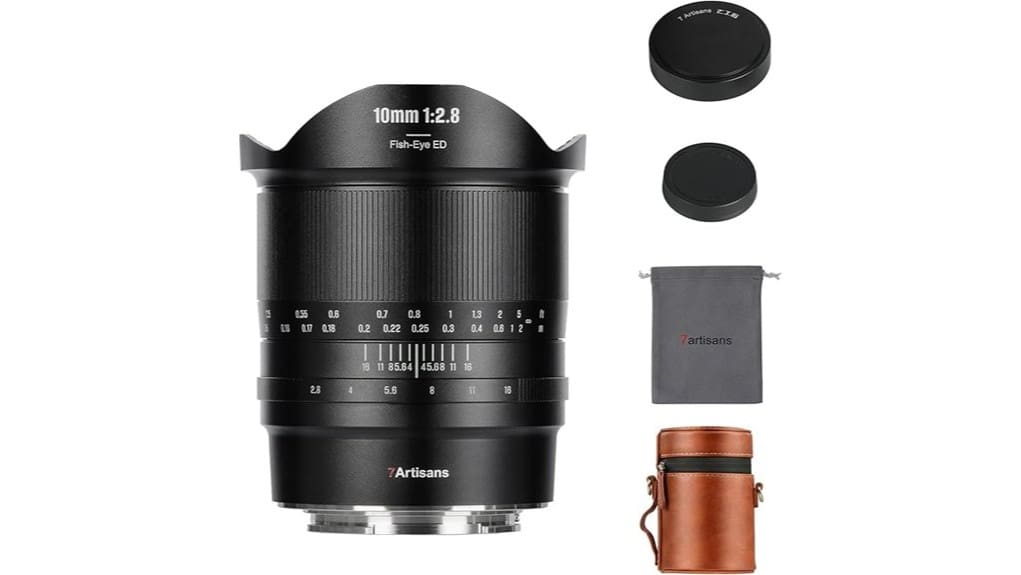
You get a true 185° full‑frame fisheye with a constant f/2.8 aperture, compact 602 g body, and an 8‑group/11‑element design including two ED and one aspherical element for strong center resolution and controlled chromatic aberration. It handles low‑light and astrophotography well with limited coma and correctable vignetting in RAW, but it’s manual focus only with no electronic contacts. If you want technical performance, creative ultra‑wide perspective, and practical compatibility notes, more specifics follow.
Some Key Takeaways
- True 185° full-frame fisheye delivering extreme ultra-wide field and dramatic perspective for creative and landscape work.
- Constant f/2.8 aperture and controlled coma make it strong for low-light and astrophotography with star-tracking.
- Optical design (11 elements/8 groups) with two ED and one aspherical element yields strong center resolution and good edge sharpness for a fisheye.
- Manual-focus only with 0.15 m minimum focus enables close-up fisheye effects, zone focusing, and focus-peaking techniques.
- Compact 602 g build in Leica/Panasonic/Sigma L mounts lacks electronic contacts, so RAW correction/EXIF depend on camera.
Real-World Look: What the 7artisans 10mm F2.8 II Delivers Optically
When you put the 7artisans 10mm F2.8 II on a full‑frame body, it delivers a true 185° fisheye sweep with controlled edge performance thanks to its 8-group/11-element design including two ED and one aspherical element. You’ll notice strong center resolution with measured edge sharpness that holds well across the field for a fisheye, minimizing soft falloff near the frame. Chromatic aberration is reduced, so lateral color fringing is limited and fine detail remains intact. Color rendition stays neutral and consistent across apertures, supporting accurate hues for post processing. Distortion character is predictable, enabling precise creative control. For photographers who enjoy exploring perspectives, mastering lens choices like this can significantly improve wide-angle results and zoom lens technique.
How It Handles Low Light, Night Sky, and Starry-Sky Shooting
Having established its solid edge-to-edge performance and low chromatic aberration, you can expect the 7artisans 10mm F2.8 II to perform strongly in low-light and night-sky work. Its constant F2.8 and 8-group, 11-element design with two ED and one aspherical element improves low light sensitivity, delivering usable exposures with reduced coma and controlled color fringing. The 185° ultra-wide field captures expansive starfields; vignetting is present but correctable in RAW. Manual focus requires precise setup, but the optical clarity suits long exposures and stacking workflows. Star tracking compatibility is excellent for modern trackers, though you’ll need accurate polar alignment for best results. For astrophotographers who also shoot timelapses, pairing the lens with a camera slider can add smooth foreground motion to night-sky sequences.
Focusing, Close-Up Fisheye Effects, and Creative Uses
Explore the 7artisans 10mm F2.8 II’s manual-focus design to exploit extreme close-up fisheye effects and precise compositional control: with a 0.15 m minimum focus distance and a true 185° field, you can create exaggerated perspective (oversized foreground subjects, compressed backgrounds) while maintaining edge-to-edge sharpness thanks to the 8-group, 11-element optics; manual control demands deliberate focus technique—zone focusing, focus peaking, or live-view magnification—to guarantee critical focus for portraits, macro-style shots, and creative distortion work. You’ll use controlled framing for extreme portraits and tabletop abstracts, leveraging curvature for dynamic lines, reflections, and surreal scale contrasts. Consider pairing these techniques with lens calibration to ensure optimal focus accuracy and consistent results.
Mount, Size, Weight, and Practical Compatibility Notes
Although compact, the 7artisans 10mm F2.8 II packs full-frame coverage into a 602 g body and offers mounts for Leica, Panasonic, and Sigma L-mount mirrorless systems. You’ll find straightforward mount compatibility across those three mounts, with no electronic contacts—manual aperture and focus only—so EXIF and in-camera corrections depend on your body. The barrel is short and well-balanced; handling ergonomics favor handheld and tripod use with small mirrorless rigs. At 602 g it’s portable for long hikes yet substantial enough to resist accidental knocks. Note lens hood and filter options are limited; check flange focal distance interactions for adapter use. This makes understanding lens mount adapters important when integrating the optic into different mirrorless setups.
Verdict: Who Should Buy the 7artisans 10mm F2.8 II and Alternatives to Consider
With its compact full-frame coverage, manual operation, and durable 602 g chassis, the 7artisans 10mm F2.8 II targets photographers who prioritize extreme ultra-wide perspective and creative control over autofocus convenience. You should buy it if you shoot landscapes, architecture, night sky, or experimental portraits and accept manual focus plus some fisheye distortion. Evaluate price comparison against native-brand fisheyes and wider rectilinear alternatives if you need autofocus or less pronounced distortion. Read user reviews for real-world sharpness, coma, and build notes before deciding. Alternatives to take into account include established fisheyes and ultra-wides offering AF, different coatings, or lighter ergonomics. Gear Guide caters to enthusiasts and camera fans seeking curated digital camera products and buying advice, making it a useful resource for enthusiast photographers.
Some Questions Answered
Does the Lens Include Weather Sealing?
No, it doesn’t have full weather sealing. You’ll get basic weather resistance in normal outdoor use, but there’s no all-encompassing environmental protection specified. There’s also no dedicated mount gasket reported to provide a sealed camera-lens interface, so you should avoid heavy rain, sand or prolonged moisture. Treat it as splash-resistant at best, use protective covers or a rain sleeve for demanding conditions, and avoid exposing the manual-focus mechanics to persistent moisture.
Is There Image Stabilization in the Lens?
No — the lens doesn’t include image stabilization. You’ll rely on camera-body IS or fast shutter speeds; the constant F2.8 helps low-light capture but won’t compensate for handshake. Optically, the design emphasizes vignetting control and reduced chromatic aberration via ED and aspherical elements, maintaining edge-to-edge sharpness. For handheld night or close-up fisheye work, pair it with in-body stabilization or a tripod to avoid motion blur.
Does It Support Electronic Aperture Control?
No — it doesn’t support electronic aperture control. You’ll be using direct mechanical aperture communication; there’s no electronic coupling to the camera body for iris adjustments. You’ll stop the lens manually on the barrel, and the camera can’t drive aperture changes or record electronic aperture metadata. Expect manual aperture operation and manual-exposure workflows; the lens provides optical specs but relies on you to adjust aperture and confirm settings on the camera.
What Is the Filter Compatibility or Filter Thread?
There’s no conventional front filter thread, so you can’t use standard screw‑in filters. You’ll need rear gelatin or specialized panoramic/clip‑on solutions; check lens cap compatibility since the bulbous front element often requires a specific cap or integrated cover. Hood options are typically fixed or built‑in to protect the protruding element rather than attachable petal hoods. For ND/grad needs, plan on rear filters or specialty adapter systems.
Is Autofocus Available With Any Camera Bodies?
No — autofocus isn’t available with any camera bodies. You’ll use manual focus only; the lens is purely mechanical and relies on your camera’s focusing aids (focus peaking, magnification). Expect optical quirks typical of extreme fisheyes (field curvature, pronounced distortion) that you’ll manage via composition and careful focusing. For precision close work or night scenes, use live view magnification and focus peaking to guarantee sharpness despite the lens’s unique rendering.