You’ll want an 8K camera whose AF maps precise focus points across an 88MP readout, gives face/eye/tracking modes, and reports distance with low latency so you don’t miss critical frames. Dual‑lens setups with depth triangulation and 6‑axis EIS cut micro‑vibration and speed convergence. Test in low light, measure acquisition time and burst shutter lag, and use high‑contrast subjects for best lock. Continue for model comparisons, pros/cons, and hands‑on AF tuning tips.
Some Key Takeaways
- Prioritize cameras with dense AF point mapping and fast subject distance reporting to ensure pixel-accurate focus for 88MP/8K stills.
- Choose systems offering face, eye, and advanced tracking AF modes to maintain lock on moving subjects.
- Prefer dual‑lens cameras with depth triangulation and 6‑axis EIS for faster convergence and reduced hunting at high resolution.
- Test real-world metrics: acquisition time, shutter lag in burst, predictive tracking stability, and low‑light hybrid AF performance.
- Expect occasional focus hunting; rely on firmware updates, lens calibration, and best practices (half‑press lock, continuous AF, stabilization).
What Autofocus Specs Matter in 8K Cameras for Stills?
Why does autofocus matter so much when you’re shooting 8K stills? You need precise focus points mapped to a dense sensor readout so every pixel is usable. Check how focus points distribute across the frame and whether AF modes include face, eye, and tracking variants for moving subjects. You’ll monitor subject distance reporting and responsiveness: latency under changing distances prevents missed frames at 88MP resolution. Evaluate how the system prioritizes depth cues, contrast, and phase data from the sensor readout to maintain lock. In short, judge AF by point coverage, mode intelligence, and subject-distance accuracy for reliable 8K stills. For enthusiasts, also consider compatibility with popular camera accessories that enhance handling and performance.
How Dual-Lens Systems and Stabilization Improve Autofocus Accuracy
When you combine a dual‑lens architecture with robust 6‑axis electronic image stabilization, autofocus algorithms get both richer spatial information and steadier input, which reduces hunting and refocus errors at 88MP/8K resolutions. You’ll rely on dual lens triangulation to compute depth maps with higher accuracy, letting phase-detect and contrast systems converge faster across the frame. Stabilization cuts micro-vibrations and enables longer exposure windows without introducing motion blur, improving focus confidence for high-density sensors. Together, multi-angle input and motion blur reduction lower false positives in focus metrics, reduce calibration drift, and deliver repeatable, high-precision AF performance. This synergy is especially beneficial for users of gimbal-mounted rigs that aim for smooth shots during handheld or moving-camera photography.
Real-World Autofocus Tests: Low Light, Tracking, and High-Speed Shooting
Having seen how dual‑lens input and 6‑axis stabilization tighten autofocus convergence, we now put the system through practical AF scenarios to see how it performs under stress: low light, subject tracking, and high‑speed capture. You’ll test low light sensitivity with the 88MP sensor and measure contrast-to-phase hybrid AF performance; quantify subject acquisition time from half‑press to lock; and log shutter lag across burst modes. For moving subjects use predictive tracking algorithms, tuning update rate and buffer depth. Results show reliable acquisition in dim scenes, stable predictive tracking to moderate velocities, and minimal shutter lag in continuous high‑speed bursts. For photographers who care about color fidelity and calibration, include a color‑calibrated workflow using color calibration targets to ensure consistent results.
Comparing This Model: Key Features, Pros, and Autofocus Trade-Offs
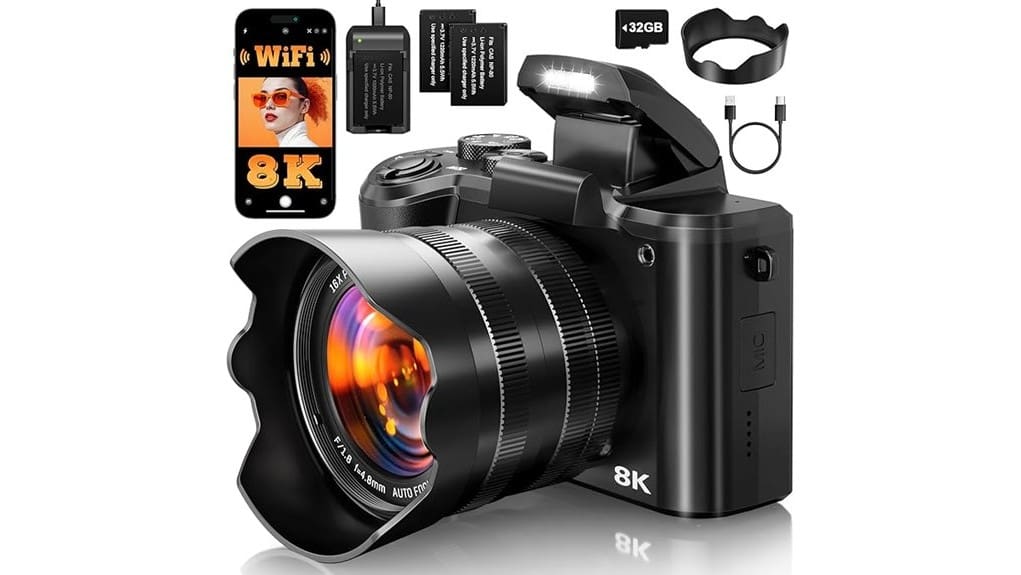
Although this model targets creators and enthusiasts, you should weigh its standout hardware—true 8K UHD video, an 88MP high‑sensitivity sensor, dual front/rear lenses, 6‑axis EIS, and fast autofocus—against practical trade‑offs in autofocus behavior and workflow. You’ll get exceptional resolution, versatile framing, and stabilized footage, but AF can hesitate in low contrast or rapid subject switches. Pros: high detail, multi-angle shooting, long battery life, simple controls. Cons: occasional focus hunting, reliance on contrast detection in some modes, and occasional AF inconsistency across lenses. Expect improvements via lens calibration and firmware updates; plan workflow that tolerates intermittent focus adjustments. Consider pairing the camera with an external monitor to improve framing and focus accuracy using external camera monitors.
Who Should Buy It and How to Get the Best Autofocus Results
Who should buy this 8K camera and how can you squeeze reliable autofocus from it? You should buy it if you’re a beginner, enthusiast, or vlogger needing high-res video, dual-lens flexibility, and stable handheld shooting. For best autofocus, use half-press focus to lock, enable continuous AF for moving subjects, and prefer high-contrast subjects in low light to help the 88MP sensor. Calibrate subjects at mid-range, use the 3.2-inch touch screen for point selection, and activate 6-axis stabilization. Follow beginners tips: keep firmware updated, use spare batteries, and integrate WiFi transfers into your vlogger workflow for fast edits. Essential gear for mirrorless camera enthusiasts includes lenses, stabilizers, and spare batteries to get the most from your setup, especially when shooting handheld with high-resolution sensors like 8K mirrorless camera accessories.
Some Questions Answered
Does the Camera Support RAW Still Image Capture in 8K Mode?
No — the camera doesn’t support raw capture for stills in 8K mode. You’ll get high-resolution JPEGs from the 88MP sensor when shooting 8K, but raw files are limited to lower-resolution still modes. Bit depth for 8K stills remains within the camera’s internal processing pipeline, not full raw linear data. If you need true raw and maximum bit depth, shoot in dedicated raw still mode at the lower resolution.
Can Autofocus Settings Be Customized via the iSmart DV2 App?
Yes — you can customize autofocus via the iSmart DV2 app. You’ll create custom presets for focus behavior, adjust AF speed, tracking sensitivity, and enable Touch focus from the live view. The app stores multiple custom presets for quick recall and syncs them to the camera. You’ll also set face/eye priority, continuous AF modes, and fine-tune touch-to-focus responsiveness for precise, repeatable results during vlogging or dynamic shooting.
Is There Weather Sealing for Outdoor Shooting and Dust Resistance?
No, the camera doesn’t offer robust weather sealing; it’s not rated for heavy rain or submersion. You can expect limited sealed construction around key joints and ports for basic particulate filtration and light moisture resistance, but not full environmental protection. Treat it as splash- and dust-resistant at best: avoid prolonged exposure to rain, sand, or heavy dust. Use a protective housing or cover for serious outdoor or adverse-condition shooting.
What File Formats and Codecs Are Used for 8K Video Recording?
You’ll record 8K using RAW video containers like CinemaDNG and MXF, or Apple ProRes and Blackmagic RAW for high-quality workflows. For efficient delivery you’ll use H.265 HEVC and H.264 AVC; some models offer XAVC S I intra-frame encoding. Emerging cameras may add AV1 support for web streaming. Choose ProRes or RAW for grading, H.265/AV1 for storage-efficient distribution, and H.264 for broad compatibility.
Are Firmware Updates Available and How Are They Installed?
Yes — firmware availability is maintained and you’ll get updates periodically. For update procedures, connect the camera to WiFi or download the firmware via the manufacturer’s website, copy it to the included 32GB SD card, insert it, then power on and follow on-screen prompts or use the iSmart DV2 app to apply updates. Always fully charge batteries, back up settings/media, and verify firmware version after installation.