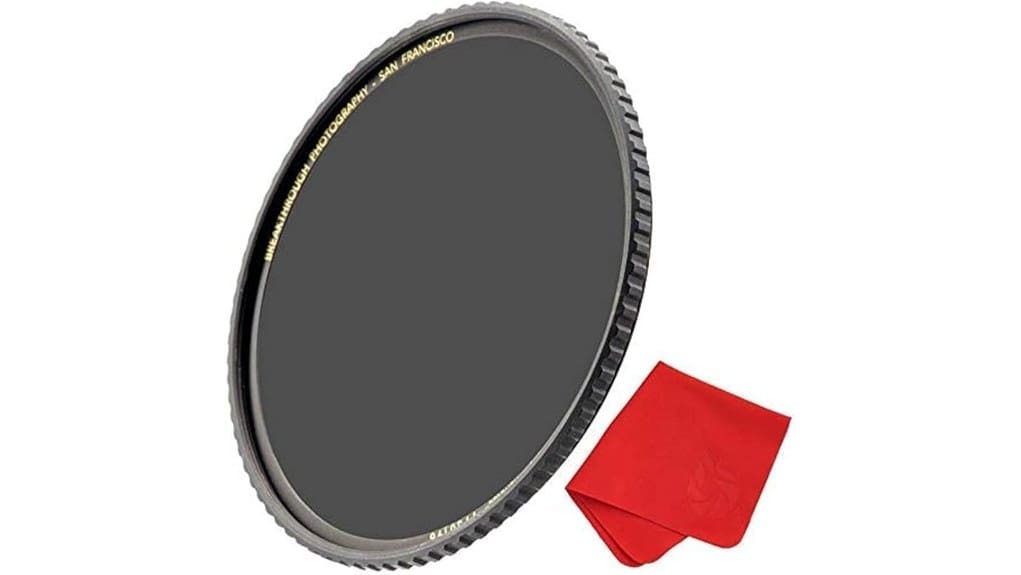
You’ll get a true 10-stop cutoff with near-neutral color and negligible sharpness loss, so you can stretch shutter speeds or open apertures for creative long exposures without heavy stacking. Schott B270 glass, MRC16 anti-reflective layers and Nanotec hydrophobic treatment keep contrast high and surfaces durable in harsh conditions. The filter is weather-sealed, ultra-slim, and built for pro landscape and architecture work, though it’s less flexible than variable NDs—keep going to see full test notes.
Some Key Takeaways
- True 10-stop neutral density reduces light reliably for long exposures and wider apertures in bright conditions.
- Schott B270 glass and MRC16 coatings preserve sharpness, microcontrast, and minimize flare and ghosting.
- Nanotec hydrophobic coating repels water, salt, and contaminants for easier cleaning and outdoor durability.
- Ultra-slim, weather-sealed 95mm design fits outdoor lenses and performs well in cold, dusty, or alpine environments.
- Premium build and 25-year warranty justify cost for landscape and architecture pros, but limits flexibility versus variable NDs.
How the X4 10-Stop ND Works and Who Needs It
Because it cuts light by 10 stops while preserving color neutrality and sharpness, the X4 10‑Stop ND lets you trade exposure for motion blur or wider apertures without introducing color cast or resolution loss. You’ll use it to control shutter speed for deliberate motion blur, extend exposures in bright conditions, or reduce depth of field where lenses can’t open further. In workflow terms, it reduces reliance on exposure stacking for noise control by enabling single long exposures. Evaluatively, it’s aimed at landscape, architecture, and creative long-exposure shooters who demand neutral, high-resolution attenuation in bright light. Mastery of graduated ND filters like those featured on our site helps photographers balance sky and foreground exposures for more compelling landscape images, making the X4 a valuable part of that landscape workflow.
Build, Glass, and Coatings: Schott B270, MRC16, and Nanotec Explained
When you inspect the X4’s construction, three engineered elements define its performance: Schott B270 optical glass for base clarity and dimensional stability, the MRC16 multi-resistance coating system to suppress reflections and preserve contrast, and the Nanotec environmental treatment that repels water and contaminants without compromising transmission. You’ll note glass sourcing from Schott guarantees consistent refractive index and low inclusions. MRC16’s 16 layers boost surface hardness and reduce ghosting; its formulation targets coating longevity under frequent cleaning. Nanotec delivers proven hydrophobic performance and resists salt, dust, and abrasion. Together they produce a rugged, optically stable filter you can trust. This combination of materials and treatments makes the X4 especially well-suited for photographers focused on lens filters and outdoor shooting.
Real-World Performance: Color Neutrality, Sharpness, and Long Exposures
Although a 10-stop ND can introduce measurable artifacts, the X4 delivers impressively neutral color and preserved microcontrast in real-world long exposures. You’ll notice excellent color fidelity across highlights and shadows; tint correction is minimal and consistent frame-to-frame. Sharpness loss is negligible when you stop down modestly; edge-to-edge resolution stays intact thanks to Schott B270 glass and MRC16 coatings minimizing scatter. Long exposures obey exposure reciprocity well—measured stops translate predictably to shutter time with only minor adjustments. For critical work, you’ll bracket and review histograms, but the X4 gives repeatable neutrality and microcontrast that professional landscapes demand. Consider pairing the filter with a quality lens filter kit to get the full range of creative options.
Weather, Durability, and Compatibility With 95mm Lenses
If you plan to shoot in harsh conditions, the X4’s Nanotec environmental protection and weather-sealed, ultra-slim design will keep your optics functional and clean. You’ll get extreme weather resistance: water-beading Nanotec, MRC16 hard coating, and Schott B270 glass resist salt spray, dust, and abrasive particles without compromising transmission. Durability is measurable—scratch and oil resistance extend service life; the proprietary coating is structurally harder than the substrate. Compatibility is straightforward: it fits all 95mm-thread lenses, but verify thread markings under the cap. In cold alpine scenarios its mountain ice performance prevents adhesion and facilitates cleaning, maintaining optical integrity. For photographers, pairing this filter with reliable backup gear helps ensure images and equipment stay protected in the field.
Buying Verdict: Strengths, Trade-Offs, and Who Should Buy the X4
Because the X4 delivers true 10-stop attenuation with flat spectral transmission and robust environmental protection, you’ll get reliable long-exposure performance without color casts or compromised sharpness. You’ll appreciate Schott B270 glass, MRC16 and Nanotec coatings for low flare, easy cleaning, and field durability. Strengths: laboratory-level neutrality, consistent exposure control, weather resistance, and a 25-year warranty that supports resale value. Trade-offs: fixed 10-stop limits flexibility versus variable NDs, and premium construction raises cost. Who should buy: landscape, architecture, and commercial shooters who prioritize image fidelity and predictable creative workflows; casual users may find it overbuilt. Many serious photographers also pair high-quality filters with cfexpress memory cards to handle large RAW files and high-resolution workflows.
Some Questions Answered
Does the Filter Affect Autofocus or Metering on Modern Cameras?
Yes — you’ll see effects. A 10-stop dense ND can introduce autofocus lag and force exposure bias because cameras struggle with low light reaching AF and metering sensors. Modern phase-detect systems may hunt; contrast-detect can slow. Using back-button AF, focus peaking, live view, or pre-focusing before screwing the filter on prevents most issues. Metering shifts often require + exposure bias or manual exposure compensation for accurate results.
Can the ND Be Stacked Safely With Other Filters or Polarizers?
Yes — you can stack the ND with other filters or a polarizer, but you’ll face stacking risks. You’ll introduce extra reflections, vignetting, and potential color casts despite the ND’s neutrality. Metering and autofocus usually work, yet you’ll need exposure compensation for combined light loss. Test combinations at varied apertures and angles; prefer slim profiles and high-quality multi-coated glass to minimize flare, ghosting, and mechanical interference.
Is There a Recommended Cleaning Method for the Nanotec Coating?
Yes. You should use a gentle, staged approach: blow or brush loose debris, then use microfiber swabs dampened with compatible cleaning fluid; avoid soaking the Nanotec layer. Verify solution compatibility with lens-coating-safe alcohol mixtures or proprietary cleaners—don’t use strong solvents or abrasives. Dab and roll swabs, work outward from center, and finish with a dry microfiber wipe. Store capped; avoid excessive pressure to preserve the hard MRC/Nanotec surface.
Are There Options for Other Thread Sizes or Step-Up Rings Included?
Yes — adapter availability exists via step-up rings sold separately; the filter itself fits 95mm threads, so size compatibility depends on your lens. You’ll need to verify your lens thread size under the cap or on the barrel, then acquire appropriate 95mm-to-your-thread step-up rings. This maintains optical performance while avoiding vignetting on wider lenses; evaluate ring quality to preserve flat transmission and coating protection.
How Do I Register the Serial Number to Activate the 25-Year Warranty?
You register the serial number via Breakthrough’s registration portal to activate the 25-year warranty. Use the serial lookup on the portal to confirm your filter’s authenticity, then complete the warranty activation form. Keep a copy of confirmation. If the serial lookup fails or you need help, contact customer support with purchase proof and serial. This technical registration guarantees traceable coverage and enables tracked support and product-feedback linkage.