
You’ll get a compact, affordable APS‑C wide zoom that’s optically corrected for everyday use: sharp centers from f/5.6, mild corner softening and vignetting wide, plus correctable distortion. The polycarbonate build is lightweight, the STM AF is smooth and quiet, and the Optical Image Stabilizer delivers about 3–4 stops of usable handheld stabilization. It’s ideal for landscapes, architecture, travel, and run‑and‑gun video on Canon crop bodies — keep going to see detailed performance, comparisons, and buying tips.
Some Key Takeaways
- Affordable, compact APS-C wide zoom offering 10–18mm (16–28.8mm equiv.) ideal for travel and landscapes.
- Good center sharpness from f/5.6, corners improve stopped down, with manageable distortion and vignetting.
- Quiet, smooth STM autofocus with minimal focus breathing benefits video and run-and-gun shooting.
- Optical Image Stabilizer delivers about 3–4 stops of handheld stabilization for photos and video.
- Lightweight polycarbonate build, 52mm filter support, and strong value versus older or third-party wide zooms.
Quick Verdict: Is the Canon EF‑S 10‑18mm Worth Buying?
While it’s not a professional-grade zoom, the Canon EF‑S 10‑18mm delivers exceptional value for APS‑C shooters: you get a compact, optically corrected wide-angle range with quiet STM autofocus and effective image stabilization at a very affordable price, making it a strong buy for landscape, architecture, and travel use where size and cost matter. You’ll find it an affordable choice that balances optical performance and portability; sharpness is respectable centrally, distortion and chromatic aberration are controlled, and IS plus STM suit handheld video. For hobbyists and enthusiasts seeking a travel favorite, it’s a pragmatic, cost-effective tool. Our site focuses on accessories like tripod compatibility to help you get the most from lenses like this.
What the Lens Offers: Build, Optics, and Key Specs
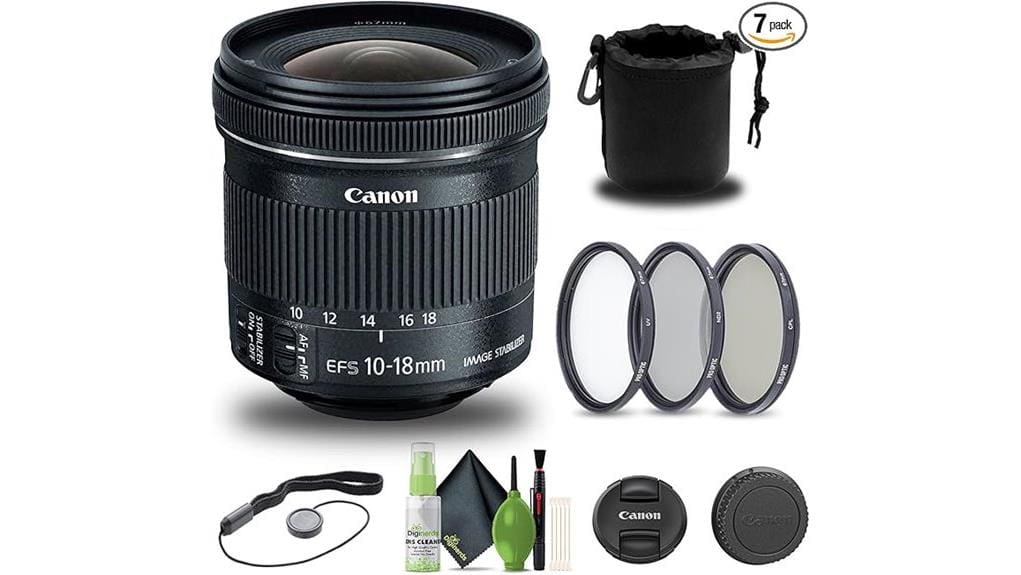
Because you’ll be working with APS‑C bodies, the 10–18mm concentrates useful wide-angle coverage into a compact, lightweight package that balances practicality with solid optical engineering. You get compact construction—polycarbonate barrel, modest weight, and a smooth zoom ring—so it’s easy to handhold and travel with. Optically, the four-group design includes a UD element and an aspherical element to control chromatic and spherical aberrations; a large-diameter element aids corner illumination. Super Spectra optical coatings reduce flare and ghosting. Specs: 10–18mm (16–28.8mm equiv.), f/4.5–5.6 aperture, rounded 7-blade diaphragm, STM AF, and Optical Image Stabilizer. This lens is a great fit for mirrorless camera enthusiasts looking for versatile wide-angle options with compact portability.
Real‑World Performance: Sharpness, Distortion, AF, and Stabilization
The compact build and optical ingredients set expectations for real-world behavior, so let’s see how the 10–18mm performs on the street and in the studio. You’ll find center sharpness strong from f/5.6 onward; corners improve stopped down but retain mild softening and a visible corner vignette at wide settings. Distortion is well controlled for a wide zoom thanks to the aspherical element, correctable in RAW easily. STM AF is smooth and quiet, reliable for stills and slow pans; you’ll notice minimal focus breathing when racking focus. IS gives 3–4 stops of usable stabilization for handheld work. For maintaining lens clarity during shoots, it’s worth keeping a high-quality lens cloth on hand to protect coatings and remove oils.
Who Should Buy It and Which Shoots It Suits Best
If you shoot landscapes, architecture, interiors or vlogs on an APS‑C Canon and need a lightweight, budget‑friendly ultra‑wide, this lens fits those briefs precisely: it gives you a true wide field (16–28.8mm equivalent), reliable IS for handheld work, quiet STM AF for video and stills, and optics tuned to keep distortion and chromatic aberration manageable. You’ll want this if you’re a beginner travelers photographer seeking easy-to-carry reach or a real estate interiors shooter needing expansive framing without heavy glass. It excels in tight spaces, environmental portraits, and run-and-gun video; low-light and shallow-depth tasks are its clear limits. If you’re often on the move and value portability, pairing this lens with a lightweight tripod can make travel shoots even more effective.
Value Checklist: Accessories, Alternatives, and Final Buying Tips
While you’re weighing the Canon EF-S 10‑18mm’s cost-to-performance, factor in essential accessories and practical alternatives to judge real value; they’ll affect total outlay and usability more than the lens body alone. Check accessory compatibility: 52mm filters, hood, pouch, and a stabilizing tripod plate fit easily, and the included filter kit and pouch improve immediate usability. Compare against used 10–22mm, third-party 10–18 equivalents, or a full-frame wide zoom if you might upgrade. Evaluate long term value by scoring optical performance, STM focus, IS benefit, resale, and how often you’ll need wider coverage before spending more. Consider pairing the lens with a sturdy light stand or tabletop tripod from a specialist retailer to improve shooting stability and versatility, especially for photographers who enjoy studio and on-location work with small lighting setups; see options for photography light stands.
Some Questions Answered
Is This Lens Weather-Sealed for Outdoor Use?
No — the lens isn’t weather-sealed. You’ll get basic weather resistance from its metal/plastic build and coatings, but it lacks dedicated environmental protection seals at mounts and controls. That means you shouldn’t rely on it in heavy rain, dust storms, or prolonged moist conditions. Use a rain cover or shoot under shelter for outdoor work, and dry/clean the lens promptly after exposure to moisture to avoid long-term damage.
Can It Be Used on Full-Frame Canon Bodies?
No — you can’t mount it directly on full-frame Canon DSLRs without severe vignetting. The EF-S design projects a smaller image circle for APS-C sensors. You could use it on full-frame bodies only with a crop adapter or mirrorless adapter plus a compatible camera that crops or uses Super35-style crop mode, but you’ll lose coverage and resolution. For full-frame use, choose a native full-frame wide-angle or an EF-design lens instead.
Does the Lens Accept 77MM or Other Common Filter Sizes?
No — the lens uses a much smaller front filter size, so it won’t accept 77mm filters. You’ll fit filters sized for the lens’s actual thread (typically around 67mm or smaller depending on production), and you’ll still use the lens cap and a rear adapter if you need to protect or adapt it for special mounting. You should verify the exact front thread on your copy; using the correct filter size avoids vignetting and guarantees secure attachment.
How Compatible Is It With Third-Party Lens Hoods?
You’ll find third-party compatibility generally good; aftermarket hoods for the 10–18mm fit securely if they’re designed for Canon EF-S short petal mounts. Verify dimensions and bayonet specs before purchase and rely on fit testing from reputable sellers—some generic hoods can vignette or rub on front elements. Choose hoods labeled for EF-S 10–18mm or 10–22mm, check return policies, and expect equivalent sunflare protection to Canon’s OEM hood.
Is There a Focus Distance Scale on the Lens?
No — the lens lacks a focus scale on the barrel. You’ll rely on the camera’s live view, viewfinder indicators or distance markings in menus for precise framing and focus confirmation. The optical design still delivers close performance, but the minimum focus distance (0.22–0.25m depending on focal length) governs how near you can get. For technical or hybrid shooting you’ll want to verify focus with magnified live view or focus peaking if available.