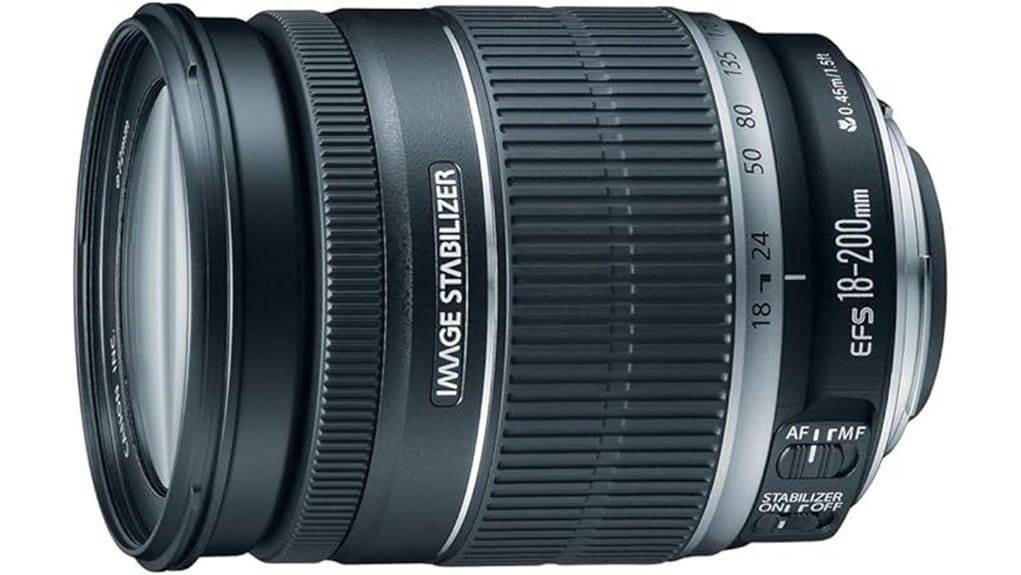

You’ll find the Canon EF‑S 18‑200mm f/3.5‑5.6 IS a pragmatic, do‑everything zoom that favors convenience and range over class‑leading optics or weather sealing. Center sharpness is usable stopped down, edges soften wide open and at long tele; CA and busy bokeh edges are correctable in RAW. AF is competent in good light but driven by a micromotor, and IS gives about four stops of handheld help. Keep expectations modest — more details follow if you want them.
Some Key Takeaways
- Versatile all-in-one APS-C zoom (18–200mm) ideal for travel and run-and-gun shooting, prioritizing convenience over peak image quality.
- Center sharpness is usable across focal lengths; edges soften wide-open and at long telephoto, improving when stopped down.
- Optical Image Stabilizer delivers roughly four stops of handheld correction, aiding telephoto shots and casual vlogging.
- Autofocus is competent in good light but uses a basic micromotor, hunts in low light, and lacks full-time manual override.
- Affordable renewed units offer value but check optics, AF, and warranty; higher-quality alternatives exist for demanding users.
Quick Verdict: IS the Canon EF-S 18-200MM F/3.5-5.6 IS Worth Buying?
While it won’t replace dedicated primes or pro telezoom glass, the Canon EF-S 18-200mm f/3.5-5.6 IS gives you a highly practical, do-everything option for APS-C shooters who prioritize convenience and range over ultimate image perfection. You’ll get affordable versatility: one lightweight, compact unit covering wide to long telephoto, useful for travel convenience and run-and-gun shooting. The optical IS delivers usable stabilization (around four stops), and autofocus is competent though driven by a basic micromotor. Build is average, no weather sealing. If you value single-lens practicality and cost-effective flexibility over peak optics, it’s a sensible buy. It’s especially handy for photographers learning how to get the most from zoom lenses in varied shooting situations.
Optical Performance: Sharpness, Aperture Behavior, Chromatic Aberration, and Bokeh
Although the 18–200mm covers an impressive range, you should expect compromises in optical performance. You’ll find center sharpness usable across most focal lengths, but sharpness consistency towards the edges falls off, especially at wide-open apertures and long tele. Stopping down improves mid-frame resolution, yet aperture diffraction limits peak detail beyond f/11–f/16. Lateral chromatic aberration appears at high-contrast edges, correctable in raw processing but noticeable in JPEGs. Bokeh is pleasant at longer focal lengths with the seven-blade diaphragm, though specular highlights show busy edges and nervous rendering when stopped down. Overall: competent, not class-leading. For cleaning and maintaining optical clarity, consider using quality lens-cleaning supplies like microfiber cloths and solution recommended by Crystal Clear Shots.
Autofocus, Image Stabilization, and Handling in Real Shooting Conditions
Expect the EF-S 18–200mm’s AF to be competent but not class-leading: its micromotor drive locks reasonably fast in good light but hunts in low light and won’t give you full-time manual override, so you can’t tweak focus without switching modes. You’ll get acceptable autofocus consistency for casual shooting and travel, but tracking fast subjects is hit-or-miss. The optical IS delivers up to four stops of correction; handheld stabilization is effective for static and mildly active scenes, noticeably improving keeper rates at tele. Handling is compact and light, zoom creep minimal, control feels utilitarian—reliable but not premium. For photographers who prioritize portability and versatility, pairing this lens with a camera stabilizer can further improve handheld results.
Who Should Buy This Lens : Use Cases, Camera Compatibility, and Limitations
If you want a single, do-it-all lens for travel and everyday shooting, the Canon EF-S 18–200mm delivers a compact, affordable solution that covers wide-angle to telephoto on APS-C bodies. You should buy it if you prioritize convenience: travel photography, urban exploration, and mixed shooting where changing lenses slows you down. It’s ideal as a beginner telephoto option and works for casual vlogging compatibility on crop DSLRs with optical IS. Don’t expect professional sharpness, weather sealing, or fast apertures; AF is micromotor-driven and renewed condition varies. Choose it for versatility, not ultimate optical performance. Consider pairing it with other mirrorless accessories to expand your shooting options.
Price and Alternatives: Renewed Value, Comparable Lenses, and Final Buying Recommendation
While a renewed Canon EF-S 18–200mm usually sells for markedly less than a new unit, its value depends on condition, warranty length, and how you weigh versatility against optical compromises. You’ll get broad coverage, 4-stop IS and compact handling, but evaluate used condition carefully—check optics, AF operation, and the 90-day warranty. If you prioritize image quality, consider prime or higher-grade zooms (EF-S 17–55mm f/2.8, EF 70–200mm f/4) despite higher cost. For tight budgets, look at budget alternatives like third-party 18–200/18–135 options or reliable kit lenses. Buy renewed only when price justifies tradeoffs. Consider also carrying a spare battery to avoid missing shots when shooting long with a versatile zoom due to battery drain.
Some Questions Answered
Does This Renewed Lens Include Original Caps and Hood?
No — renewed listings don’t guarantee original caps or a replacement hood; you shouldn’t assume they’ll be included. You should check the seller description and ask directly whether original caps are present and if a replacement hood is provided. If caps or hood are missing, expect aftermarket replacements to work fine. I’d recommend confirming photos and return policy before buying, since renewals vary and you want assurance on accessories and condition.
Is the Warranty Extendable Beyond 90 Days?
No, the renewed unit ships with a 90-day limited warranty and you can’t extend that through Canon directly. You’ll need third-party warranty extensions or service plans from the retailer or a specialized provider. I’d recommend comparing coverage limits, deductibles, and authorized repair channels before buying. For technical gear, choose plans that explicitly cover optical faults, image stabilization failures, and electronic focus motors to avoid surprise exclusions.
Can It Be Used on Full-Frame Canon Bodies?
No — you can’t use it natively on full-frame Canon bodies. The EF‑S lens projects a smaller image circle sized for APS‑C sensors, so it would vignette heavily on full‑frame. You could fit it with a mount adapter that forces EF‑S onto EF bodies, but you’ll face severe crop, vignetting or degraded edge performance; adapters don’t enlarge the image circle. I wouldn’t recommend it for full‑frame shooting except as a last‑resort hack.
How Weather-Resistant Is the Lens Construction?
It’s not very weather-resistant; you shouldn’t rely on seal integrity for harsh conditions. The renewed EF-S 18-200mm lacks robust environmental testing and factory weather sealing, so dust and moisture can penetrate during heavy use. You’ll get basic protection in light drizzle or casual outdoor use, but for serious wet or dusty environments you should add protective measures—rain cover, silica packs, or choose a lens with documented sealing and lab-tested durability.
Does It Come With Any Calibration or Service History?
No — renewed listings typically don’t include formal service records or documented optical alignment reports. You’ll get a functional, inspected unit with Canon’s or the seller’s basic refurb checks, but don’t expect full calibration certificates. If you need verified optical alignment history, ask the seller for detailed service records or request an independent technician’s adjustment before purchase. I’d recommend insisting on return protection or a thorough inspection period.