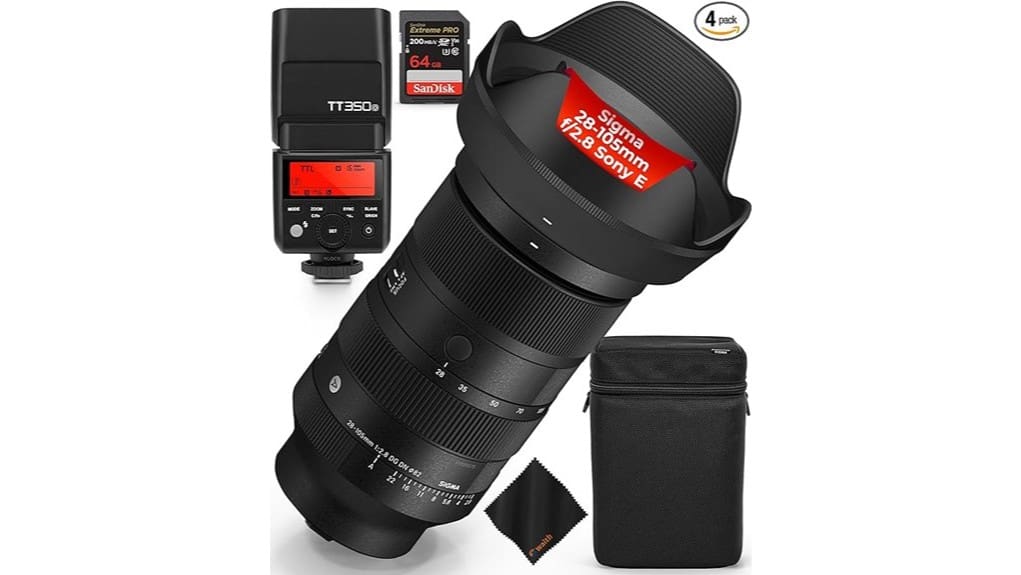

You’ll find the Sigma 28–105mm f/2.8 DG DN Art gives near‑prime sharpness across the center, a constant f/2.8 for subject isolation, and fast, quiet HLA autofocus that tracks predictably. It’s compact, weather‑resistant, and balances well on Sony E bodies for handheld work. Expect mild edge falloff and some focus breathing, no optical stabilization, and controlled noise at moderate ISOs. Keep going and you’ll get full details on handling, optics, and practical tradeoffs.
Some Key Takeaways
- Consistently strong center sharpness across 28–105mm delivers near-prime detail for stills and video.
- Constant f/2.8 provides reliable low-light performance and consistent subject isolation throughout the zoom.
- Fast, quiet HLA autofocus gives predictable tracking and minimal focus breathing for hybrid shooters.
- Robust, weather-resistant build with balanced handling and precise zoom/focus rings suits handheld work.
- No optical stabilization — use gimbals, tripods, or in-body stabilization on Sony bodies for steady footage.
Performance at a Glance: Sharpness, Autofocus, and Low‑Light Handling
Typically, you’ll notice the Sigma 28-105mm f/2.8 DG DN Art delivers consistently strong center sharpness across the zoom range, with peripheral resolution tapering slightly at the widest and longest focal lengths; its constant f/2.8 aperture helps maintain subject isolation and steady exposure when you’re working in mixed lighting. You’ll get reliable autofocus with fast, quiet HLA-driven moves and predictable tracking for stills; contrast and edge definition remain high across apertures. Low-light performance benefits from wide aperture and good dynamic range on modern Sony bodies, keeping shadow detail while noise performance stays controlled at moderate ISOs. The lens is a great fit for photographers who prefer wide-angle perspectives and want versatile coverage without changing glass.
Build, Handling, and Ergonomics for Sony E Shooters
Having seen how the 28–105mm f/2.8 performs optically and in low light, you’ll appreciate how its construction supports that performance in the field. You get a robust metal-and-polymer chassis with weather resistance that mates cleanly to Sony E bodies. Zoom and focus rings are damped precisely; the HLA AF motor is quiet and responsive. Compact controls are logically placed: a textured zoom ring, a narrower focus ring, and a customizable AF lock. Balance remains centered across the zoom range, aiding handheld shooting. Grip comfort on your camera is notable—ergonomic weight distribution and a secure mounting collar minimize fatigue. For photographers carrying gear into the field, a dedicated camera backpacks setup can make transporting the lens and accessories much easier.
Optical Behavior: Distortion, Vignetting, Chromatic Aberration, and Bokeh
While the Sigma 28–105mm f/2.8 delivers strong center sharpness, you’ll notice predictable optical trade-offs toward the edges: barrel distortion is present at 28mm, gently shifting to mild pincushioning by 105mm, and both are readily corrected in-camera or in post. Vignetting is noticeable wide open, especially at 28mm, but closes appreciably by f/5.6. Lateral CA is well controlled; longitudinal chromatic effects appear in high-contrast out-of-focus transitions when shooting wide open, so stop down for critical work. Bokeh is generally smooth with slightly busy highlights; petal shaped bokeh appears occasionally near frame edges, but remains pleasant for portraits. For shooters using filters, a quality circular polarizer or graduated filter can help manage reflections and contrast while maintaining image integrity, especially when combined with proper filter technique.
Video Features and Flash Pairing (Stabilization, Focus Breathing, and TT350S Use Cases)
Often overlooked for run-and-gun video work, the Sigma 28–105mm f/2.8 is a capable cine-friendly zoom when paired with a stabilizing platform and the TTL Godox TT350S for controlled lighting. You’ll rely on stabilization strategies: gimbals for handheld, tripod-plus-dolly for precise pans, and lens-mounted support for macro or low-angle shots since the lens lacks optical IS. Expect minimal focus breathing; it’s noticeable only at the extremes but manageable with careful pull timing. Integrate flash workflows using the TT350S for fill, backlight, or keyed strobe; use high-speed sync and radio triggering to maintain sync at wider apertures. For the best results in motion-heavy shoots, consider balancing and tuning your handheld gimbal to match the lens’ weight and length.
Who Should Buy It? Use Cases, Alternatives, and Final Verdict
Because it blends a fast constant f/2.8 aperture with a versatile 28–105mm range, the Sigma 28–105mm f/2.8 DG DN Art is aimed at photographers and hybrid shooters who need a single, high-quality zoom for run-and-gun assignments, event coverage, and on-location video without swapping glass. You’ll benefit if you’re a travel photographers or a budget filmmakers seeking sharp optics, robust build, and near-prime performance across focal lengths. Use cases: weddings, corporate events, travel, documentary, and handheld video with external stabilization. Alternatives: native 24–70mm f/2.8 plus tele zoom for reach. Verdict: exceptional value for versatility and image quality. It’s a great match for owners of mirrorless cameras who want one lens to cover most shooting scenarios.
Some Questions Answered
Is This Lens Weather-Sealed for Shooting in Rain?
No — it isn’t fully weather-sealed. You’ll get moisture resistance? from Sigma’s water-resistant construction at key joints, but that’s not a guaranteed weather sealing? rating. You shouldn’t rely on it for heavy rain or prolonged exposure. Use a rain cover or limit shooting in wet conditions, and dry/clean contacts afterward. For professional outdoor work in adverse weather, choose lenses specified as fully weather-sealed by the manufacturer.
Does the Lens Accept 82MM Threaded Filters?
Yes — you can use 82mm threaded filters; the lens accepts them directly. You’ll appreciate the clear filter compatibility: Sigma designed the front element and barrel to accept standard 82mm screw-in filters without adapters. When mounting polarizers or ND filters, handle the front element carefully to avoid touching coatings. For stacked filters or thick holders, verify vignette impact at 28mm, since wide-angle performance can be affected by added filter thickness.
How Long Is the Manufacturer Warranty Period?
The manufacturer provides a limited warranty; you’ll need to check the specific paperwork for exact warranty duration, as the listing only states “limited warranty.” You should verify coverage limits before purchase, since those define what’s excluded (accidental damage, wear, unauthorized repairs). Contact the seller or Sigma with the ASIN B0DKPDYYVS and your serial number to obtain precise warranty duration and written details on coverage limits and claim procedures.
Is the TT350S Flash Included Compatible With Older Sony A-Mount Bodies?
No, the TT350S flash isn’t natively compatible with older Sony A-mount bodies; it’s designed for Sony E systems and supports Sony ADI/P-TTL on E-mount. You can use mount adapters to attach the flash physically, but flash compatibility functions (TTL, high-speed sync, wireless TTL) won’t be guaranteed and often won’t work through passive adapters. For full TTL features on A-mount, choose a flash or transmitter specifically supporting Sony A protocols.
Can the Lens Be Used on APS-C Sony Bodies Without Crop Issues?
Yes — you can use the lens on APS C Sony bodies; it offers full APS C compatibility. You’ll have a cropped field of view, not optical issues. Expect a focal equivalent of roughly 42–157.5mm on APS C (1.5× crop), which changes framing and reach. You’ll retain autofocus and aperture behavior, but vignetting and resolution distribution differ versus full-frame. Metering and stabilization depend on the camera body.