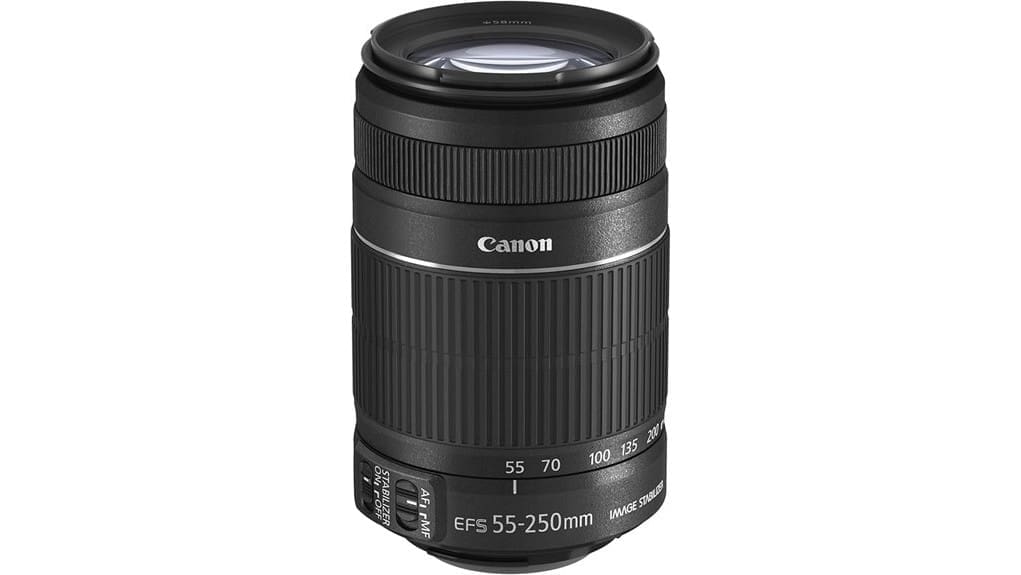
You’ll find the Canon EF‑S 55–250mm f/4–5.6 II a pragmatic, lightweight telezoom that gives good reach for travel and casual wildlife on APS‑C bodies. It’s plasticky but easy to carry, with a DC motor and front‑focusing that’s reliable in good light though not ultrafast. Stopped down a stop or two it yields respectable center sharpness; edges and CA suffer toward 250mm. It’s great as an affordable starter telephoto, and the sections below explain trade‑offs and alternatives.
Some Key Takeaways
- Lightweight, budget telephoto zoom delivering useful 55–250mm reach for APS-C Canon users.
- Good center sharpness stopped down (around f/8) but edges soften toward 250mm and wide apertures.
- UD element limits longitudinal color; lateral chromatic aberration appears at high-contrast edges.
- DC motor with front-focusing is reliable in good light but slower and prone to hunting in low contrast.
- Best for hobbyists and travel; not ideal for pro fast-action or low-light work—consider STM, Sigma, or used L alternatives.
Quick Verdict: Is the Canon EF-S 55–250mm F/4–5.6 II Worth Buying?
Wondering if the Canon EF-S 55–250mm f/4–5.6 II is worth buying? You’ll find it’s a pragmatic budget telephoto that gives reach without hefty cost. You assess build and performance against price: plastic construction and a DC motor mean lightweight handling but modest autofocus speed; front-focusing simplifies use but can feel less refined. Optics include a UD element, supporting competent results for casual shooters. If you need robust long term durability for heavy professional use, this isn’t ideal. For hobbyists or travel photographers seeking economical reach, it’s a solid, cost-effective choice. Many photographers pair such lenses with essential DSLR accessories to maximize usability and protection.
Image Quality and Optics at 55–250mm
Although the EF-S 55–250mm II is a budget telephoto, its optics deliver good, usable results across the zoom range when you stop down a stop or two. You’ll find centre sharpness is respectable from 55mm through 250mm at f/8, resolving fine detail for prints and web. Edge sharpness lags at wide apertures and towards the long end, so compose with care or crop conservatively. The UD element helps control longitudinal color, but lateral chromatic aberration appears in high-contrast edges, especially at 250mm; you’ll remove most of it in RAW conversion. Overall contrast is solid when stopped down. These characteristics make it a practical choice for photographers exploring creative perspectives with fisheye lenses.
Autofocus, Handling, and Build in Everyday Shooting
Typically, the EF-S 55–250mm II’s autofocus is workmanlike rather than lightning-fast: its DC motor and gear-driven front-focusing system will acquire and track subjects reliably in good light but can struggle with fast-moving subjects or low-contrast scenes. You’ll notice consistent focus accuracy for static or moderately paced subjects, though hunting appears under challenging lighting. Handling ergonomics suit casual use: the lightweight telephoto zoom balances well on APS-C bodies and you’ll operate the zoom ring smoothly, but plastic construction and a simple mount limit robustness. Overall build feels economical yet practical for everyday shooting where predictability matters more than speed. This makes it a sensible choice for photographers learning to master telephoto lenses in wildlife and sports photography.
Who This Lens Is Best For and Alternatives to Consider
If you shoot on an APS-C Canon and need an inexpensive, lightweight telephoto for travel, wildlife at a distance, or casual sports, the EF-S 55–250mm II is a sensible choice because it delivers useful reach, consistent sharpness for static subjects, and easy handling without breaking the bank. You’ll appreciate it as an enthusiast wildlife starter lens or for budget travel where weight and cost matter. It won’t satisfy fast-action pros or low-light shooters due to modest aperture and gear-driven AF. Consider alternatives: Canon EF-S 55-250mm IS STM for quieter focus, Sigma 100–400mm for greater reach, or used EF 70–200mm f/4L for build and optics. Many enthusiasts find mastering zoom lenses improves composition and versatility.
Buying Tips: Compatibility, Condition, and Value
When shopping for the EF-S 55–250mm II, prioritize mount compatibility, condition, and overall value so you get a working telephoto without surprises. First, check compatibility with your Canon DSLR body—EF-S mounts require an APS-C camera; international versions may lack warranty. Next, assess condition: inspect the mount, aperture blades, UD element, and front-focusing mechanism; test autofocus via the DC motor and confirm closest focus at ~1.1 m. Finally, compare prices across used, refurbished, and new listings; factor in return policy and seller reputation. Balance optical needs, mechanical state, and total cost to decide. Also consider whether this lens fits your mirrorless transition plans and any adapter needs.
Some Questions Answered
Does This Lens Include Image Stabilization (IS)?
No, it doesn’t include image stabilization. You’ll rely on optical stabilization only if the specific IS-marked version is specified; this international EF-S 55-250mm II variant lacks IS/optical stabilization. You’ll get the listed optical design, UD element, and a DC motor front-focusing system, but not built-in vibration reduction. For steady handheld telephoto shots, you’ll need a stabilized camera body, faster shutter speeds, a tripod, or seek the IS-labeled edition instead.
Is a Lens Hood or Case Included With Purchase?
No, a lens hood or case isn’t included with purchase. You’ll get the lens only (international version, no warranty), so plan to buy a compatible lens pouch or lens bag separately if you need protection. Given its front-focusing design and 55–250mm telephoto build, a padded lens bag or snug lens pouch helps prevent impact and dust. Check exact dimensions before buying to make certain proper fit and adequate padding.
Can This Lens Be Used on Full-Frame Canon Cameras?
No — you can’t directly mount this EF-S lens on full frame? bodies without issues. EF-S lenses are made for APS-C sensors, so using a mounting adapter on a full-frame camera will cause severe vignetting and image-circle mismatch unless the camera forces crop mode. You’d need a special adapter and you’ll face crop factor and optical limitations; realistically it’s best used on crop-sensor Canon bodies to avoid vignetting and compatibility problems.
Is This Lens Compatible With TC (Teleconverters)?
No, it’s not reliably compatible with most teleconverters. You’ll run into mounting and clearance issues because the lens has an EF-S mount and a protruding front element, and any TC designed for EF lenses may not fit or may cause damage. Even if a TC mounts, you’ll lose light and autofocus performance; focus breathing and the DC gear-driven front-focusing design will worsen AF speed and accuracy. Stick to native use for best results.
What Is the Filter Thread Diameter?
The filter thread diameter is 58 mm. You’ll want 58 mm filters for this lens, and you can use Thread adapters if you need to fit different filter sizes or step-up/step-down rings. Because the lens uses a front-focusing, gear-driven design, check adapter clearance to avoid vignetting at long focal lengths. You’ll also confirm the international version’s specs with the manufacturer, since descriptions can be abbreviated and accessory fitment matters for performance.