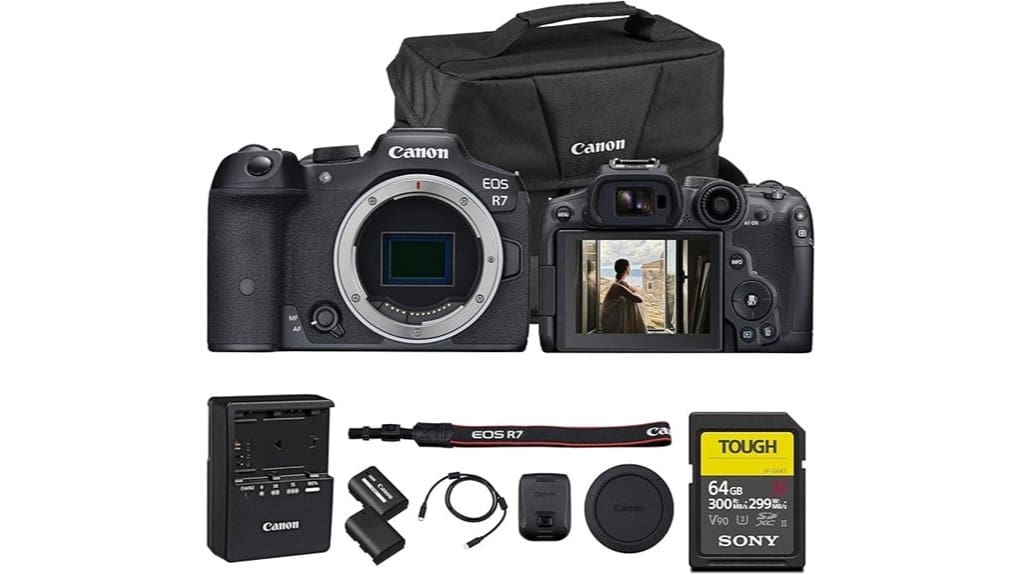
You’ll find the Canon EOS R7 gives you 32.5MP APS‑C stills with fine detail, oversampled 4K60 from a 7K read and 10‑bit color for solid grading latitude. Its Dual Pixel CMOS AF II plus deep‑learning tracking and up to 30 fps electronic bursts make it excellent for sports, wildlife and hybrid vlogs, though low‑light range lags some full‑frame rivals. Handling is compact and workflow‑friendly, battery life is fair, and accessories help extend shoots — keep going to see full specs and comparisons.
Some Key Takeaways
- 32.5MP APS-C sensor delivers high-resolution stills with strong detail and texture retention.
- Oversampled 4K60 (from 7K read) and 10-bit C-Log 3 provide cinematic grading latitude.
- Dual Pixel CMOS AF II plus deep-learning tracking reliably follows people, animals, and vehicles.
- Electronic burst up to 30 fps (mechanical 15 fps) suits wildlife and sports, with UHS-II buffer support.
- Compact ergonomics, LP-E6P battery, and built-in Wi‑Fi make it a travel-friendly hybrid option.
What the Canon EOS R7 Offers at a Glance
Explore what the Canon EOS R7 brings to the table: a 32.5MP APS-C sensor that yields high-resolution stills and oversampled 4K60 video from a 7K source, 10-bit color with C-Log 3 and HDR PQ for cinematic grading, and a burst engine built for action—up to 30 fps with the electronic shutter and 15 fps mechanically—making it a strong hybrid for wildlife, sports, and content creators; add Dual Pixel CMOS AF II with deep-learning subject tracking (eyes, faces, animals, vehicles), robust connectivity via Wi‑Fi/Bluetooth and Canon cloud/webcam utility, plus a pro-oriented kit including an LP-E6P battery and a 64GB UHS-II card, and you get a camera that balances resolution, speed, and workflow integration better than many APS-C rivals.
You’ll notice compact ergonomics that feel deliberate—grips, dials, and menu layout suit prolonged use—while the bundled accessories and beginner pricing position the R7 as an attainable pro-grade step up.
The site also carries essential mirrorless accessories to help you get the most from the R7, like compact grips and upgraded memory cards.
Image Quality and Video: 32.5MP Stills, Oversampled 4K60, and 10‑Bit Color
Having covered the R7’s handling, speed, and autofocus, let’s examine what the sensor and video pipeline actually deliver in images and footage. You’ll get 32.5MP files that resolve fine detail for high resolution landscapes, retaining texture and microcontrast better than many APS-C rivals. Still noise control is strong up to mid ISOs; sharpening trade-offs are manageable in RAW. Video uses oversampled 4K60 from a 7K read, producing cleaner 4K with fewer artifacts than line-skipped capture. 10‑bit output with C-Log3 or HDR PQ lets you perform cinema grade grading, preserving latitude for highlights and shadows. For travel photographers who need to keep gear light, pairing the R7 with a lightweight tripod designed for portability and stability can significantly improve landscape and low-light results.
Speed, Autofocus, and Real‑World Tracking Performance for Sports and Wildlife
Frequently, the R7’s responsiveness is what sets it apart in fast-action scenarios: you’ll get up to 30 fps with the electronic shutter and 15 fps mechanically, letting you pick the cadence that best suits sports or wildlife sequences while reducing missed moments compared with many APS-C competitors. You’ll rely on Dual Pixel CMOS AF II and deep-learning subject tracking for consistent hits on runners, birds, and vehicles. In comparative tests, acquisition speed rivals full-frame alternatives, and low light tracking remains usable though sensitivity limits appear sooner. Buffer management is robust with UHS-II cards, but long bursts still require pace and periodic pauses. For shooters pairing the R7 with support gear, a sturdy tripod can significantly improve image stability during long wildlife sessions, especially when using heavy telephoto lenses and precision tripod heads.
Handling, Battery Life, Connectivity, and Workflow Integration
After covering how the R7 handles high-speed capture and tracking, it helps to look at how the camera feels in prolonged use and how its power and connectivity support a modern workflow. You’ll notice handling ergonomics are strong: deep grip, well-placed buttons, and a responsive touchscreen that reduce fatigue compared with smaller APS-C bodies. Battery longevity with the LP-E6P is adequate for long shoots but you’ll want a spare for 4K60 or extended burst sessions. Built-in Wi‑Fi/Bluetooth and Canon cloud make transfers reliable and faster than older USB-only models, fitting smoothly into hybrid mobile/desktop workflows. Consider keeping a high-quality spare camera battery on hand to avoid downtime during long shoots.
Who Should Buy the EOS R7 : Use Cases, Alternatives, and Final Verdict
Who should pick the EOS R7 and why does it stand out? You’ll want the R7 if you need a versatile APS-C hybrid: wildlife and sports shooters benefit from 30 fps burst and advanced AF, travel vloggers get oversampled 4K60 and compact handling, and budget conscious beginners gain pro-level features without full-frame cost. It’s stronger on speed and tracking than entry-level bodies, and more affordable than many full-frame mirrorless alternatives. Consider an R6 or APS-C Sony for low-light or lens ecosystem trade-offs. Verdict: buy if you prioritize speed, autofocus, and high-res video in a midrange package. The site also offers curated accessories and lens options for camera fans and enthusiast photographers gear guide.
Some Questions Answered
Does the R7 Have In-Body Image Stabilization (IBIS)?
Yes — the R7 has in-body image stabilization (IBIS). You’ll notice strong stabilization performance for handheld stills and video, often matching or improving on non-IBIS APS-C bodies. IBIS reduces blur, complements stabilized RF/EF-S lenses, and enables slower shutter speeds. Expect some extra battery impact during prolonged IBIS use, so carry the spare LP-E6P. Compared to competitors, it balances effectiveness and power draw well for action and travel shooting.
Can the R7 Use Full-Frame RF Lenses Without Crop Mode?
No — you can’t use full-frame RF lenses on the R7 without crop mode; the APS-C sensor forces a 1.6x crop when you mount full-frame glass. With full frame adaptation you’ll still get excellent center resolution, but you’ll often see lens vignette reduced at the edges and a narrower field of view versus native full-frame bodies. Comparatively, full-frame bodies preserve intended angle of view and edge performance for those RF optics.
What Microphones and Headphone Ports Are Available?
You get an external microphone input (3.5mm stereo mini-jack) and a dedicated 3.5mm headphone monitoring jack for real-time audio checks. Compared to many mirrorless models, the R7’s ports let you use shotgun or lavalier mics and monitor levels onsite without adapters. You’ll find this setup more flexible than single-port designs, though XLR adapters give pro-level audio. It’s ideal for run-and-gun creators and indie filmmakers.
Is There Vertical (Portrait) Shooting Support With a Grip?
Yes — you can shoot vertically with a Battery grip that adds Vertical controls. You’ll get dedicated shutter, AF-on, and multi-controller placement for comfortable portrait framing, making long sessions easier than relying on camera-only handling. Compared to shooting without a grip, the added ergonomics and battery life boost steadiness and uptime. If you prioritize sports or wildlife portraits, the grip’s Vertical controls give faster, more consistent handling and control.
Does the Camera Support External Recording via HDMI RAW?
No — you can’t do external recording of raw via HDMI on the R7. The camera outputs clean 4K60 video over HDMI, but raw HDMI external recording is blocked by firmware limitations. Compared to higher-end Canon bodies that offer RAW over HDMI, the R7 lets you capture internal oversampled 4K and 10-bit C-Log3/HDR, yet you’ll rely on internal files or an external recorder for ProRes migration rather than true raw HDMI output.