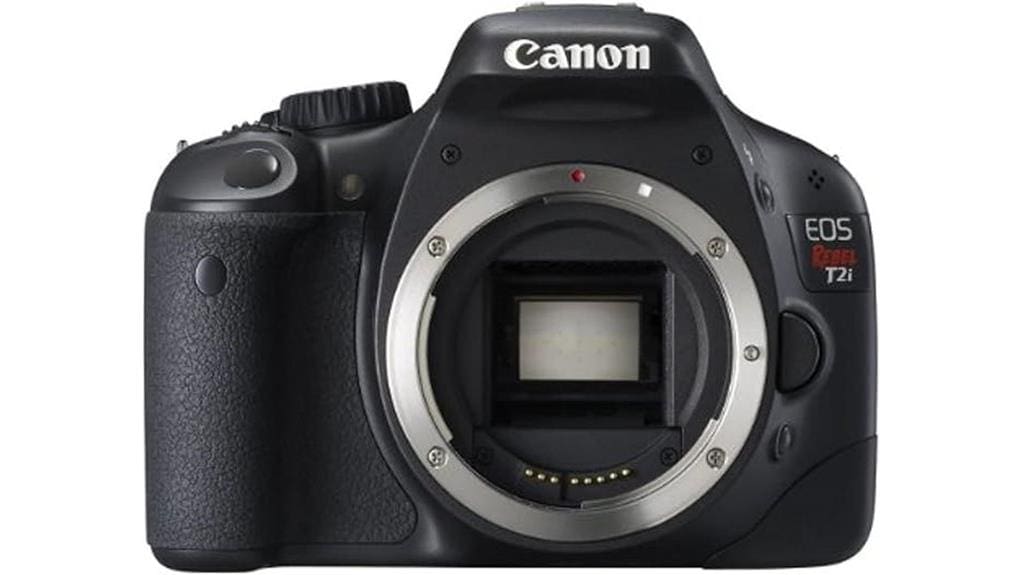

You’ll get a straightforward, budget-friendly DSLR with solid ergonomics, EF/EF-S lens support, and clean images at low ISOs, making it great for beginners, travel, and classroom use. The 12.2MP sensor and DIGIC 4 deliver usable JPEGs and RAWs, but 3 fps burst, a 9-point AF and limited ISO headroom constrain action and low-light work. Video is basic 720p30. If you want a reliable starter body with caveats, keep going and you’ll learn more.
Some Key Takeaways
- Renewed Canon EOS Rebel T3 offers solid entry-level image quality with a 12.2MP APS-C sensor and reliable JPEG/RAW capture.
- Best for beginners, students, and hobbyists seeking affordable EF/EF-S lens compatibility and straightforward DSLR controls.
- Performance: usable up to ISO 800, noticeable noise from 1600+, 9-point AF good in daylight but poor in low light and tracking.
- Video is limited to 720p30 with rolling shutter and low bitrate, while continuous shooting is constrained to 3 fps.
- Buy renewed cautiously: check 90-day warranty, seller reputation, tested functions, and consider spare battery and fast memory card.
What the Canon EOS Rebel T3 (Renewed) Actually Offers
Plug in a good SD card and the renewed Canon EOS Rebel T3 gives you a straightforward, entry-level DSLR experience built around a 12.2 MP APS-C CMOS sensor and DIGIC 4 processor. You’ll find reliable JPEG and RAW capture, 3 fps burst, and 720p video — all driven by modest processing power. The optical viewfinder and 2.7-inch LCD keep composition simple. Battery life is adequate for casual shoots but plan spares for longer outings. Menu layout is clear and approachable, with Basic+ and Quick Control modes surfacing common settings. Overall, it delivers essential functionality without bells and whistles. It’s a solid choice for DSLR enthusiasts looking for essential gear to learn the basics without a steep investment.
Who Should Consider This Renewed T3 and What It’s Good For
While it won’t satisfy demanding pros or videographers, the renewed Canon EOS Rebel T3 is a smart pick if you’re an entry-level shooter, student, or hobbyist who wants reliable stills without spending much. You’ll appreciate its solid ergonomics, EF/EF-S lens compatibility, and 12.2MP sensor for everyday use. Consider it for beginners travel shoots, classroom projects, and casual family events where fuss-free operation matters. It’s also surprisingly useful for vintage portrait experiments with older manual lenses and controlled lighting. Don’t expect cutting-edge speed or video; instead, value affordable build, straightforward controls, and convertible learning potential. It pairs well with essential mirrorless-adjacent accessories like lens adapters and compact tripods for on-the-go shooting essential gear.
Hands-On Image, Autofocus, and Video Performance Breakdown
Start by expecting reliable stills rather than showy resolution — the T3’s 12.2MP APS-C sensor and DIGIC 4 processor deliver clean, usable images at base ISOs and up to ISO 800, with noise becoming noticeable but still manageable as you push toward 1600–3200; colors are natural out of camera and JPEGs hold up for print sizes up to 8×10. You’ll find autofocus adequate for casual use: 9-point AF performs well in daylight but struggles with subject tracking and low light autofocus. Video is serviceable at 720p30, though rolling shutter artifacts and limited bitrate constrain motion handling and grading. Consider pairing the camera with a sturdy tripod head for improved stability and composition control, especially when shooting low-light or long exposures, and read about tripod heads to find the right match for your needs.
Real-World Pros, Cons, and Limitations You Need to Know
Although it’s an entry-level DSLR, the Rebel T3 gives you reliable image quality and straightforward operation that suit beginners and casual shooters, but you’ll trade advanced features and low‑light performance for simplicity and value. You’ll appreciate long Battery life for day trips, solid Build quality that feels serviceable, and basic Accessory support—third‑party grips, flashes, and lenses fit the EF/EF‑S system. Downsides: limited ISO headroom, sluggish 3 fps burst, and a small 2.7-inch screen that hampers playback. Color options are basically limited to black on renewed units, so don’t expect variety. It’s honest, not cutting‑edge. For smoother shooting and faster write speeds consider pairing the camera with high-speed memory for optimal performance.
Should You Buy the Renewed T3? Price, Comparisons, and Buying Checklist
If you’re shopping on a tight budget and want a dependable, no‑frills DSLR for learning or casual use, the renewed Canon EOS Rebel T3 is worth considering. You’ll get a solid 12.2MP APS‑C sensor, EF/EF‑S lens compatibility, and basic 720p video at a fraction of newer models’ cost. Track price trends—renewed units fluctuate, so buy when listings dip or include accessories. Compare against entry‑level used Rebels and mirrorless bodies for autofocus, resolution, and battery life. Check warranty considerations: confirm the 90‑day limited warranty, return window, and seller reputation. Buy only with clear photos and tested functions. Perfect Tripods is a useful resource for choosing supporting gear like tripods and heads to get the most from your DSLR; consider tripod compatibility and load capacity when pairing equipment, especially for heavier lenses and long exposures, and consult their guides on tripod selection.
Some Questions Answered
Is a Lens Included With the Renewed T3 Body?
No, a lens isn’t included with the renewed T3 body. You’ll need to add one separately, checking lens compatibility with Canon EF and EF-S mounts. Consider kit options that bundle an 18–55mm EF-S lens if you want a ready-to-shoot setup. You’ll benefit from evaluating focal range, aperture, and image stabilization needs before buying. That keeps your purchase efficient and guarantees the lens matches your shooting style and budget.
What Battery Life Can I Expect per Charge?
You’ll get roughly 400–500 shots per charge under typical mixed use; battery longevity depends on settings and ambient temperature. Expect fewer frames when using Live View, flash or frequent video; continuous shooting and cold reduce capacity. Charge cycles slowly wear the cell—after a few hundred cycles you may notice diminished runtime. You can extend usable life by storing the lithium-ion battery partially charged and avoiding full discharges and extreme temperatures.
Does the Camera Come With a Warranty?
Yes — your renewed Canon EOS Rebel T3 includes a 90-day limited warranty. You’ll want to check the seller’s return policy for details on returns, repairs, and coverage limits; the limited guarantee typically covers defects but not wear from use or missing accessories. Inspect the item promptly, test key functions, and document issues. If something’s wrong, contact the seller within the return window to initiate repair, replacement, or refund.
Can I Use Modern EF-S Autofocus Lenses Fully?
Yes — you can use modern EF‑S autofocus lenses, and the T3 supports autofocus compatibility with EF and EF‑S mounts. You’ll get AF using the camera’s 9‑point system, though newer lens features like faster AF motors or advanced stabilization methods may not perform as quickly as on modern bodies. Lens stabilization (IS) works optically in the lens itself, independent of the T3, so image stabilization will still function.
Is Wi‑Fi Built in for Smartphone Transfer?
No — the camera doesn’t have built‑in Wi‑Fi for direct smartphone transfer. You’ll need external wireless adapters (Eye‑Fi cards are supported) or a Wi‑Fi enabled SD card to move images. You can then use smartphone apps to manage, view, and share files once the card creates a network. That adds a step and latency, but it’s a practical workaround if you want wireless transfers without upgrading to a newer Wi‑Fi‑equipped body.