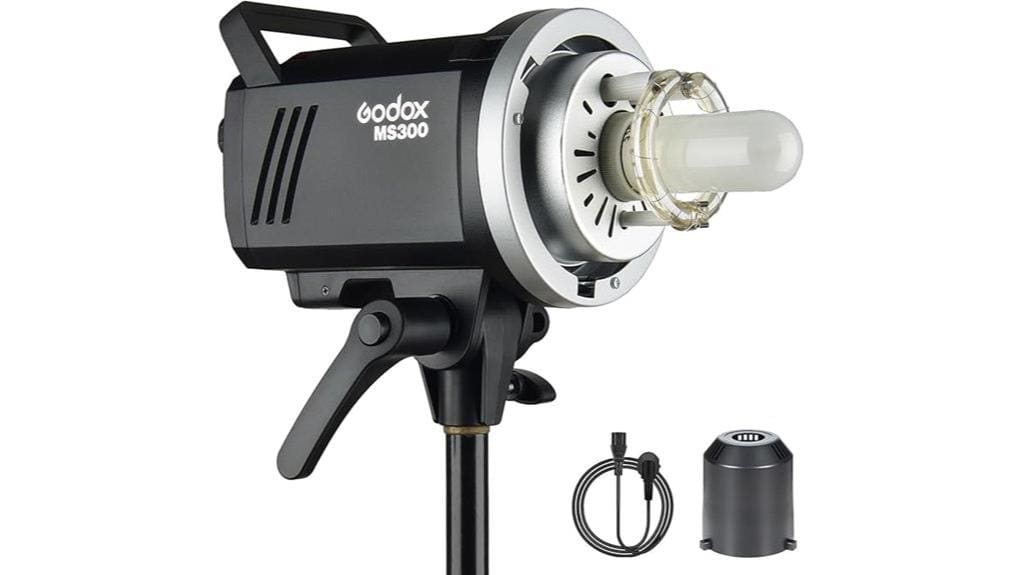

You’ll get a compact, 300W daylight-balanced monolight that’s light to carry, uses a Bowens mount, and gives repeatable manual output with GN58. It lacks HSS and weather sealing, so you’ll need to manage sync and avoid harsh environments. Modeling lamp is 150W adjustable for framing; recycle spans ~0.1–1.3s with stable color and small output drift. Wireless Godox 2.4G control is built in. Keep going to see detailed performance, limits, and alternatives.
Some Key Takeaways
- Compact 300W monolight delivering GN58 and manual power control, ideal for small studios and on-location shoots.
- Daylight-balanced ~5600K output with ≤2% variance and stable color during extended use.
- 150W modeling lamp adjustable 5%–100% for accurate composition and shadow preview.
- No high-speed sync (HSS); standard sync only, with anti-preflash compatibility.
- Fast recycle (0.1–1.3s), Bowens mount compatibility, lightweight 1.3 kg, but may thermally throttle under continuous high-power use.
Quick Verdict and Who the MS300 Is For
While it lacks high-speed sync, the Godox MS300 delivers a reliable, compact 300W monolight suited for small studios and on-location shoots where consistent daylight-balanced output and fast recycle times matter. You’ll find its compact build and 1.3 kg weight make transport and setup straightforward, and Bowens mount compatibility keeps modifiers flexible. As a budget alternative, it offers stable power (≤2% variance) and predictable modeling lamp control without advanced sync modes. You’ll accept manual exposure control and no HSS if you prioritize cost, portability, and repeatable output for product, portrait, or basic commercial work. For those using continuous lighting, pairing strobes with quality LED photo lights can help ensure consistent color and easier workflow.
Core Specs That Matter: Power, Modeling Lamp, Sync and Connectivity
Because these core specs determine how the MS300 performs in real shooting scenarios, focus on its 300W output, 150W modeling lamp, and sync/connectivity limits. You get 300W Power output in a compact monolight, offering a GN58 and manual exposure control; note HSS is not supported. The Modeling lamp is 150W, adjustable 5%–100%, useful for composition and previewing shadows. Sync options include standard sync with anti-preflash compatibility but no high-speed sync. Wireless control is handled via Godox 2.4G X System (32 channels, 16 groups) and works with X1/X2/XPro/XT16 transmitters for remote power and modeling-lamp adjustments. This makes the MS300 a practical choice for photographers who use reflectors and modifiers to shape light.
Real-World Performance: Light Quality, Recycle Time, and Stability
When you evaluate the MS300’s real-world output, you’ll find a consistent, neutral 5600 K color that renders skin tones and mixed-light scenes predictably, with less than 2% output variance during extended use. You’ll notice soft falloff from Bowens-mounted modifiers, delivering usable gradients without harsh hotspots. Color fidelity stays tight across power steps, so white balance shifts are minimal. Recycle times range 0.1–1.3 s, giving reliable burst capability for most studio work. Flash consistency holds through long sessions unless ambient heat accumulates; thermal throttling can engage under continuous high-power use, reducing peak output until cooled. These characteristics make the MS300 a strong choice for photographers using softbox lighting who want consistent, studio-quality results.
Ease of Use and Workflow: Mounting, Controls, Wireless Triggering, and Safety
Having confirmed consistent color and recycle performance, you’ll want to know how the MS300 fits into a studio workflow. You’ll appreciate fast mounting speed via the Bowens mount and lightweight 1.3 kg body; modifiers attach securely. The control layout is straightforward: power knob, modeling lamp dial, and clear radio settings for groups/channels. The 2.4G Godox X system gives reliable wireless range for typical studio distances and supports X1/X2/XPro/XT16 transmitters. For workflow, you’ll adjust power and modeling lamp remotely and hear the buzzer status. Follow safety reminders: remove the lamp cover before use, avoid moisture, and respect operating voltage. This makes the MS300 a solid choice for photographers focused on selfie lighting and compact studio setups.
Buy-or-Skip Checklist With Alternatives and Final Recommendation
If you need a compact, reliable 300W monolight for controlled studio work, the Godox MS300 is worth considering for its 300W output, stable ≤2% power consistency, Bowens mount compatibility, and full integration with the 2.4G Godox X system. Buy if you want consistent daylight-balanced output, simple manual control, and accessory compatibility. Skip if you need HSS, weather sealing, or faster recycle. Consider budget alternatives (older Godox/Neewer 300W units) or higher-end Godox AD models for HSS. Use lighting modifiers you already own. For short projects, rental options reduce risk; check long term support and warranty. Also consider basic studio lighting principles like consistent color temperature and modifier choice when selecting a kit.
Some Questions Answered
Does the MS300 Include a Protective Carrying Case?
No, the MS300 doesn’t include a protective carrying case. You get the flash, power cord, lamp cover, 150W modeling lamp, manual and cloth. If you need transport protection, you’ll have to buy a soft pouch or case with custom inserts separately to secure the unit and accessories. Choose a Bowens-compatible case or padded insert sized for the MS300’s 28.3 cm length and 1.3 kg weight to prevent damage in transit.
Can It Run on Batteries With a Portable Power Pack?
No — it won’t run directly on batteries. You’d need a compatible portable power pack or inverter that supplies stable AC 110–120V at sufficient wattage and surge capacity. Check battery compatibility and power efficiency: choose a high-output unit rated above 300W plus headroom for modeling lamp and recycle peaks. Verify pure sine wave output, correct connectors, and thermal safety. Using inadequate packs risks instability, reduced performance, or damage.
Is the Modeling Lamp Replaceable With LED Options?
Yes — you can replace the 150W modeling lamp with an LED retrofit, but you’ll need an LED that matches the unit’s bulb sockets and physical dimensions. Check the lamp base type and Bowens-mount clearance, confirm thermal dissipation and power draw, and verify voltage compatibility. Avoid adhesives or modifications that void warranty. Use a purpose-built retrofit rated for continuous studio use to maintain stability and safe operation.
What Is the Lifespan of the Flash Tube Under Regular Use?
You can expect an average lifespan of roughly 5,000–10,000 flashes for the flash tube under regular studio use. That means your replacement frequency will typically be every 1–3 years depending on shooting volume and power settings. High-power, frequent firing shortens life; conservative settings extend it. Monitor output consistency and tube discoloration to decide replacement timing, and have a spare tube available to avoid downtime.
Are Firmware Updates Available for X System Compatibility?
Yes — you can update firmware for X system compatibility, though updates depend on Godox release timing. Check the manufacturer site or your transmitter for firmware compatibility and an update schedule. You’ll download firmware files and use the recommended USB/OTG or transmitter-assisted method per instructions. Maintain current firmware to make certain stable radio linkage; follow release notes for compatibility changes and rollback guidance if a specific transmitter model isn’t yet supported.