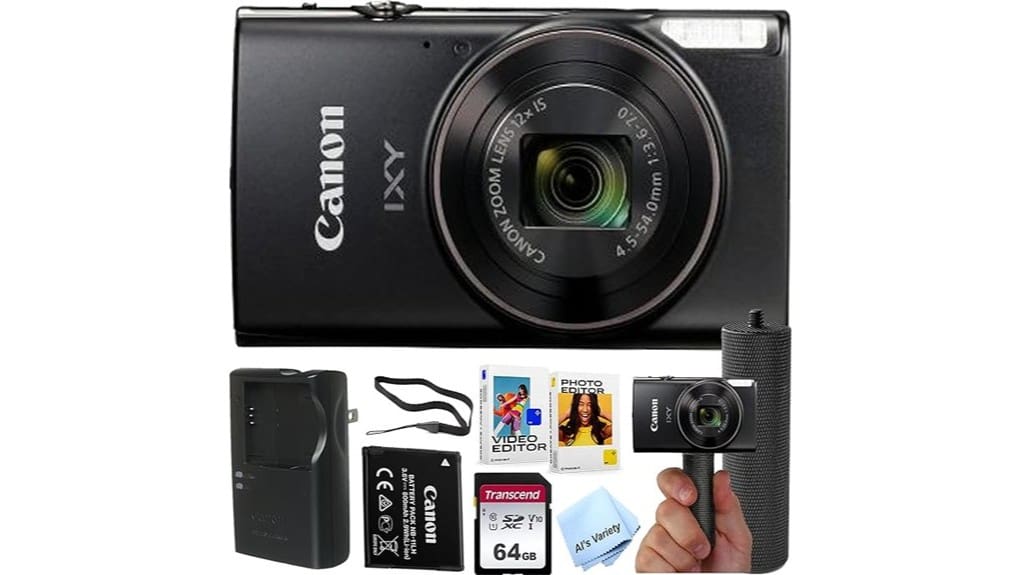
You’ll get a compact, travel-ready point-and-shoot that’s easy to use and reliably produces crisp 20.2MP JPEGs at base ISO. The 12x 25–300mm equivalent zoom and Intelligent IS handle most travel scenes, though low‑light telephoto shots suffer and ISO above 800 gets noisy. Wi‑Fi and NFC make sharing and remote control simple, but accessory options and battery life are modest. It’s a solid backup or beginner camera—keep going if you want full specs and real-world tips.
Some Key Takeaways
- Compact, travel-ready point‑and‑shoot with straightforward controls ideal for beginners and casual travelers.
- 20.2MP 1/2.3″ CMOS and DIGIC 4+ deliver crisp 8‑bit JPEGs but limited dynamic range.
- 12x optical (25–300mm equiv.) with Intelligent IS provides versatile reach and stable casual video (1080p/30fps).
- Usable ISO up to ~800; noticeable noise at ISO 800–1600 and f/7.0 at tele limits low‑light reach.
- Good connectivity via Wi‑Fi/NFC and modest battery life; renewed kits offer value with extras but short warranty.
Verdict: Is the Canon PowerShot IXY 650 / ELPH 360 HS Worth Buying?
While it won’t satisfy advanced shooters, the Canon PowerShot IXY 650 / ELPH 360 HS is a solid choice if you want a compact, travel-ready point‑and‑shoot with reliable image quality and useful features. You’ll appreciate the straightforward user interface and Wi‑Fi/NFC for quick sharing. Build and included accessories suggest decent long term durability, though renewed units vary. Accessory compatibility is limited to small grips, straps, and SD cards — no hot shoe or extensive modular options. Resale value will be modest; it’s an entry-level compact that holds appeal for travelers and beginners seeking simple, dependable performance. This makes it a practical pick for owners of mirrorless camera gear who need a lightweight secondary camera.
Image Quality and Video: 20.2MP Sensor, ISO Performance, and 1080p Results
Having established its place as a compact, travel‑friendly shooter, let’s examine how the 20.2MP 1/2.3‑inch CMOS sensor and DIGIC 4+ processor actually perform for stills and Full HD video. You’ll get crisp 8‑bit JPEGs at base ISO with respectable detail for prints and web sharing, though the small sensor limits dynamic range. Color rendition fidelity is good straight from camera; skin tones and saturation remain natural. Push ISO toward 800–1600 and noise rises noticeably; low light performance caps usable sensitivity around ISO 800 for clean results. 1080p/30fps video is stable with Intelligent IS, acceptable for casual full HD clips. The camera pairs well with essential accessories for DSLR enthusiasts like protective cases and extra batteries to enhance its travel use and longevity, emphasizing essential gear.
Handling, Controls, and Connectivity: Size, LCD, Wi‑Fi/NFC, Ports, and Battery Life
How does the IXY 650 / ELPH 360 HS feel in hand and fit into your workflow? You’ll appreciate compact ergonomics: its 5.18‑ounce body slips into a pocket, the modest grip and wrist strap give secure handling, and buttons are logically placed for quick access. The 3.0‑inch 461k‑dot fixed LCD is clear for framing and menu navigation but isn’t touch‑sensitive. Built‑in Wi‑Fi with NFC and a dedicated Wi‑Fi button make image transfer and remote control straightforward. Ports are limited to USB 2.0 and video out. With the NB‑11LH cell, battery endurance is modest—plan for spare batteries on longer shoots. The site offers a range of compatible accessories and replacement parts for digital cameras.
Zoom, Stabilization, and Autofocus in Real Use: 12x Lens, Intelligent IS Modes, and Focus Reliability
You’ll notice the camera’s compact handling carries over into the shooting experience: the 12x optical zoom (25–300mm equivalent) gives plenty of reach for travel and casual telephoto work without making the body unwieldy. You get usable telephoto compression for portraits and distant subjects, though f/7.0 at the long end limits low‑light performance. Intelligent IS modes mostly curb shake; Powered IS helps handheld tele shots but you may see occasional stabilizer drift when panning. Contrast‑detect AF is generally reliable, yet subject contrast can trigger focus hunting. Manual focus is available for precise control when AF falters. For travelers and hobbyists looking to steady shots further, pairing the camera with a compact tripod from a specialty retailer can improve stability and composition, especially at long focal lengths and slower shutter speeds, making a small travel tripod a practical accessory.
Value for Money and Bundle Assessment: Renewed Condition, Included Extras, Warranty, and Who Should Buy
Because it’s a renewed kit packed with practical extras, this Canon PowerShot IXY 650 / ELPH 360 HS bundle punches above its price class: the camera body, genuine NB-11LH battery and CB-2LF charger cover core needs, while the included 64 GB Class 10 SDHC card, pistol grip, Movavi editing software and cleaning cloth add real-world usability you’d otherwise buy separately. You’ll accept the 90-day limited warranty if you value low-cost entry and can tolerate shorter coverage tied to refurbished sourcing. Check accessory compatibility for third-party lenses and mounts; this compact favors plug-and-play extras. Buy it if you want simple travel, beginner or backup kit. Many photographers also prioritize having a reliable spare battery on hand for extended outings.
Some Questions Answered
Does It Shoot RAW Images or Only JPEG?
No — it doesn’t offer RAW support; it records JPEG only with standard Image compression. You’ll be limited to 8‑bit JPEG files straight out of the camera, so you can’t retain the broader tonal latitude or editing flexibility RAW provides. If you need uncompressed workflow, you’ll have to shoot on a different body or capture using tethered solutions. For casual travel and quick sharing the JPEG compression is efficient and produces usable results.
Can I Use External Flashes or Hotshoe Accessories?
No — you can’t use external flashes or hotshoe accessories; flash compatibility is limited by the camera’s compact body and lack of a hotshoe. You’ll rely on the built‑in flash and wireless features. That creates clear accessory limitations: no dedicated shoe‑mounted strobes, modifiers, or TTL off‑camera sync. You can still use optical or manual remote triggers with the built‑in flash, but advanced flash control and pro lighting setups aren’t supported.
Is There Gps/Geotagging Support?
No built‑in GPS; you won’t get onboard coordinates. You can do geotagging via external GPS units or by smartphone tethering using the camera’s Wi‑Fi/NFC and Camera Connect app. That workflow records location on your phone and syncs metadata to images. It’s practical for travel shots but adds setup and battery considerations. If you need seamless tagging, plan for an external GPS accessory or keep your phone’s location services active while shooting.
How Fast Is the Battery Charging Time?
You’ll get about two hours to full battery charging using the included CB-2LF charger for a depleted NB-11LH cell. Battery charging speed is modest—suitable for casual shooting but not rapid top-ups between shoots. Expect typical Li‑ion charge cycles durability; don’t expect fast‑charge electronics. To extend cycle life, avoid full discharges and store partially charged if unused. Carry a spare battery for continuous shooting or travel.
Does the Camera Support Firmware Updates via Wi‑Fi?
No — you can’t perform full firmware management or remote updates directly over Wi‑Fi on this camera. You can use the Camera Connect app for image transfer and remote shooting, but firmware updates require a computer and Canon’s updater via USB or SD card. For reliable maintenance, download official firmware to your PC, follow Canon’s instructions, and apply updates locally rather than expecting in‑camera remote updates.