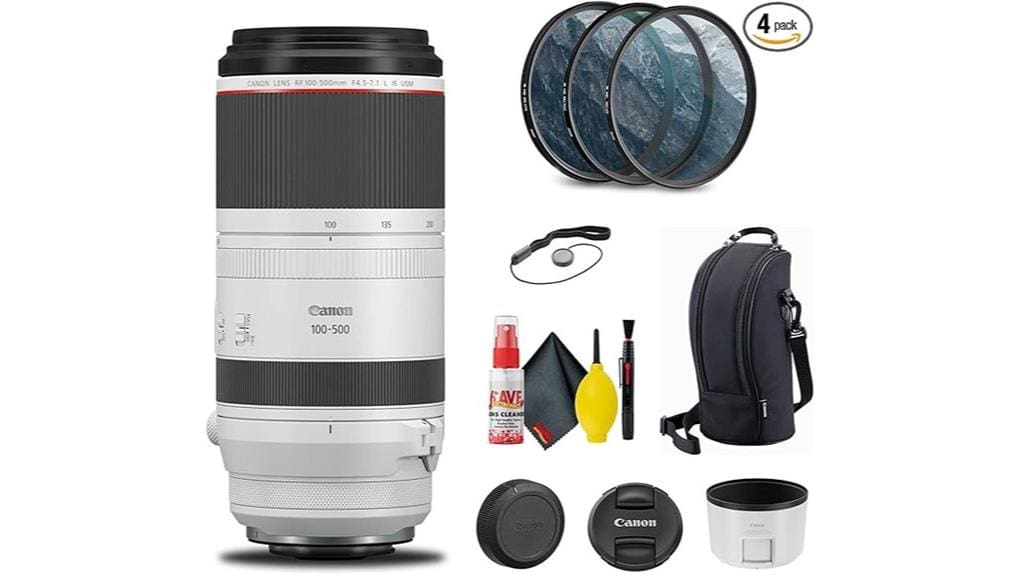
You’ll find the Canon RF 100–500mm f/4.5–7.1L IS USM gives you pro-grade optics, long reach, and surprisingly manageable handheld use for wildlife and sports. It balances sharp center performance to 400mm, tightens when stopped down, and controls chromatic aberration with UD glass. Dual Nano USM and up to five stops of IS make tracking fast subjects reliable. It’s lighter than typical super-telephoto zooms, but you’ll still want a solid tripod for extended sessions—keep going to learn specifics.
Some Key Takeaways
- Versatile 100–500mm reach balances image quality, handheld usability, and portability for wildlife and sports shooters.
- Lightweight ~5.5 lb L-series build with weather sealing, removable tripod collar, and ergonomic zoom/control rings.
- Strong center sharpness wide open to 400mm; slight softening at 500mm, improved by stopping down to f/8–f/11.
- Dual Nano USM AF and up to five stops optical IS deliver fast, quiet focus and confident handheld stabilization.
- Premium optics and features justify price; consider used RF 100–400mm or third-party 100–600mm if budget or weight are priorities.
Quick Verdict: Who This 100–500mm Lens Is Best For
If you need a portable super-telephoto that balances reach, image quality, and handheld usability, the Canon RF 100–500mm f/4.5–7.1L IS USM is aimed squarely at advanced enthusiasts and professionals who shoot wildlife, sports, or distant subjects without a gimbal or heavy rig. You’ll appreciate its sharp optics, effective 5-stop IS, and fast Dual Nano USM focus for tracking. Compared to larger super-telephotos, it trades absolute aperture for weight and versatility, making it a practical choice for wildlife beginners and budget birders stepping up to full-frame RF systems. You’ll gain reach without sacrificing portability. Consider pairing it with a heavy-duty tripod for outdoor photography to maximize stability and long-range shooting stability advantages.
Build, Handling, and Features That Matter for Handheld Telephoto Use
Having established who benefits most from this lens, let’s examine how its construction and controls support handheld telephoto work. You’ll notice the lens balances well on RF bodies thanks to relatively lightweight construction for a 100–500mm L-series, reducing fatigue during long shoots. The tripod collar is removable yet solid when needed. Dual Nano USM and responsive IS give you confidence shooting at slower shutter speeds. Torque-adjustable rotating zoom ring and customizable control ring place ergonomics where you expect them; the control layout is logical and tactile compared with competitors. Weather sealing and fluorine coating add durability for field use. This makes it a great match for photographers who use lens mount adapters to expand lens compatibility across camera systems.
Optical Performance: Sharpness, Bokeh, Chromatic Aberration, and Real‑World Samples
While the RF 100-500mm’s design prioritizes handheld versatility, its optics deliver the real-world performance you need to judge it against pro telephoto zooms: center sharpness is extremely strong from 100–400mm wide open, with only modest softening at 500mm and noticeable improvement by stopping down one to two stops; edge and corner acuity trail the center at the long end but tighten considerably by f/8–f/11, making the lens very capable for wildlife and sports when you balance shutter speed and aperture. You’ll appreciate restrained chromatic aberration thanks to UD elements, smooth bokeh with nine blades, competent microcontrast rendering, and manageable edge softness at extreme telephoto settings—real-world samples show clean detail and natural out-of-focus shifts. This balance of reach and handling makes it an excellent choice for photographers focused on telephoto performance.
Autofocus, Stabilization, and Video Performance Tested
Put the RF 100-500mm’s AF and IS systems to work and you’ll see why Canon designed this zoom for handheld, run-and-gun shooting. You get Dual Nano USM-driven, near-silent phase detection AF that locks quickly on stills and tracks moving subjects with minimal hunting compared with older tele zooms. Optical IS delivers up to five stops of stabilization; handheld panning stays steady across the zoom range. On video you’ll benefit from smooth transitional change and low microvibration, though rolling shutter on some EOS bodies can expose skew during fast pans. Overall, AF speed, tracking resilience, and IS are class-leading for its weight. Consider pairing it with a sturdy L-bracket to improve handling and mounting flexibility during fast-paced shoots.
Buying Guide: Value, Alternatives, and Recommended Accessories
Weigh your priorities: the RF 100-500mm packs pro-grade optics, class-leading AF/IS performance and a relatively lightweight 5.5 lb chassis, so it delivers exceptional handheld reach for wildlife and sports shooters who need fast, reliable tracking without a massive rig. You’ll pay a premium, but you get UD/super-UD elements, Dual Nano USM, five-stop stabilization and a robust build. Consider budget alternatives—used RF 100-400mm or third-party 100–400/150–600mm zooms—if weight or cost dominates. Essential accessories: high-quality 77mm filters, carbon-fiber monopod/tripod system, spare battery, dedicated lens case and the included tripod collar. For photographers who hike with gear, choose a hiking backpack with a camera compartment that balances protection and comfort to carry this lens and accessories on long walks, prioritizing comfortable load distribution.
Some Questions Answered
Is This Lens Compatible With Ef-Mount Cameras via Adapter?
Yes — you can use a mount adapter to fit this RF lens to EF‑mount bodies, but you’ll need an RF-to-EF adapter that maintains electronic communication and correct flange compatibility. With a proper adapter you’ll retain autofocus, image stabilization, and focus confirmation on most cameras, though performance can be slightly reduced compared with native RF bodies. Compare adapters for firmware support; some third‑party units may limit features or AF speed.
Can I Use Teleconverters With the 100–500mm RF Lens?
Yes — you can use teleconverters, but teleconverter compatibility is limited and you’ll face image quality_tradeoffs. You’ll retain AF with Canon RF extenders on many bodies, yet expect reduced light, slower AF, and slightly softer resolution and contrast versus native focal lengths. Optically, diffraction and increased aberrations can appear, so compare 1.4x vs 2x performance and test critical sharpness; stabilization still helps but can’t fully offset degradation.
What Is the Closest Focusing Distance and Maximum Magnification?
The minimum focus distance is 0.9 m (3.0 ft) at 100 mm and 1.3 m (4.3 ft) at 500 mm, yielding maximum magnification ratios of approximately 0.15x at 100 mm and 0.24x at 500 mm. You’ll find the close up capability respectable for a super tele macro approach but not true macro; it’s more comparative tele-focused than dedicated high-magnification optics, so expect practical but limited magnification for close-up work.
Does the Lens Support In-Camera Lens Aberration Correction Profiles?
Yes — you’ll get in camera profiles for this RF lens and automatic chromatic correction on compatible Canon bodies. You can rely on firmware-enabled lens corrections (distortion, vignetting) plus chromatic correction applied in-camera or RAW converters. Comparatively, newer RF bodies implement more complete corrections than older models, so you’ll see fewer residual aberrations and fringing. If you need perfect control, you can still refine or disable these corrections in post.
Is the Included Tripod Collar Removable and Arca-Compatible?
Yes — the included tripod collar is removable and offers Arca compatibility when used with the collar’s foot. You’ll detach the collar for lighter handheld work or rotate it for composition, and you’ll mount on Arca-style plates for stable, quick-release operation. Comparatively, its integrated foot is more robust than many third-party collars, providing secure Arca-compatible indexing and better balance for the lens’s weight during long telephoto shooting.