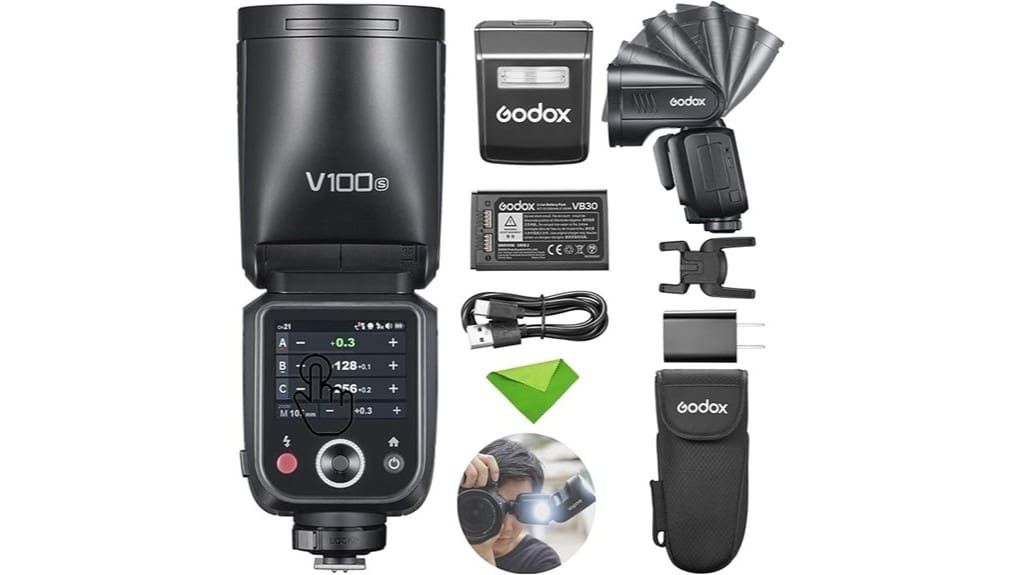
The Godox V100S gives you compact 100 Ws punch with native Sony hot‑shoe TTL and HSS support, 1/1–1/256 manual scaling, and a single rapid USB‑C‑charge lithium cell for quick recycle. Its 2.3‑inch touchscreen, SU‑1 sub‑flash, and 2W modeling lamp speed on‑camera workflows, while built‑in Godox 2.4G radio lets it act as master or receiver. TTL is reliable though may need small EV tweaks in contrasty scenes; keep reading for full performance details.
Some Key Takeaways
- 100 Ws output and 1/1–1/256 manual range deliver predictable exposure and strong pop‑flash punch for Sony shooters.
- Native Sony hot shoe with reliable TTL and HSS compatibility, though TTL may need +/- EV tweaks in mixed/high‑contrast light.
- Single proprietary lithium battery offers ~1.7 s recycle at full power with dozens of full‑power flashes before thermal limits.
- Built‑in Godox 2.4G X System lets the unit act as master or receiver, enabling group control and one‑tap pairing with X3 triggers.
- On‑camera workflow benefits: 2.3″ touchscreen, detachable SU‑1 sub‑flash, modeling lamp, and intuitive physical controls for quick adjustments.
Key Specs and What Matters for Sony Shooters (Guide Number, Battery, Mount, Sync)
While the V100S packs a lot into a compact Sony‑mount speedlight, the details that matter most are power, battery, fit, and sync. You get a Guide number tied to 100 Ws maximum output in Manual mode, giving predictable exposure scaling across the 1/1–1/256 range. The single proprietary lithium battery supports rapid USB‑C charging and long average runtime; treat advertised flash counts as manufacturer figures. Mount type is Sony Alpha hot‑shoe native, ensuring physical and TTL/communication compatibility with compatible bodies. Built‑in 2.4G wireless and high‑speed sync support handle modern shutter and multi‑unit setups reliably. For mirrorless shooters looking to accessorize, consider essential add‑ons for your system like mirrorless camera gear to expand creative options.
Real‑World Performance: Pop Flash, TTL Accuracy, Recycle Time, and Full‑Power Endurance
Because the V100S pairs a high‑output 100 Ws tube with a fast, single‑cell lithium pack, you’ll notice pop‑flash punch, consistent TTL response, and quick recycle times in typical shooting scenarios. You’ll get reliable pop‑up bouncing off ceilings and walls for fill and portrait work; head geometry and round output smooth changes. TTL generally reads accurately on Sony bodies, though occasional metering discrepancies appear in high‑contrast or mixed‑lighting scenes and benefit from +/‑ EV tweaks. Recycle time hovers near the quoted 1.7 s at full power; the unit sustains dozens of full‑power flashes before thermal limits affect timing. The V100S also integrates well with wireless flash triggers, making it easy to incorporate into multi‑flash setups for more creative lighting control.
On‑Camera Features That Change Workflow: Touchscreen, SU‑1 Sub‑Flash, Modeling Lamp, and Controls
If you rely on quick adjustments and on‑camera control, the V100S’s 2.3‑inch full‑color touchscreen, detachable SU‑1 sub‑flash, 2W modeling lamp, and streamlined controls materially speed your workflow. You get responsive Touchscreen customization for power, TTL/M switching, HSS and device pairing; menus are clear, taps are accurate under varied light. The SU‑1 enables flexible Sub‑flash positioning for rim and catchlight effects without off‑camera gear. The 2W modeling lamp offers ten intensity steps for previewing falloff and shadow behavior. Physical dials and a simple button layout let you confirm changes quickly while shooting. This makes the V100S a practical choice for photographers who use flash triggers and want integrated on‑camera versatility.
Wireless, Compatibility, and Triggering: Godox X System, HSS, Master/Receiver Use With Sony Cameras
Although compact, the V100S gives you a full-featured wireless toolkit: its built-in Godox 2.4G X System lets the flash act as master or receiver, pair one‑tap with X3 triggers and other Godox lights, and control groups and channels from the camera position. You’ll get TTL, manual and HSS up to the camera’s limits; HSS behaves predictably with Sony bodies and the X System. Radio latency is low and consistent, so sync issues are rare. Multi‑triggering modes let you assign group firing, rear‑curtain and multi‑flash patterns. Compatibility spans Sony Alpha hot shoes; setup is straightforward via the touchscreen. It’s a compact option well-suited for telephoto lens shooters who need reliable off-camera flash control in wildlife and sports situations.
Who Should Buy the V100S? Use Cases, Alternatives, and Final Recommendation
When you need a compact, high‑output on‑camera flash that integrates tightly with Sony Alpha bodies and the Godox X ecosystem, the V100S is a practical choice: it delivers 100 Ws of guide power, TTL/HSS support, fast recycle, and master/receiver radio control in a lightweight package. You should buy it if you’re a portrait photographer needing reliable TTL, fast recycle for continuous sessions, or an event shooter who wants onboard master control and robust wireless integration. Alternatives include the Godox V1 (round head, broader ecosystem) and smaller Sony OEM speedlights. Recommendation: buy if you value compact power and system compatibility. Gear Guide caters to enthusiasts and camera fans looking for camera‑related products and informed buying advice, making it a useful resource for enthusiast photographers.
Some Questions Answered
Does the V100S Work With Sony Multi-Interface (MI) Shoe Accessories?
Yes — the V100S’s hot shoe is functional with Sony MI shoe accessories for basic triggering and flash communication. You’ll get full Accessory compatibility for TTL, HSS, and wireless Godox 2.4G functions when mounted on Sony Alpha bodies with the Multi‑Interface shoe. Some MI‑shoe devices that rely on proprietary contacts may be limited; test specific triggers or microphones. Firmware and physical adapter installation (USA version) can affect feature availability.
Can I Use Third‑Party Batteries Instead of the Supplied Lithium Pack?
Yes — you can use aftermarket cells, but you shouldn’t. The V100S relies on a nonstandard lithium pack with specific voltage, contacts and battery management. Using third‑party cells or battery adapters can void warranty, cause poor performance, incorrect charge reporting, or damage. If you choose aftermarket parts, pick high‑quality, manufacturer‑spec packs or OEM replacements that match voltage, capacity and pinout, and avoid improvised adapters that alter contacts or charging behavior.
Is the Flash Firmware User‑Upgradable via Usb‑C?
Yes — you can update the flash firmware via USB‑C. You’ll use the USB‑C charging port for firmware updates when Godox releases firmware updates; connect to a computer and run Godox’s updater tool to apply firmware updates. Keep the battery charged and follow on‑screen prompts. Note that USB‑C charging also powers the unit, but you shouldn’t interrupt updates. Always download updates from Godox’s official site to avoid corrupted firmware.
Does the V100S Support Optical Slave Triggering in Addition to RF?
Yes — the V100S supports optical triggering alongside RF. You can use its optical triggering for slave modes when wirelessly syncing with other flashes that emit pre‑flash or optical pulses. The touchscreen lets you choose slave modes and switch between RF master/receiver and optical slave operation. Expect standard optical limitations (line‑of‑sight, ambient light sensitivity) versus the more robust 2.4GHz RF system for reliable off‑camera use.
Are There Heat‑Safety or Thermal Cut‑Off Warnings During Long Bursts?
Yes — the V100S implements thermal throttling and safety protocols. You’ll get warnings on the touchscreen and the unit will reduce or cut output during extended high‑power bursts to protect the battery and electronics. The device limits consecutive full‑power flashes and slows recycle rates when temperatures rise. You should monitor remaining flash capacity and allow cool‑down periods to avoid unexpected shutdowns and preserve long‑term reliability.