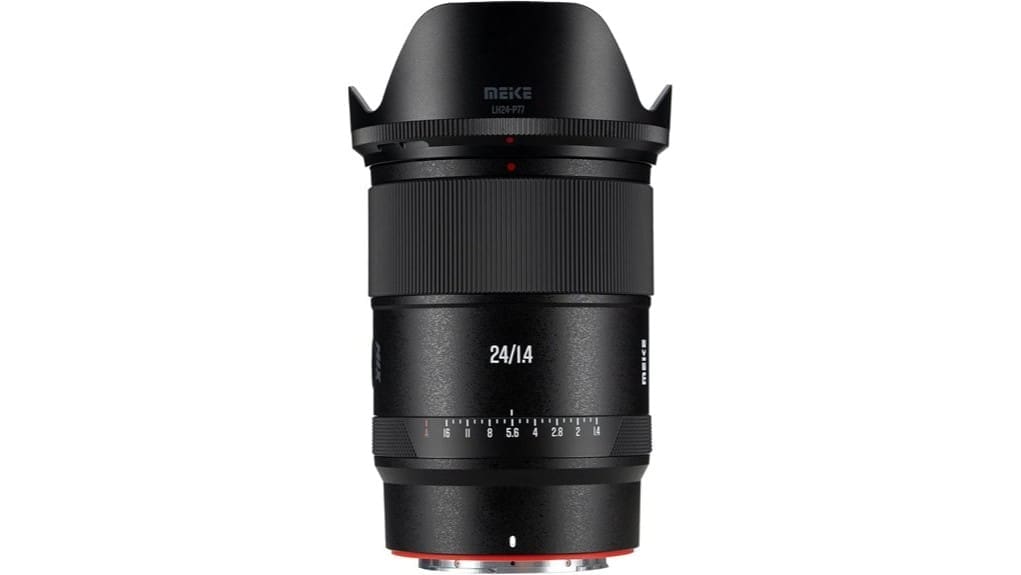
You’ll get a compact 24mm f/1.4 Z‑mount prime that prioritizes low‑light speed and weight over sealing and the fastest AF. It’s 400g, 15 elements/12 groups with 3 ED and 2 aspherics, nine‑blade diaphragm and USB‑C updatable firmware. Centers are crisp wide open, edges soften until f/4, vignetting is strong at f/1.4, and AF is quiet but occasionally hunts in low contrast. It’s a value pick for budget travel shooters — keep going to see detailed tradeoffs and comparisons.
Some Key Takeaways
- Fast f/1.4 aperture offers excellent low‑light performance and shallow depth control in an ultra‑wide 24mm field.
- Optical design (15 elements/12 groups, 3 ED, 2 aspherics) yields crisp center detail and controlled chromatic aberration.
- Edges soften and vignetting is strong at f/1.4 but largely corrected by f/2.8–f/4.
- STM autofocus is quiet and smooth but slightly slower, with occasional hunting in low‑contrast or dim scenes.
- Compact 400g build provides strong value versus Nikon natives but lacks weather sealing and in‑lens stabilization.
What the Meike 24mm F1.4 STM FF‑Z Actually Is and Who It’s For
Though it’s branded as an affordable alternative, the Meike 24mm f/1.4 STM FF‑Z is a purpose-built ultra‑wide prime for Nikon Z shooters that balances high-speed aperture and compact weight for landscape, environmental portrait, and low‑light work. You’ll find a 24mm fixed focal length, f/1.4 speed, and 400g body aimed at budget shooters and travel photographers who need fast glass without a hefty kit. You’ll evaluate build, STM-driven AF, firmware upgradability via USB-C, and lack of weather sealing or IBIS. You’ll accept tradeoffs: no stabilization, limited support on Apple platforms, but strong value for targeted use. It’s a good fit for photographers focused on mirrorless camera systems who want a lightweight, affordable ultra-wide option.
Key Specs and Optical Performance You Need to Know
Having outlined what the Meike 24mm f/1.4 STM FF‑Z aims to be, let’s look at the specs and optical behavior that determine real-world performance. You get a 24mm ultra‑wide prime with f/1.4–f/16, 15 elements in 12 groups, 3 extra‑low dispersion and 2 aspherics, nine‑blade diaphragm, and multi‑coating. Expect strong low light performance from the large aperture and center‑weighted rendering, though there’s no optical stabilization. STM drive yields quiet AF but firmware updates may be necessary. Meike’s coatings and ED elements deliver disciplined Chromatic control and excellent ghost suppression; slight image breathing and modest peripheral falloff remain. This makes it a practical choice for photographers focused on lens calibration and precision focusing.
Real-World Image Quality: Sharpness, Bokeh, Vignetting, and Color
When you push the Meike 24mm f/1.4 to its limits, its optical design delivers crisp center detail wide open while the edges show predictable roll‑off. You’ll find sharpness comparisons favor the center at f/1.4–f/2; stopping to f/4 evens field sharpness substantially. The nine‑blade diaphragm produces smooth bokeh character for foreground separation despite the wide angle; highlight rendition is rounded but shows nervousness at extreme close focus. Vignetting is noticeable wide open but corrects well by f/2.8–f/4. Color leans warm, with robust contrast and very good control of purple fringing and ghosting in real scenes. For photographers interested in enhancing image quality and creative effects, using quality lens filters can further control contrast and reduce unwanted reflections.
Autofocus, Handling, Firmware, and Practical Usability on Nikon Z Bodies
Several aspects of autofocus and handling stand out when you mount the Meike 24mm f/1.4 STM on a Nikon Z body: the STM drive delivers quiet, generally smooth AF shifts suited to stills and casual video, but you’ll notice slightly slower lock times and occasional hunting in low-contrast or dim scenes compared with native Z lenses. You’ll see measurable autofocus latency versus Z-native optics, particularly during rapid subject changes. Manual focus feel is precise with stepped aperture control, but lack of stabilization demands higher shutter speeds. Firmware quirks require Type-C Android updates; keep firmware current to mitigate intermittent AF errors. For improved shooting ergonomics and a better workstation setup, consider a monitor mount arm to optimize your editing and tethering workflow monitor mount arm.
How It Stacks Up vs Alternatives and Should You Buy It?
How does the Meike 24mm f/1.4 STM compare against native Nikon Z primes and other third‑party options for practical use? You’ll find tradeoffs: price comparison favors Meike — it’s markedly cheaper than Nikon Z 24mm f/1.8/1.4 alternatives — but optical and mechanical compromises exist. Build quality is solid for the price yet lacks weather sealing and weighs 400g. Autofocus is quiet STM but not as quick or consistently reliable as native Z glass; no in‑body stabilization. Optically it controls fringing and flare well, with slight breathing and center‑weighted resolution. Buy it if budget and focal character matter more than absolute speed. This makes it an appealing choice for photographers who use lens adapters to mount native or third‑party lenses across systems.
Some Questions Answered
Does This Lens Include a Lens Pouch or Case?
No — the retail packaging? doesn’t include a dedicated lens pouch or hard case. You’ll get the lens, front and rear caps, and a hood; Meike lists no pouch in the box contents. That means you’ll need to buy a separate protective pouch or carry case for safe transport and weather protection, since the lens isn’t water resistant and the 400g weight still benefits from padding during travel and storage.
Is the Lens Compatible With Full-Frame Z9 Video Autofocus?
Yes — you can use the lens on a Z9 and get video autofocus, but performance varies. You’ll get STM-driven AF that’s generally quiet and smooth, yet you might notice slight hunting and image breathing under challenging tracking. Firmware compatibility is vital: update the lens via Meike’s Type-C tool (Android-supported) to guarantee best AF behavior. Test firmware revisions against your Z9 body to reduce latency and occasional focus inconsistencies.
Can the Aperture Be Declicked for Video Use?
Yes — you can use a manual aperture mode with click removal for video by switching the Meike’s stepped manual aperture to its de-clicked position. You’ll access manual aperture control to eliminate detents, reducing audible and visible jumps during ramping. Expect precise, tactile adjustment but no in-body mechanical clickless mechanism; the lens relies on its stepped ring. Firmware updates may refine behavior, so check Meike’s Type-C update tool.
Does It Support In-Camera Stabilization on Z Bodies?
No — it lacks optical stabilization, so it won’t provide in-body stabilization in the lens itself; Z-body sensor-shift IS still compatible and will work in body to stabilize images when the camera supports lens-in-body stabilization. You’ll rely on the camera’s stabilization, not lens hardware. Firmware updates improve autofocus compatibility and performance, so check Meike’s firmware for compatibility fixes; update via Type-C if you encounter stabilization-related AF issues.
Are Genuine Meike Replacement Caps Available Separately?
Yes — genuine Meike replacement caps are available separately, though availability varies by region and seller. You’ll find official Meike accessories sold through Meike’s site and authorized dealers; check part numbers and fit for the Nikon Z mount. If originals aren’t listed, you can use high-quality third party caps; verify diameter and retention style. Don’t assume universal fit — measure the lens thread and confirm return policies before buying.