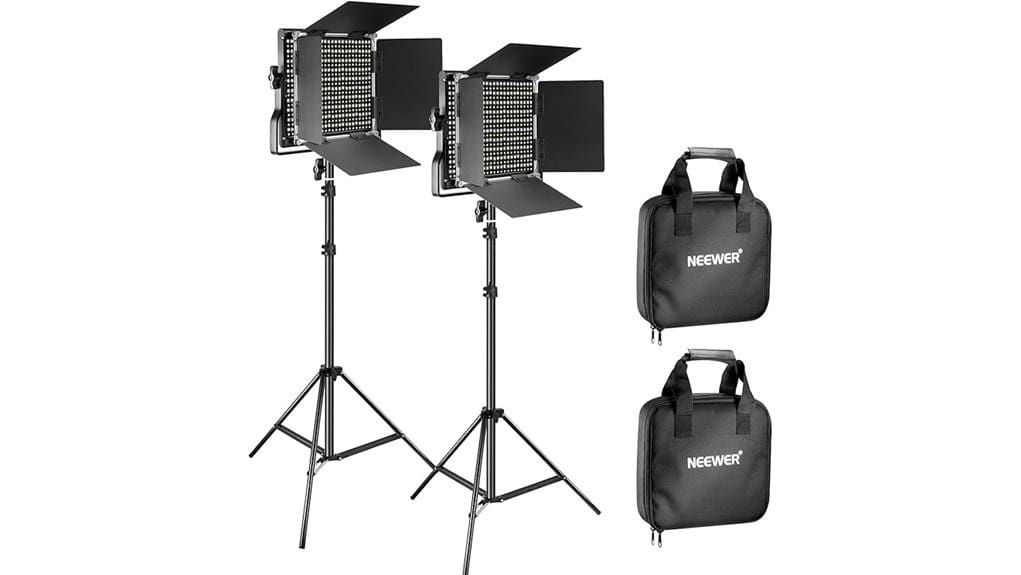
You’ll get bright, color‑accurate bi‑color panels that punch well above their price, with CRI 96+ and flicker‑free output for interviews, product shots, or run‑and‑gun work. The kit’s rugged aluminum housings, useful stands, barndoors, and bags beat typical plastic competitors, though batteries aren’t included. Expect about 3300 lux at 1 m, smooth dimming, and quiet passive cooling—great value if you prioritize cost-to-performance over pro features, and more details follow below.
Some Key Takeaways
- High CRI (96+) bi‑color LEDs deliver accurate, flicker‑free color across 3200–5600K, great for skin tones and run‑and‑gun shoots.
- Peak brightness ~3300 lux at 1 m with even distribution; passive cooling causes slight output drop under prolonged max power.
- Rugged aluminum panels, metal barndoors, and stable stands feel more durable than typical budget kits; batteries not included.
- Straightforward LCD controls and NP‑F battery compatibility make setup and location use simple; NP‑F970 batteries recommended.
- Excellent cost‑to‑performance for interviews, small events, and product work; consider Aputure/Godox for higher output or weatherproofing.
Real Verdict Up Front: Is the NEEWER 2 Pack Bi Color 660 LED Worth Buying?
Bottom line: if you need bright, color-accurate LED panels for run-and-gun shoots or a small studio, the NEEWER 2 Pack Bi-Color 660 delivers strong value. You get high CRI, adjustable 3200–5600K, and reliable flicker-free output that beats cheaper single-color panels. Compared to pro fixtures it’s less refined but far more affordable, which strengthens its value proposition for creators on a budget. User testimonials praise portability, ease of use, and solid light quality; common caveats mention missing batteries and basic build. If you prioritize cost-to-performance over premium features, this kit’s a smart buy. These bi-color panels are particularly useful for photographers who want flexible color temperature control for mixed-light environments and quick setup in small studios.
What’s in the Box and Build Quality Breakdown
Inside the box you get a practical kit: two 660-LED bi‑color panels, two adjustable aluminum stands, power adapters and cables, two carrying bags, and the U‑brackets with metal barndoors—batteries aren’t included. You’ll appreciate tidy packaging details: items are separated, protected, and labeled for quick setup. Build quality is solid for the price—rugged aluminum housings, firm locking knobs, and metal barndoors outperform typical plastic alternatives. Accessory quality is decent: stands feel stable, bags are functional, adapters are standard. Compared with competitors, this kit balances durability and value, though professional rigs use heavier-duty fittings. These continuous LED panels are ideal for photographers seeking perfect lighting during shoots.
How the Lights Perform: Brightness, Color Accuracy, and Real-World Tests
When you crank these Neewer panels up, they deliver solid output for most run-and-gun and small-studio shoots. You’ll see a max of about 3300 lux at 1 m, giving predictable lux distribution across a medium frame. Color accuracy rates high (CRI 96+), so skin rendition stays natural compared with cheaper bi-colors. Dimming is smooth and exposure consistency holds across the 3200–5600K range; minimal flicker helps sync with fast shutter speeds. Passive aluminum housing aids thermal performance—no fan noise, though output drops slightly under prolonged max power. Overall, they balance cost and control better than entry-level units. These panels are a good match for photographers and creators looking for bi-color versatility in a budget-friendly kit.
Setup, Power Options, and Portability for Studio vs. Location Shoots
Getting set up is straightforward, and you’ll quickly see how these panels split their strengths between studio stability and location flexibility. In studio you’ll favor the included AC adapter, steady aluminum stands, and precise LCD controls for repeatable setups. On location you’ll appreciate battery compatibility with NP-F packs for cable-free shoots, though batteries aren’t included. The travel case and carrying bags make transport tidy, but the kit isn’t weatherproofing rated, so you’ll need covers in damp conditions. Overall, choose studio work for reliability and location for portability—just plan batteries and protective gear accordingly. These kits are ideal for photographers and creators focused on improving lighting with video light kits that balance power and portability.
Who Should Buy These Lights (Use Cases, Alternatives, and Final Buying Tips)
If you need versatile, affordable bi-color panels that work both on a controlled set and out in the field, these Neewer 660 kits are a strong choice. You’ll appreciate them if you’re a budget filmmaker needing high CRI, flicker-free output and battery operation for run and gun shoots. They suit interview setups, small event lighting, and product work where portability and color control matter. For higher output or weatherproofing, consider Aputure or Godox alternatives in product comparisons. Final tip: buy NP-F970 batteries and a softbox accessory to maximize usefulness and avoid mid-shoot power limits. These kits pair well with softbox accessories to brighten photos and soften shadows for more professional results.
Some Questions Answered
Can These Lights Be Used in Rain or Humid Environments?
No — you shouldn’t use them in rain or very humid environments. They lack a waterproof rating and aren’t water resistant, so they rely on a protective casing that’s vented for passive cooling. Compared to fully sealed, weatherproof fixtures, these are more suited for controlled indoor or dry outdoor use; you’ll need additional protective enclosures or rain covers for safe outdoor operation in wet conditions.
Do the LEDS Produce Audible Noise During Operation?
No — you won’t hear fan noise from these LEDs during operation. Their rugged aluminum, fanless design passively dissipates heat, so they run quietly and avoid thermal throttling under normal use. Compared to fan-cooled panels, they’re noticeably silent but can get warmer to the touch during long, high-output sessions. If you need continuous max brightness for extended periods, monitor temperature to prevent any performance reduction despite the lack of audible fans.
Are Gels or Softboxes Included or Compatible?
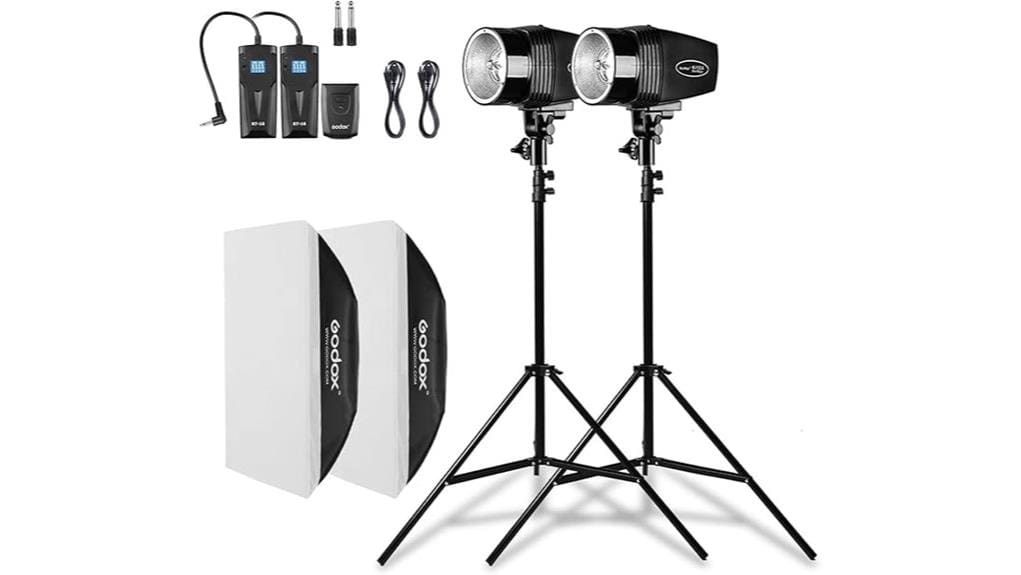
No, color gels or softboxes aren’t included, but you can use color gels and diffusion panels with these lights. You’ll get metal barndoors for basic shaping, and the U-bracket lets you attach aftermarket softboxes or diffusion panels—compare third-party softboxes sized for 660 LED panels. If you want true soft light, a softbox or a high-quality diffusion panel outperforms gels alone for softening; gels remain best for color correction or creative tinting.
Can the Lights Be Daisy-Chained to One Power Source?
No, you can’t daisy chain them from one power source like some prosumer panels; they lack true power passthrough. You’ll need to plug each unit into its own AC adapter or run each on individual NP-F batteries. Compared to lights with passthrough or linkable power, this setup is less tidy for multi-light shoots but still flexible—battery operation lets you go cable-free, while separate adapters work fine for studio use.
What Batteries Model and Runtime Estimates Are Typical?
You’ll use Sony NP-F series batteries (NP-F550 or NP-F970) and run times vary: with NP-F970 you’ll get several hours at mid power, NP-F550 gives shorter runtimes. Run times depend on brightness and color temp; two NP-F970s per light stretch longest. AA batteries aren’t recommended—AA batteries offer much shorter runtime and lower current capability. Overall, choose NP-F970s for reliability and longer continuous operation.