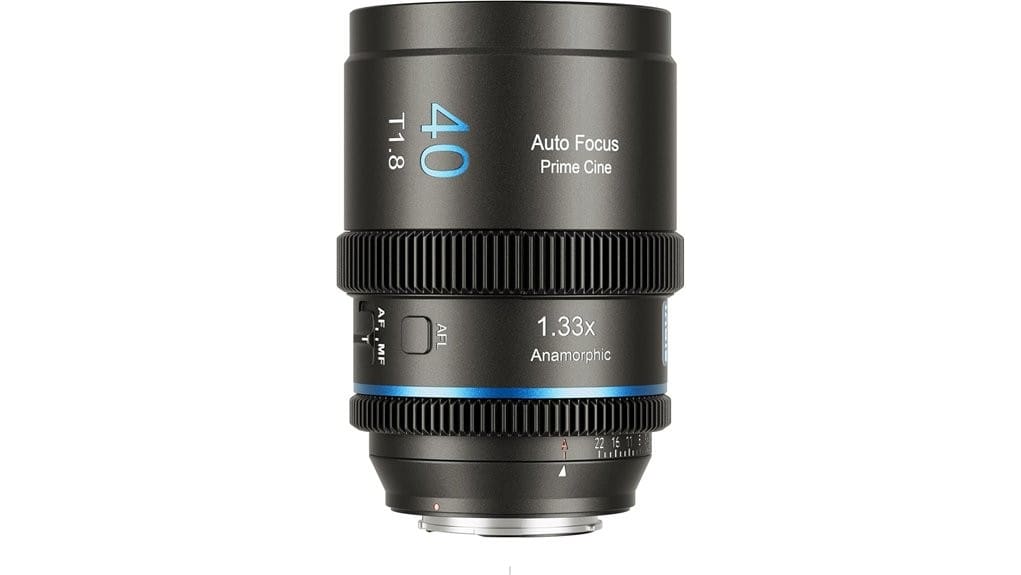
You’ll get a compact 40mm T1.8 1.33x anamorphic that produces sharp, high‑contrast images with controlled chromatic aberration and precise microdetail at T1.8. Autofocus on Nikon Z bodies is responsive via STM with reliable eye and subject tracking; focus and aperture rings are smooth and video‑friendly. Expect oval bokeh, mild horizontal compression, neutral streaky flares and limited breathing. No stabilization or weather sealing means support and protection planning. Continue for practical rigging tips and workflow notes.
Some Key Takeaways
- Optical design delivers high-resolution, controlled chromatic aberration, and precise texture rendition at T1.8 across the frame.
- 1.33x squeeze yields cinematic ~2.35:1 widescreen, with oval bokeh and mild horizontal compression.
- STM autofocus on Nikon Z bodies is responsive and reliable for stills, video, and eye/subject tracking.
- No image stabilization and not weather-sealed; use IBIS, gimbal, or protective measures for handheld or harsh conditions.
- Lightweight and compact for indie filmmakers and vloggers, offering anamorphic look cheaper than full-frame alternatives.
Lens Performance Summary: Sharpness, Bokeh, Flare, and Low‑Light Handling
When you push the SIRUI 40mm T1.8 1.33x into real-world use, it delivers a consistently high-resolution image across the frame thanks to its aspherical and cylindrical elements, with chromatic aberration well controlled and minimal focus breathing during rack focus. You’ll notice strong contrast control that preserves midtone detail while maintaining highlight headroom. Texture rendition remains precise at T1.8, rendering skin and fabrics with fine microdetail. Color fringing is minimal even wide open, reducing post work. Bokeh exhibits elliptical character, and gloss highlights retain specular definition without harsh clipping, aiding low-light subject separation and practical exposure. This makes it an excellent option for photographers who prefer the distinctive rendering of prime lenses and value optical consistency.
Autofocus, Handling, and Ergonomics on Nikon Z Cameras
Although compact in form, the SIRUI 40mm T1.8 1.33x integrates autofocus and handling features that make it straightforward to operate on Nikon Z bodies, and you’ll find its STM-driven AF responsive for both stills and video workflows. You’ll notice autofocus reliability is strong for static subjects and routine tracking, with eye-detect and subject-tracking modes supported by Z-series firmware. Physical controls are minimal but well-placed; focus and aperture rings offer predictable damping and clickless aperture for video. Ergonomic controls map intuitively when mounted on Z5–Z9 bodies, keeping balance and access to camera menus unobstructed during run-and-gun or controlled shoots. For shooters looking to expand their rig, external camera monitors can improve composition and focus accuracy when using anamorphic lenses, especially in tight or mobile setups with external monitors.
Video Results and Anamorphic Characteristics (1.33x Squeeze, Aspect Ratio, and Flare Look)
Because the 1.33x squeeze changes how you compose and process footage, you’ll need to plan framing and post workflows differently than with spherical lenses: on a 16:9 Nikon Z sensor the squeeze yields a cinematic 2.35:1 delivery aspect, so you’ll either de-squeeze in-camera or in post to restore horizontal proportions and preserve the lens’s characteristic oval bokeh and horizontal compression. You’ll notice mild anamorphic distortion at edges that accentuates facial width when close and straightens at longer distances. Neutral-flare renders restrained, contrast-preserving cinematic streaks along bright highlights, while oval bokeh and horizontal compression deliver pronounced subject separation for narrative work. For stabilized, rackable movement and consistent framing during handheld shots, pairing the lens with a motorized gimbal stabilizer like those sold by Mastering Smooth Shots With Gimbal Stabilizers improves shot quality and repeatability when pushing anamorphic compositions, especially in run-and-gun scenarios with changing focal planes and pacing gimbal stabilizers.
Technical Specs, Limitations, and Real‑World Caveats (Stabilization, Weather Resistance, Weight)
While the SIRUI 40mm T1.8 delivers strong optics and a compact form, you should account for several practical limitations in real-world use: the lens provides no image stabilization, so handheld shooting at slower shutter speeds will rely on camera bodies with IBIS (where available) or external gimbals/rigs to avoid motion blur; it’s not weather-resistant, so you need protective measures in damp or dusty environments; and at 614 g it strikes a balance between portability and support requirements—light enough for run-and-gun setups and gimbal use, but heavy enough that prolonged handheld or tightly balanced stabilization systems may need counterweights or frequent rebalancing. You’ll plan mounts, rigging, and protective covers around these weight concerns and weather limitations. For gear protection and transport, consider investing in a hard shell camera case designed for photographers with hard shell camera cases and customizable foam inserts.
Who Should Buy It and How It Compares to Alternatives
If you prioritize cinematic widescreen framing from a compact S35 package, the SIRUI 40mm T1.8 1.33x is a strong choice—its 1.33x squeeze gives a true 2.35:1 look on 16:9 sensors while the T1.8 aperture and optical construction deliver high resolution, controlled aberrations, and usable low‑light performance. You’ll want it if you’re an indie filmmaker seeking an affordable anamorphic aesthetic without heavy rigs, or vloggers on the go who need lightweight, autofocus capability with eye detect. Compared to full‑frame anamorphics it’s cheaper and smaller; versus spherical primes it sacrifices focal flexibility for distinctive widescreen character. It’s a particularly practical option for mirrorless camera users who need compact, dedicated mirrorless gear designed for on‑the‑go shooting.
Some Questions Answered
Will This Lens Cover Full-Frame Sensors Without Vignetting?
No — it won’t provide full frame coverage without vignetting. You’re using an S35-designed anamorphic optic, so on full frame you’ll encounter heavy corner falloff and potential edge stretch artifacts. You can mitigate issues by shooting with smaller sensors or cropping, but expect loss of field and irregular horizontal stretching toward the frame edges. For true full frame coverage without these artifacts, choose a lens specified for full frame anamorphic use.
Can I Use Standard Non-Anamorphic Filters on the Front Element?
Yes — you can use standard non-anamorphic filters on the front element, but consider filter considerations carefully. Threaded or magnetic filters will physically fit and alter exposure, color, and contrast normally. However, filter effects can interact with anamorphic flares, changing streak color, size, and behavior unpredictably. For predictable anamorphic flares keep neutral, high-quality optical filters and test flare-prone shots; avoid cheap coatings that induce unwanted reflections or degrade sharpness.
Is There a Compatible Diopter or Close-Up Adapter Available?
Yes — you can use close-focus conversion accessories; diopter compatibility depends on the front thread and optical design. You’ll want a high-quality close focus conversion or diopter matched to the lens’s front diameter and optical prescription to avoid degrading anamorphic characteristics (streaks, bokeh, edge sharpness). Use multi-coated, low-distortion diopters designed for anamorphic or cinematic lenses, and test for focus shift and aberrations before critical shoots.
Does the Lens Support In-Camera Lens Metadata for Stabilization?
No — it doesn’t provide in-camera stabilization metadata embedding for sensor-shift systems. You’ll rely on camera body stabilization or post stabilization. Check firmware compatibility between your Nikon Z body and the lens for autofocus and metadata fields; some cameras accept basic lens identification but not stabilization parameters. If metadata-driven IBIS is critical, confirm via manufacturer firmware notes or test with your specific camera model to verify supported fields and behavior.
Are There Mounting Adapters for F-Mount or Other Systems?
Yes — you can use mounting adapters to fit F‑mount and other systems; you’ll need to confirm flange compatibility first. You’ll mount the Nikon Z‑mount lens to F‑mount bodies via a Z‑to‑F adapter that maintains the correct flange focal distance and preserves infinity focus. Choose high‑precision, metal adapters to avoid tilt or play. Be aware some adapters may limit electronic functions like autofocus or metadata transfer depending on supported contacts.