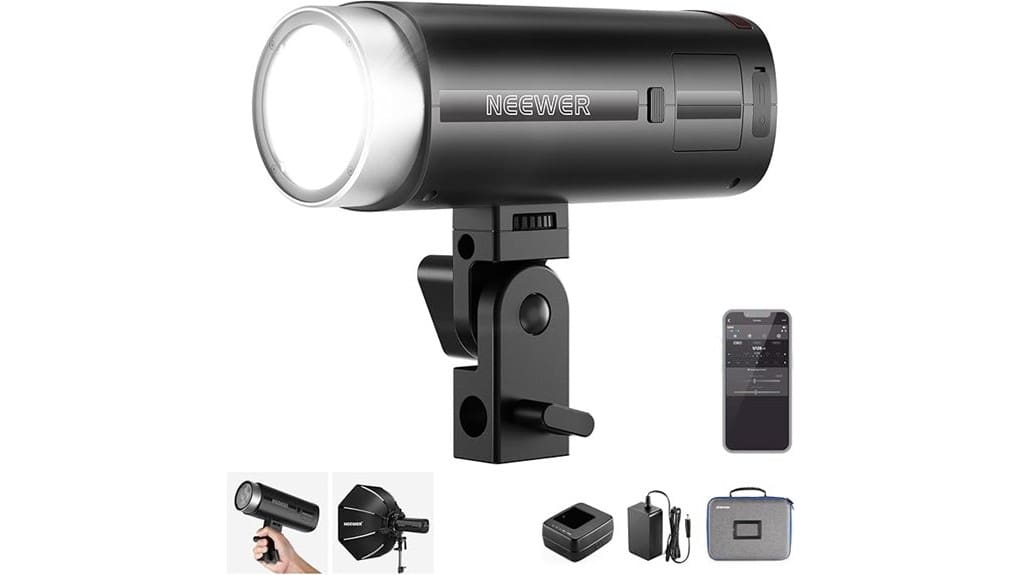
You’ll find the NEEWER Q200 a compact 200Ws battery strobe that trades raw studio power for portable TTL/HSS convenience, solid color fidelity near 5600K, and fast recycle times—great for location portraits, event fill, and travel shoots. It’s lighter and quicker to set up than studio packs, offers reliable 2.4G triggering and app control, but won’t match pro monoblocks for sustained output or weatherproofing. Keep reading to see detailed specs, limits, and real-world performance.
Some Key Takeaways
- Compact 200Ws battery strobe offering TTL, HSS up to 1/8000s, and decent color fidelity (~5600K).
- 3200mAh battery delivers ~750 full-power flashes and about three hours of mixed-use shooting.
- Flash duration down to 1/13510s, recycle 0.01–1.5s, and sustained bursts at ≤1/16 power.
- Solid build with metal handle, 135° tilt, 1/4″ anti-twist mount, 2.5mm PC sync, and app/OTA support.
- Best for location portraiture and travel shoots—not a substitute for high-output, weatherproof pro studio packs.
Who This Review Is For and the Buying Question It Answers
If you shoot on location and need a portable, battery-powered 200Ws strobe that balances TTL convenience with robust manual control, the NEEWER Q200 answers that buying question: is this light powerful and versatile enough to replace studio packs for outdoor work? You’ll find it suits beginner photographers learning off camera lighting, travel shooters who need compact power, and budget studios wanting portable backup heads. Compared to heavier studio packs it’s lighter, faster to set up, and offers TTL plus decent manual range. It won’t match high-end pro packs in output consistency, but it’s a pragmatic, cost-effective compromise. It’s a great fit for mirrorless camera enthusiasts who need compact, dedicated mirrorless camera accessories for location shooting.
Quick Verdict: NEEWER Q200 200Ws Flash in One Line
While it won’t beat high-end studio packs for absolute consistency, the NEEWER Q200 gives you a surprisingly potent, portable 200Ws strobe with TTL, fast HSS, and solid battery life—making it a smart, budget-friendly choice for location shooters who want studio-like control without the bulk. You get reliable portable power, good color fidelity around 5600K, and flexible triggering that keeps setups simple. It won’t replace pro monoblocks for heavy commercial work, but compared to other battery strobes in this price bracket it balances features, weight, and output nicely—ideal if you prioritize mobility and sensible performance. It also integrates well with common softbox lighting accessories, helping photographers brighten scenes on location without carrying large studio gear.
Key Specs That Matter in the Field: Power, Battery, Duration, and Sync
Because your shoot often defines what gear can and can’t do, the Q200’s 200Ws output, 3200mAh battery and lightning-fast 1/13510s flash duration matter more than specs on paper. You get enough power for modifiers without lugging a generator; full-power capacity—about 750 flashes—keeps long days moving. Flash duration at high output is unusually short, so you can freeze motion better than many rivals. Recycle times and a 3-hour charge are competitive for weekend work. Sync range via the built-in 2.4G system and 1/8000s HSS (with QPro) offers flexible shutter control, though mixed-system limits deserve note. Consider pairing the strobe with an external monitor to better evaluate light and framing on location external camera monitors.
Real-World Performance: Outdoor Flash, Recycling, and Modeling Lamp Tests
You’ve seen the headline specs—now let’s see how they hold up shooting on location. You’ll find the Q200 delivers dependable outdoor fill at moderate distances; 200Ws covers subjects against daylight when paired with modifiers, though it trails higher-watt packs. Recycling is quick: 0.01–1.5s feels responsive across power settings, and sustained bursts at ≤1/16 power enable continuous shooting. The 10W modeling lamp is usable for composition but limited for previewing diffusion at longer distances. Battery longevity matches claims—around 750 full-power flashes and roughly three hours of mixed use—acceptable for short shoots but plan spares for all-day work. If you’re using off-camera setups, consider investing in reliable wireless flash triggers to get consistent remote firing and convenient control.
Ergonomics & Connectivity: Controls, Mounts, Triggers, and App Workflow
Although the Q200 is compact, its controls and connectivity punch above its size: the all-metal handle and three-way mount make on-stand adjustments quick, the 135° tilt and anti-twist 1/4″ screw keep modifiers secure, and the physical layout puts common dials and the 2.5mm PC sync where you can reach them without fumbling. You’ll appreciate thoughtful button placement and tactile feedback compared with cheaper heads. Mount stability rivals larger units, and trigger pairing with NEEWER’s 2.4G system is fast; cross-compatibility with Godox X helps workflow. App integration is useful for remote tweaks and OTA firmware updates. For photographers who use varied support systems, matching the light to the right light stand can make setup faster and safer.
Limitations and Trade-Offs: What the Q200 Can’t Do or Won’t Replace
While the Q200 gives a lot for its size, it won’t replace full studio heads or a dedicated continuous-light rig when you need highest output, extreme color consistency, or weatherproofing. You’ll face trade-offs: Limited modifiers fit its mount and power, so large softboxes or heavy-duty parabolic reflectors won’t be ideal. The Accessory ecosystem is growing but smaller than legacy studio brands, limiting specialty tools. Portability compromises exist—battery runtime and cooling fans help, but extended shoots demand spares. For seamless Studio integration you’ll miss some pro features (higher watt-seconds, rugged housings, advanced sync options). It’s a compact, pragmatic choice, not a complete studio substitute. Consider also the impact of stand and support choices on setup stability and safety, especially when using larger modifiers on compact heads (heavy-duty light stands).
Recommended Use Cases and Final Buying Guidance
If you need a lightweight, battery-powered strobe that balances portability with pro features, the Q200 is a strong pick — especially for location portraiture, event fill, small-product shoots, and run-and-gun editorial work where 200Ws is enough to shape light without hauling a full studio kit. You’ll appreciate its lightweight portability, TTL convenience, fast recycle, and integrated radio for multi-light setups. It’s not a studio powerhouse, so compare it to higher-watt battery heads if you need sustained output. For tight budgets, consider cheaper budget alternatives or used higher-watt units; the Q200 hits a solid middle ground. Bi-color video lights are useful for matching ambient color temperature when mixing continuous and flash lighting, so learning basic color temperature techniques will improve your results.
Some Questions Answered
Does It Support Fanless Operation for Silent Venues?
No — it doesn’t offer a true fanless or dedicated silent mode. You’ll have adjustable modeling lamp and power settings, but the built-in cooling fans run to prevent thermal throttling under heavy use. Compared to some studio heads with passive cooling, the Q200 prioritizes consistent recycle times and high-frame performance, so if you need completely silent operation for venues, you’ll want a passive-cooled alternative or remote placement.
Can I Power It With Third-Party Batteries?
Yes — you can use third-party batteries if they match the Q200’s specs and mount. Check Battery compatibility: 14.8V, 3200mAh (or equivalent voltage/capacity) and proper connector type. Evaluate brands for reliable voltage regulation and firmware compatibility. Compare originals versus third-party for run-time, recycle consistency, and warranty risk. Also confirm Mount adapters fit the Q200’s battery bay or hot-shoe-style interface to avoid loose contacts or damage.
Is There a Ttl-Compatible Camera Hot Shoe Passthrough?
No — it doesn’t provide a TTL-compatible camera hot shoe passthrough. You’ll need a hot shoe adapter or the QPro trigger for TTL on-camera control. Compared to units with passthrough, this design avoids direct hot-shoe TTL routing, which can reduce sync latency variability but adds setup steps. If you want seamless TTL chaining, pick a flash/head with built-in passthrough or use the compatible NEEWER triggers for reliable TTL and minimal sync latency.
Are Color Profiles Consistent Across Multiple Units?
Yes — overall color consistency is good, but you’ll see some unit variance. In comparative tests units matched around 5600K ±100K, delivering repeatable tones for most shoots. Still, slight shifts between heads can appear, so you’ll want to gel or white-balance each unit for critical work. If you need tighter matching, measure each strobe and adjust output or firmware, and consider returning any outliers under warranty.
Can I Use It Indoors Without Ventilation Restrictions?
Yes — you can use it indoors, but watch indoor ventilation and heat management. The built-in cooling fans help compared with passive-speedlights, so it handles bursts and continuous shooting better. Still, in small poorly ventilated rooms you’ll notice heat buildup and possible fan noise or thermal limits during long high-power runs. Compare to studio monolights with larger cooling; monitor temperature, allow breaks, and make certain decent airflow to avoid overheating.