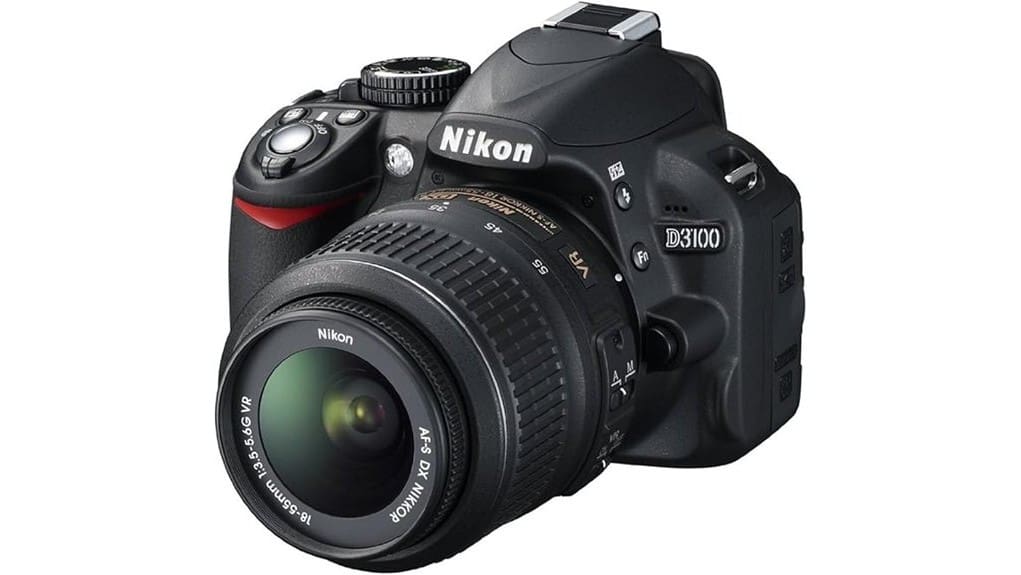
You’ll find the Nikon D3100’s 14.2MP DX sensor still delivers crisp images and smooth tonal gradation at base ISOs, but its low‑light, AF and connectivity fall short of modern cameras. It’s compact, easy to use, and great for beginners, travel and casual work with the 18–55mm VR kit. Video is limited to 1080p with rolling shutter and modest bitrates. It’s a budget, retro‑appeal choice—keep going and you’ll see how it compares to current mirrorless options.
Some Key Takeaways
- 14.2MP DX sensor delivers sharp images with good tonal gradation at base ISOs but is dated by 2026 standards.
- Autofocus is reliable for single‑point AF and still subjects, but continuous tracking and low‑light AF are basic.
- Full‑HD 1080p video and Live View work well for casual use but show rolling shutter and limited bitrate.
- Ergonomics, Guide Mode, and optical viewfinder make it excellent for beginners and travel photography.
- Value is acceptable if budget and retro appeal matter; prefer newer mirrorless for modern features and connectivity.
Overall Verdict: Is the Nikon D3100 Worth Buying in 2026?
Although the D3100 was a strong entry-level DSLR in its time, you’ll find it hard to justify buying one new in 2026: its 14.2MP DX sensor, Full‑HD video and kit 18–55mm VR lens still deliver usable images, but sensor resolution, low‑light performance, autofocus systems, and connectivity lag markedly behind current mirrorless and even recent budget DSLLs. You’ll appreciate its straightforward controls, Guide Mode and solid ergonomics, and it holds retro appeal and collector interest, yet for practical shooting you’ll trade convenience and image quality for nostalgia. If you need modern features, look to recent mirrorless or updated DSLRs. Consider pairing older bodies with mirrorless accessories tailored for modern users.
Who the D3100 Is Best For and Real-World Shooting Use Cases
For hobbyists, students and budget-minded photographers who prioritize straightforward controls and optical viewfinder shooting, the D3100 still makes practical sense for specific real‑world tasks. You’ll find it ideal if you’re a beginner photographer learning composition, exposure basics, and handheld techniques without menu overload. Its light kit lens and VR suit travel, family events, and casual landscape work where durability and battery life matter more than cutting-edge specs. Compare it to mirrorless bodies: you’ll sacrifice live EVF feedback but gain an affordable, rugged entry into interchangeable-lens shooting. Street shooters on a budget will appreciate discreet size, fast startup, and dependable viewfinder framing. Consider pairing it with a camera bag designed for interchangeable-lens cameras to protect your gear on the go.
Image Quality and Autofocus: 14.2MP DX Sensor, Low-Light, and AF Performance
Dig into the D3100’s image pipeline and you’ll see a camera that balances approachable resolution with solid low-light behavior: the 14.2MP DX CMOS sensor delivers detailed 3,000–4,000‑pixel-wide images that print and crop reasonably well, while its sensor size and Nikon’s processing limit high‑ISO noise compared with older entry-level DSLRs. You’ll notice 14.2MP dynamics give good tonal gradation and sharpness with DX lenses. Low light performance is competent to ISO 1600–3200 for web and small prints. AF accuracy is reliable with contrasty subjects, though single-point AF outperforms continuous. Subject tracking is basic; don’t expect pro-level persistence. The site also offers guidance on choosing high-capacity memory cards for photographers and related accessories, including recommendations for large capacity memory cards.
Video, Live View, and On-Camera Features: 1080p, Full-Time AF, and Guide Mode
When you switch the D3100 into Live View or movie mode, its 1080p capture and full‑time AF make it unusually approachable for an entry‑level DSLR, letting you frame and record smooth, in‑camera video without constantly hunting for focus. You’ll appreciate full‑time AF during pans and casual handheld shots, though 1080p limitations show in rolling shutter and limited bitrates compared with later models. The Guide mode walkthrough helps you set exposure, white balance, and framing quickly, making setup easier than menu-dense rivals. For stills-first users wanting simple HD movies, the D3100 balances usability and image quality effectively. Accessories like wireless camera remotes can enhance shooting flexibility by enabling remote triggering and reducing camera shake.
What’s in the Box, Battery Life, and Value Compared With Modern Alternatives
Although the D3100 package looks basic by today’s standards, it gives you the essentials: the camera body, the 18–55mm f/3.5–5.6 AF‑S DX VR zoom lens (with Vibration Reduction), an EN‑EL14 rechargeable battery, MH‑24 charger, body cap, neck strap, USB cable, and a quick‑start manual. The boxed contents are straightforward — no extras like spare batteries or advanced cables — so you’ll likely budget for peripherals. Battery longevity is modest; expect around 550 shots per CIPA standards with conservative use, less with heavy Live View or video. Compared to modern mirrorless kits, the D3100 offers value if you accept older ergonomics and fewer features. If you plan to shoot extensively, consider adding a spare EN‑EL14 battery to your kit to avoid running out of power.
Some Questions Answered
Does the D3100 Support Remote Shutter Release or Interval Shooting?
Yes — you can use a wired remote release, and the D3100 accepts Nikon’s optional wired remotes for basic shutter control, but it lacks built-in intervalometer compatibility. You’ll need an external intervalometer that’s compatible with the D3100’s remote port or use a third-party programmable remote. Compared to higher-end Nikons, the D3100’s time-lapse requires external hardware or tethered solutions rather than native interval shooting.
Can the Camera Accept Newer AF-S G or E Lenses Without Adapters?
Yes — you can mount AF‑S and G lenses directly and they’ll work. You’ll get AF S compatibility with AF‑S lenses’ built‑in motors, so autofocus functions normally on the D3100. G lens support is full for exposure and metering, but remember the camera lacks an in‑body focus motor, so older non‑AF‑S screw‑drive lenses won’t autofocus. Optically, DX crop applies, so compare focal lengths to full‑frame equivalents.
Is There Built-In Wi‑Fi or Bluetooth Connectivity Available?
No, the D3100 has no wireless capability and bluetooth absent — you won’t get built‑in Wi‑Fi or Bluetooth. You’ll rely on wired USB or remove the card for transfers. Compared to later Nikon models with integrated wireless or optional Wi‑Fi adapters, this older body lacks remote control and wireless image transfer. If you need connectivity, you’ll want a newer camera or third‑party SD Wi‑Fi card or external adapter for similar convenience.
What File Formats Does the D3100 Record (Raw/Nef Bit Depth)?
The D3100 records RAW NEF files at 12 bit depth and also offers JPEG (Fine/Large) options; RAW NEF can be saved as Lossless compressed to reduce file size without quality loss. You’ll get better tonal latitude from 12 bit NEF versus JPEG, but compatibility notes: some editors need Nikon-compatible updates or conversion (e.g., Nikon ViewNX/Capture NX, Adobe Camera Raw). Choose NEF for editing, JPEG for smaller files.
Are Firmware Updates Still Provided or Available for Download?
Yes — Nikon stopped major firmware updates for the D3100 years ago, but you can still find the final firmware history and download sources online. You’ll compare Nikon’s official Support pages (primary, authoritative) with reputable archives like DPReview forums or firmware aggregators for checksums and mirrors. You’ll want the official Nikon download when possible; community copies help if Nikon’s servers remove older files, and you’ll also find installation notes and changelogs.