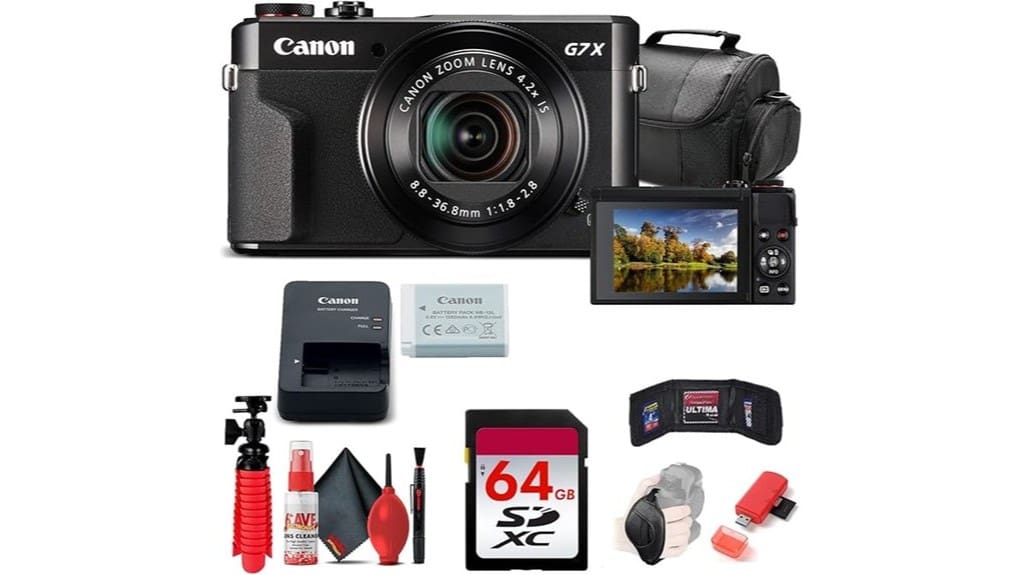
You’ll find the Canon PowerShot G7 X Mark II is a pocketable, fast‑handling compact that’s ideal if you want decisive street shots and grab‑and‑go travel vlogging. Its 20MP 1.0″ sensor, bright 24–100mm f/1.8–2.8 lens and Intelligent IS give strong low‑light framing and steady Full HD video, though noise rises past ISO 1600 and there’s no 4K. Controls are tactile and touchscreen responsive, but battery is modest—keep a spare if you plan long outings; more detail follows.
Some Key Takeaways
- Pocketable 20.1MP compact with 1.0″ sensor and DIGIC 7, optimized for low‑light speed and responsive operation.
- Bright 24–100mm (35mm equiv.) f/1.8–f/2.8 lens with Intelligent IS delivers strong handheld stills and Full HD 60p video.
- Good autofocus and 8 fps burst, though buffer is short and high‑ISO noise becomes noticeable around ISO 3200.
- Excellent handling: tilting 3.0″ touchscreen, manual control ring, and tactile controls suit street and travel shooting.
- Lacks 4K and newer sensor tech; buy for pocketability and price, not future‑proofing—consider newer mirrorless alternatives.
Why the G7 X Mark II Matters: Who This Camera Is For
Although it’s compact enough to slip into a jacket pocket, the G7 X Mark II delivers controls and image quality that appeal to more than casual shooters. You’ll find it ideal if you want a pocketable tool that handles decisive moments and low-light scenes with confidence. For street photography, its discreet size and responsive handling let you react quickly and stay unobtrusive. For travel vlogging, the tilting touchscreen and reliable autofocus help you frame and record on the move without bulky rigs. You’ll appreciate tactile controls, fast operation, and image consistency that elevate everyday shooting into purposeful work. It also pairs well with compact supports like lightweight tripods to stabilize low-light and video capture.
Key Specs at a Glance: Sensor, Lens, Stabilization, and Bundle Contents
When you pick up the G7 X Mark II, you get a compact package built around a 20.1MP 1.0″ CMOS sensor and DIGIC 7 processor that together prioritize low‑light performance and fast operation. You’ll find a 4.2x 24–100mm (35mm equiv.) f/1.8–f/2.8 lens paired with Intelligent IS stabilization, a tilting 3.0″ touchscreen and manual control ring for direct adjustments. Connectivity includes Wi‑Fi/NFC for remote control and wireless sharing. Canon bundles the camera with a 64GB card, reader, case, flexible tripod, strap, wallet and cleaning kit. Check accessory compatibility and keep an eye on firmware updates. This kit is ideal for mirrorless camera enthusiasts looking for compact, travel‑friendly essential gear.
Image and Video Performance Tested: Low Light, Autofocus, Continuous Shooting, and Stabilization
Having covered the hardware and bundle, let’s look at how that 20.1MP 1.0″ sensor, f/1.8–2.8 lens and DIGIC 7 processor actually perform in the field. You’ll get clean files at base ISO with usable detail to about ISO 1600; low light shooting benefits from the fast aperture but noise rises noticeably by ISO 3200. Autofocus is quick in good light and autofocus tracking holds moving subjects reasonably well for a compact. Burst performance reaches the rated 8 fps with short buffer depth. Stabilization testing shows Intelligent IS effectively tames handshake for handheld photos and Full HD video at 60 fps. Wildlife and sports shooters will appreciate how the camera’s focal reach and handling suit telephoto lens use in fast-action situations.
Real-World Handling: Controls, Touchscreen, Battery Life, and Wireless Features
Because Canon balanced physical controls with a responsive touchscreen, you’ll find the G7 X Mark II straightforward to operate in most shooting situations. You navigate menus quickly thanks to a smart button layout and the tilting 3.0″ display; the manual control ring complements touch input for fast exposure tweaks. Touchscreen responsiveness is good for focus point selection and menu taps, though complex adjustments still feel better with physical dials. Battery life is modest—plan for a spare on long days if you’re shooting bursts or video. Built‑in Wi‑Fi and NFC make image transfer and remote control convenient from your phone. For on‑location portrait or product shoots, consider using portable collapsible reflectors to shape and soften light when needed.
Should You Buy It in 2026? Alternatives and Final Verdict
If you’re weighing the G7 X Mark II in 2026, think of it as a compact that still shines for everyday travel and vlog-style shooting but shows its age against newer models with larger sensors, better low-light performance, and 4K video. You’ll get excellent handling, a bright lens, and useful accessories, but future proofing is limited: no 4K, older processor, and modest connectivity compared with current rivals. Consider competing mirrorless models or flagship compacts for longevity. Factor resale value and how smartphone evolution already covers casual shots. Buy it only if price and pocketability trump advanced features. For travelers prioritizing portability, consider pairing it with a lightweight tripod for stable travel photos and vlogging setups like the lightweight tripods commonly recommended for travel.
Some Questions Answered
Does It Support Raw+Jpeg Simultaneous Shooting?
Yes — you can shoot RAW+JPEG simultaneously on this camera. You’ll get unprocessed RAW files for maximum editing latitude plus ready-to-use JPEGs with chosen color profiles applied. Use exposure bracketing when you need multiple exposures; the camera will save each bracketed frame as RAW and JPEG if RAW+JPEG is enabled. This gives you flexible post-processing while retaining quick-share JPEGs and consistent in-camera color profile rendering.
Can It Charge via USB While Shooting?
No, you can’t reliably charge via USB while shooting; the G7 X Mark II doesn’t support battery pass through for active shooting. You can power it with USB adapters or external USB power, but the camera typically only charges the battery when powered off. For long sessions, use a fully charged spare battery or an official DC coupler with an AC adapter to provide continuous power without depending on USB charging during operation.
Is There a Hot Shoe for External Flashes?
No — there’s no hot shoe for external flashes on this camera. You’ll need to rely on built‑in flash, off‑camera wireless options, or shoe adapters that mount to a tripod/strap or the camera’s accessory cold shoe alternatives. For serious flash compatibility you’ll evaluate trigger systems and shoe adapters’ stability and contact method; wireless TTL won’t be native, so plan for manual control or compatible triggers to achieve reliable exposure and sync.
What’s the Microphone Input Availability?
No — there’s no external microphone input on this model. You’ll have to rely on the internal mic placement, which sits on the camera body and captures decent onboard audio but isn’t ideal in noisy or distant situations. If you need better sound, you’ll want an external recorder or a camera with an external microphone jack. Consider wind protection and monitor levels when using the internal mic for more consistent results.
Does the Bundle Include a Spare Battery?
No, the bundle doesn’t include a spare battery. You’ll rely on the single OEM battery, so manage battery lifespan by charging strategically and carrying power-saving habits. If you need extra runtime, you can buy third party compatibility options, but choose reputable brands and check reviews for capacity and safety. Consider carrying a charged spare or a USB power bank solution to avoid interruptions during shoots and prolong the original battery’s useful life.