
You get a 45.7MP BSI CMOS sensor with no low‑pass filter, EXPEED 5 processing, and class‑leading dynamic range for maximum detail and high‑ISO usability. The Multi‑CAM 20K 153‑point AF system and 7 fps burst with a ~51 RAW buffer handle demanding shoots. UHD 4K/30p, clean HDMI, dual UHS‑I slots, and robust connectivity support hybrid workflows. It’s a rugged pro body ideal for commercial, landscape, and hybrid shooters — continue for bundle and workflow specifics.
Some Key Takeaways
- 45.7MP BSI CMOS sensor with no optical low-pass filter delivers exceptional resolution and fine detail for commercial and landscape work.
- EXPEED 5 gives excellent dynamic range, low noise, and reliable color fidelity across ISOs for high-quality RAWs.
- Multi-CAM 20K 153-point AF plus 7 fps and a 51-frame RAW buffer provide precise tracking and sustained shooting performance.
- UHD 4K/30p video, clean Micro HDMI output, and interval/timelapse features make it solid for hybrid photo/video projects.
- Robust build, dual SD slots, long battery life, and comprehensive accessories in kits suit professional, travel, and studio workflows.
What the Nikon D850 (1585) Gives You Up Front
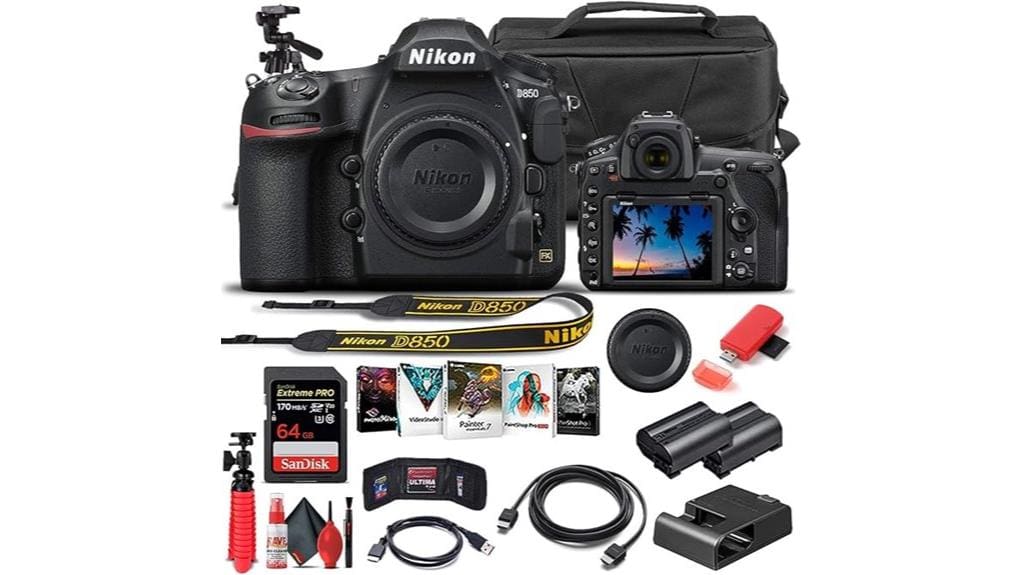
Start shooting right away with a complete pro-grade kit: the D850 body includes the 45.7 MP FX-format BSI CMOS sensor and EXPEED 5 processor for high-resolution, low-noise images, plus the EN-EL15a battery, MH-25A charger, DK-17F fluorine-coated eyepiece, BF-1B body cap, AN-DC18 strap and necessary cables so you can power up, view, and connect without hunting for accessories. You’ll receive initial accessories like a SanDisk 64GB card, spare EN-EL15, USB/HDMI cables, and a camera bag. Expect extensive out-of-box functionality, standardized connectivity (USB 3.0, micro HDMI), and accessory compatibility with Nikon F-mount lenses. This kit is ideal for mirrorless camera enthusiasts seeking complementary essential gear.
Image Quality, Sensor & Low-Light Performance Compared
Having the right accessories out of the box means you can quickly judge what matters most: the D850’s sensor and processing pipeline. You’ll exploit the 45.7MP BSI CMOS and EXPEED 5 to resolve fine detail without an optical low-pass filter. Measured dynamic range at base ISO delivers extensive highlight and shadow retention, aiding latitude in RAW. High-ISO performance benefits from back-illumination, yielding lower noise and usable detail to elevated sensitivities. Color fidelity remains neutral and consistent across ISO, with 10-bit processing potential for smoother gradations. Overall, the system prioritizes resolution, tonal headroom, and controlled noise in low light. For passionate photographers seeking accurate reproduction, pairing the camera with color calibration tools ensures consistent, reliable color from capture through editing.
Autofocus, Shooting Speed, and Real‑World Handling
While the D850’s headline is its high-resolution sensor, its autofocus and burst capabilities are engineered to match, giving you precise tracking and sustained shooting for demanding assignments. You get a Multi-CAM 20K 153-point AF array with dense phase detection coverage across the frame, enabling reliable subject acquisition and AF-C tracking with minimal hunting. The 7 fps continuous rate (buffer ~51 RAW frames) sustains sequences for action work. Controls are logically placed; grip comfort and weight distribution support prolonged handheld use. Metering and AF responsiveness remain consistent in varied lighting, yielding predictable, professional handling during extended shoots. For many users, adding a top handle can further improve grip comfort and control during extended handheld sessions.
Video, Time‑Lapse, and Connectivity for Hybrid Shooters
Curious how the D850 fits into a hybrid workflow? You’ll get 4K workflow capability with UHD 30p recording, clean HDMI output (Micro HDMI Type D) for external recorders, and precise framing on the 3.2″ 2.36M-dot tilting touchscreen. Dual UHS-I SD slots and EXPEED 5 handling support long takes and high-bit-depth stills alongside movies. Time-lapse shooters benefit from built-in interval timing and 8K interval compositing for ultra-high-res sequences. Connectivity includes USB 3.0, Bluetooth, and Wi‑Fi for Wireless transfer of selects and remote control; battery life and heat management remain practical for extended hybrid sessions. For photographers who need reliable cables for external recorders and monitors, consider using quality Micro HDMI Type D cables to ensure secure connections and optimal signal transfer.
Who Should Buy the D850 and Which Bundle Options Make Sense
If your workflow mixes high-resolution stills with serious video work, the D850 is built to handle both: its 45.7 MP BSI sensor and EXPEED 5 deliver studio-grade detail and dynamic range for commercial, landscape, and fine-art photography, while UHD 4K/30p recording, clean Micro HDMI output, and robust heat management support pro video capture and external monitoring/recording. You should buy the D850 if you require highest-resolution output, robust AF, and dual-card reliability; it’s overkill for beginners consideration unless you plan to scale. Travel photographers will value image quality and battery spares in bundles; include the spare battery, 64GB UHS-I card, and compact bag. Consider pairing it with essential accessories for DSLR enthusiasts like straps, lens filters, and tripods to create a complete shooting kit, especially when carrying gear for extended shoots with a compact bag.
Some Questions Answered
Does the D850 Include In-Body Image Stabilization (IBIS)?
No, it doesn’t include in-body image stabilization (IBIS). You shouldn’t expect sensor-shift stabilization; the mechanical shutter and sensor design prioritize resolution and low-noise performance over body stabilization. Because the D850 uses a fixed sensor mount and relies on lens-based VR, you’ll need vibration-reduction lenses or faster shutter speeds to counteract camera shake. For handheld low-light work, pair high-DR sensor design with stabilized optics or tripod support.
Can the Battery Be Charged In-Camera via USB-C?
No — you can’t charge the battery in-camera via USB-C. The D850 supports USB data transfer and powering some usb accessories, but it doesn’t implement in-camera battery charging. You’ll need to charge the EN-EL15a externally with the MH-25A charger or use a compatible external battery charger or spare battery. For field use, consider a USB-powered external charger or DC coupler solutions that supply power without relying on built-in USB charging.
Is There Built-In GPS or Geotagging Support?
No, it lacks built-in GPS support; you’ll rely on external methods for Geotag workflow. You can attach a GPS accessory or use a paired smartphone via Bluetooth/Wi‑Fi to record location, then sync timestamps and transfer GPX tracks to embed coordinates during RAW/JPEG import. For precise geotagging, you’ll use post‑capture software that matches GPX data to image timestamps or enable direct logging with an external GPS unit that writes metadata to files.
Are There Firmware Updates Provided Regularly by Nikon?
Yes — Nikon issues firmware updates for the D850 and you can track its firmware history on Nikon’s support site. You’ll download and install updates manually; they address performance, autofocus, video and lens compatibility. Update cadence isn’t fixed but Nikon has released major and minor updates periodically since launch, so you should check support pages and register your camera for notifications to stay current with firmware history and future releases.
Does the Camera Support Tethered Shooting Over Wi‑Fi?
Yes — you can use wireless tethering for remote capture with the camera. You’ll connect via Nikon’s SnapBridge/Wireless Transmitter features to control shutter, change basic settings, and transfer images remotely, though full-featured tethered workflows (robust live view, rapid RAW transfer) are limited compared with wired USB tethering. For professional studio use you’ll likely prefer USB/Mac/PC tethering; wireless tethering suits field setups and quick remote capture tasks.