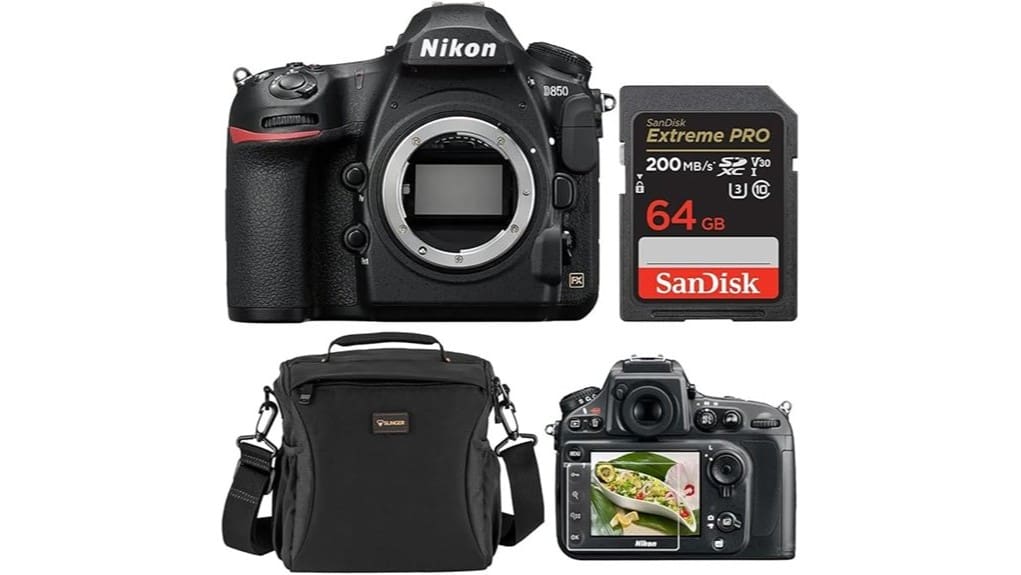
You’ll find the Nikon D850 is a professional DSLR that gives you 45.7MP of superb detail, wide dynamic range at base ISO 64, and a responsive EXPEED 5 engine for demanding shoots. Its 153-point AF, 7–9 fps burst options, rugged ergonomics, dual card slots and extensive connectivity fit pro workflows. It handles studio portraiture, action and high-res landscape work with confidence, and the following sections explain its trade-offs, video features and alternative options.
Some Key Takeaways
- 45.7MP full-frame sensor with excellent dynamic range and low-noise performance, ideal for high-resolution studio and landscape work.
- Fast EXPEED 5 processing, 7 fps (9 fps with grip), and robust shutter for prolonged professional shooting.
- Advanced Multi-CAM 20K AF (153 points) and 180k-pixel metering deliver reliable subject tracking and exposure.
- 4K video, clean HDMI output, and dual-slot recording support professional hybrid photo/video workflows.
- Rugged, ergonomic body with dual CFexpress/XQD + UHS-II SD slots, long battery life, and strong Nikon lens ecosystem.
Quick Verdict and Who Should Buy the Nikon D850
While it’s a big, professional DSLR, the D850 gives you an exceptional blend of resolution, speed and versatility that makes it a standout for serious shooters. You get a high-resolution tool that handles studio portraiture and enthusiast portraiture with fine detail and reliable handling. Its rugged build, extensive controls, and dual-card flexibility suit pros and advanced amateurs who teach or attend landscape workshops. You’ll appreciate the ergonomic balance for long shoots and the connectivity for workflow demands. If you need a single-body solution that bridges commercial, event, and educational use, the D850 merits strong consideration. Our store also carries essential accessories for mirrorless camera enthusiasts, including essential gear that complement high-resolution bodies.
Image Quality and Performance: Sensor, ISO, AF, and Continuous Shooting
Because Nikon paired a 45.7MP back-illuminated full-frame sensor with the EXPEED 5 engine, you’ll get a rare combination of high resolution and responsive processing that benefits both stills and demanding workflows. You’ll enjoy exceptional dynamic range at base ISO 64, preserving highlight and shadow detail for large prints and demanding edits. The native ISO 64–25600 (expandable to 32–102400) balances flexibility with controlled noise. The Multi-CAM 20K 153-point AF and 180k-pixel metering deliver reliable subject tracking and exposure. Continuous shooting reaches 7 fps (51 RAW) or 9 fps with a grip, while shutter durability supports professional cadence. Regular sensor maintenance using sensor swabs helps keep images free of spots and artifacts.
Video, Display, and Connectivity: 4K, Touchscreen, and Recording Workflows
Having already covered how the D850’s sensor and AF system handle demanding stills work, let’s look at how that imaging power carries into motion: the camera records 4K UHD (2160p) at 30p and can produce 8K time‑lapse sequences via Focus Shift Mode, giving you high-resolution footage suitable for professional workflows. You’ll find 4K workflows straightforward: clean HDMI output, robust codecs, and dual-slot recording options support backup and proxy creation. The 3.2-inch tilting touchscreen gives precise Touchscreen controls for focus point selection, menu navigation, and playback. Connectivity (USB 3.0, Wi‑Fi, Bluetooth, mini‑HDMI) integrates the D850 into modern capture pipelines. Field monitors enhance framing and exposure accuracy for video shoots with critical visual feedback.
Ergonomics, Battery, Storage Options, and Real‑World Handling
Although it’s a substantial DSLR in hand, the D850’s ergonomics are thoughtfully laid out so you can shoot all day without fighting the body, and its battery life and flexible storage options keep workflows moving in the field. You’ll appreciate grip comfort for long sessions, intuitive menu layout for fast adjustments, and battery longevity that supports extended shoots or high-frame bursts. Dual slots deliver card redundancy and CFexpress/XQD plus UHS-II SD flexibility; consider loader compatibility for CFexpress offloading. Pocketability is limited by size, but weight distribution and controls make real-world handling confident and efficient for pros and enthusiasts. For protecting large photo libraries in the field, pairing the D850 with an external hard drive for photos like a portable SSD provides reliable backup and easy offloading, especially when using CFexpress/XQD cards.
Value Analysis and Alternatives: Price, Lens Ecosystem, and Competing Models
Now that you’ve seen how the D850 handles in the field, it’s worth looking at what that performance costs and what alternatives offer. You’ll pay a premium upfront, but high build quality and strong resale value soften total cost over ownership. Lens ecosystem is mature: Nikon FX glass covers most needs, and reliable third party lenses expand choices affordably. If you prioritize speed or video, consider mirrorless rivals like the Sony A7R IV or Canon R5, which trade battery life and optical viewfinders for advanced autofocus and smaller bodies. Match features to your shooting priorities before committing. The site focuses on gear for enthusiast photographers and camera fans, highlighting the breadth of digital camera products available.
Some Questions Answered
Does the D850 Support Vertical Video Recording Natively?
No, the D850 doesn’t natively record vertical orientation metadata like a phone does; it captures footage in standard landscape framing unless you rotate the camera and accept a sideways file. You can mount a phone adapter or use a tripod head to shoot vertical physically, and then rotate the clip in editing. You’ll maintain full resolution and framing control, but you’ll need post‑production or external hardware to tag vertical orientation.
Can the D850 Shoot Silent (Electronic) Shutter Stills?
Yes — you can do silent shooting with the D850 using its electronic shutter (silent mode). You’ll get true shutterless capture that reduces mechanical noise and emulates mirrorless behavior, useful for discreet portraits or events. Be aware of rolling shutter and potential distortion with fast motion or strobes; dynamic range and AF performance remain tied to the DSLR’s sensor and AF system, so test settings for your specific shooting conditions.
What Is the Expected Shutter Lifespan/Cycle Rating?
You can expect a shutter durability rating of about 200,000 cycles; that’s the typical cycle expectancy for the D850. That figure reflects Nikon’s testing and gives you a realistic service-life baseline. In practice, actual lifespan varies with use, environment, and maintenance, so treat 200k as an informed expectation rather than a guarantee. If you shoot heavily, plan for earlier servicing or a shutter replacement to maintain reliability.
Are In-Camera Focus Stacking or HDR Modes Available?
Yes — you get in camera stacking via the D850’s Focus Shift Mode that captures multiple frames for later stacking, though the camera itself doesn’t merge them; you’ll perform the final stack in software. For hdr processing the D850 doesn’t offer true in-camera HDR blending; it can bracket exposures automatically, but you’ll need external HDR software to merge and tone-map. You’ll rely on thoughtful capture and post-processing for ideal results.
Does the Camera Support USB Tethered Shooting and Charging?
Yes — you can use USB tethering and perform Battery charging with the camera, but with caveats. You’ll tether via USB 3.0 for image transfer and remote control using Nikon software (SnapBridge has limited tethering; Nikon’s desktop tools offer fuller control). The battery can be charged in-camera via USB only with optional accessories (USB charging is limited); for reliable power during shoots, you’ll likely use the external charger or battery grip with AC adapter.